 Cowboy Boot Brand Logos
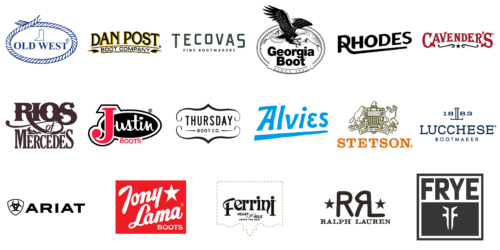
Cowboy boot brands range from Texas companies with roots stretching back more than a century to businesses created during the modern direct-to-consumer era. Lucchese began in San Antonio in 1883, Justin dates to 1879, Tony Lama opened his El Paso business in 1911, while Ariat and Tecovas represent much newer approaches to Western footwear.
Their logos are best understood through those individual histories rather than generic assumptions that serif lettering always represents craftsmanship or brown automatically communicates Western authenticity. Several of these brands have documented names, symbols and histories that provide much more specific information.
Major Cowboy Boot Brand Logos
Lucchese
Lucchese traces its history to 1883, when brothers Salvatore and Joseph Lucchese, immigrants from Sicily, opened a small boot shop near Fort Sam Houston in San Antonio, Texas. Their early customers included cavalry soldiers who needed durable riding boots. [1]
The company’s identity today includes what Lucchese officially calls its Mirrored-L logo. Lucchese has used that symbol across boots, accessories and anniversary products and treats it as one of its signature brand assets. [2]
The emblem therefore has a direct relationship with the Lucchese name. No authoritative source located for this article assigns additional symbolic meanings such as luxury, craftsmanship or Italian heritage to the geometry of the two L forms themselves.
Ariat
Ariat was founded in 1993 by Beth Cross and Pam Parker with the idea of applying athletic-shoe technology to riding boots. Ariat says it was the first company to integrate athletic footwear technology into boots for equestrian athletes. [3]
The name itself has a documented origin. Cross chose Ariat from the name Secretariat, the legendary racehorse that won the Triple Crown in 1973. She has described Secretariat’s competitiveness, athletic ability and unusually large heart as inspirations for the company. [3]
This connection provides stronger identity meaning than assigning generic concepts such as innovation or motion to the logo’s individual shapes.
Tony Lama
Anthony “Tony” Lama learned bootmaking while working as a cobbler for the U.S. Cavalry at Fort Bliss, Texas. After leaving military service, he established his own business on East Overland Street in El Paso in 1911. [4]
The business began as a repair shop before demand for Lama’s custom boots led to larger-scale production. His family later became deeply involved in the company, giving Tony Lama a direct founder-based identity similar to several other historic Western footwear brands.
The current logo is centered on the Tony Lama name. No authoritative source located for this article assigns an official meaning to its typography beyond identifying the founder whose name became the brand.
Frye
The Frye Company was established in March 1863 when John A. Frye opened a small shop on Elm Street in Marlboro, Massachusetts. The company says its first boot was produced in 1888. [5]
Frye is therefore older than several dedicated cowboy boot companies on this page, although its product history encompasses much more than Western footwear. The company has produced work, riding, fashion and heritage boots over different periods of its history.
Its visual identity relies heavily on the Frye name rather than a separate pictorial symbol. The historical value comes from the company’s documented age and footwear heritage rather than from assigning generic meanings such as authenticity or timelessness to its lettering.
Tecovas
Tecovas was founded in 2015 by Paul Hedrick. The company says Hedrick believed the Western footwear market had become difficult to navigate, particularly for first-time boot buyers, and wanted to create a more modern way to experience Western products. [6]
Hedrick initially sold boots at farmers’ markets, fairs and other local events before Tecovas developed into a larger retail brand. The company’s identity is substantially more restrained than many historic Western marks, relying strongly on the Tecovas name.
No authoritative source located for this article says that the logo’s simplicity was specifically designed to communicate transparency, quality or an absence of pretension.
Justin Boots
Justin Boots began in 1879 with bootmaker Herman Joseph Justin. After learning the trade in Gainesville, Texas, H.J. Justin moved to Spanish Fort along the Chisholm Trail and began repairing and making boots for cattlemen. [7]
An important early innovation came from Justin’s wife, Annie, who developed a measuring chart and order card that allowed traveling cattlemen to order replacement boots by mail. The family later moved the business to Nocona, Texas, and it grew substantially during the early 20th century. [7]
Justin also became associated with the roper boot. The company credits John Justin Jr. with developing the shorter, lower-heeled form to better suit calf ropers who needed footwear for both walking and riding. [8]
Stetson
Stetson is primarily famous for hats rather than boots. John B. Stetson founded the company in Philadelphia in 1865 after learning hatmaking through his family. Stetson credits him with creating what became the modern cowboy hat, particularly through the Boss of the Plains design introduced during the late 1860s. [9]
The Stetson name subsequently expanded into a broader Western lifestyle identity, including footwear. The logo shown here therefore represents a wider heritage brand rather than a company originally established as a cowboy boot manufacturer.
The founder’s surname carries much of the identity value. No authoritative source located for this article assigns a specific symbolic meaning to the current Stetson lettering.
Dan Post
Dan Post is an established Western footwear brand closely associated with traditional cowboy boots and comfort-focused construction. Its identity prominently uses the Dan Post name rather than relying on a complex pictorial emblem.
Public brand material commonly traces Dan Post’s history to the mid-20th century, but no sufficiently authoritative primary source located for this article establishes a precise founding year or documents the designer and meaning of the current logo. Those details are therefore better omitted than reconstructed from secondary logo histories.
Rios of Mercedes
Rios of Mercedes legitimately traces its bootmaking heritage back to 1853, but that date requires context. The company’s historical timeline says the grandparents of Zeferino and Abraham Rios were making cavalry boots for Emperor Maximilian’s soldiers in General Terán, Nuevo León, Mexico, beginning in 1853. [10]
The Rios family moved to the Rio Grande Valley in Texas in 1901. A boot shop opened in Raymondville in 1928, and Zeferino Rios opened a shop in Mercedes, Texas, in 1929. The company’s “Since 1853” claim therefore refers to the family’s multigenerational bootmaking tradition rather than the uninterrupted operation of the present Mercedes, Texas business since that year. [10]
Rios continues to emphasize handmade production and sells its boots through selected retailers rather than directly to consumers. [11]
Thursday Boot Company
Thursday Boot Company is significantly newer than the traditional Western bootmakers above. Nolan Walsh and Connor Wilson founded the business in 2014 after meeting at Columbia Business School and identifying a gap for versatile boots positioned between formal footwear and rugged everyday styles. [12]
The Thursday name has an official explanation. The company describes Thursday as both a workday and the unofficial beginning of the weekend, reflecting its goal of producing products that can move between different parts of a customer’s life. [13]
Thursday produces Western-inspired boots among a much broader footwear collection, so it is more accurately described as a modern boot company than as a traditional cowboy bootmaker.
What Cowboy Boot Brand Logos Actually Have in Common
The strongest similarity among these brands is not a specific typeface, color or Western symbol. Most rely heavily on names with genuine historical connections.
- Founder names: Lucchese, Tony Lama, Justin and Stetson all preserve the names of people central to their early histories.
- Long bootmaking traditions: Justin dates to 1879, Lucchese to 1883 and Tony Lama to 1911, while Rios traces its family bootmaking tradition to 1853.
- Modern brands tell different stories: Ariat derives its name from Secretariat, Tecovas began in 2015 with a modern Western retail idea, and Thursday’s name describes versatility between work and leisure.
- Wordmarks remain important: many of these brands rely more on recognizable names than on elaborate cowboy imagery.
- Heritage claims require context: a family craft tradition, company founding date and current corporate organization are not always the same thing.
Why Generic Western Logo Symbolism Can Be Misleading
Western branding makes it easy to assume that serif lettering represents craftsmanship, brown represents leather, or an old-fashioned wordmark proves authenticity. Those interpretations are not necessary when the brands already have more specific histories.
Lucchese documents its Mirrored-L symbol. Ariat was named for Secretariat. Tony Lama and Justin preserve their founders’ names. Rios of Mercedes explains how its “Since 1853” history developed across Mexico and Texas, while Thursday even explains why a day of the week became its company name.
These stories provide meaningful information about each identity without applying the same generic Western symbolism to every logo.