BSA Logo PNG
BSA is one of the historic names of the British motorcycle industry. The initials stand for Birmingham Small Arms, reflecting the company’s beginnings as a firearms manufacturer rather than a motorcycle business. Birmingham Small Arms Company Ltd was founded in 1861, established its motorcycle division in 1903 and produced its first complete motorcycle in 1910. [1]The best-known BSA motorcycle logo combines the three initials with a stylized wing extending from the upper left of the B. That compact emblem became strongly associated with BSA motorcycles during the company’s postwar peak and remains central to the revived BSA identity today.What Does BSA Stand For?
BSA stands for Birmingham Small Arms. The name comes directly from the Birmingham Small Arms Company, which was established in 1861 to manufacture firearms.BSA’s industrial activities later expanded far beyond weapons. The group became involved in bicycles, motorcycles, cars, commercial vehicles, machine tools and other engineering businesses. The company also acquired Daimler in 1910 and Lanchester in 1931. [1]BSA Logo Meaning
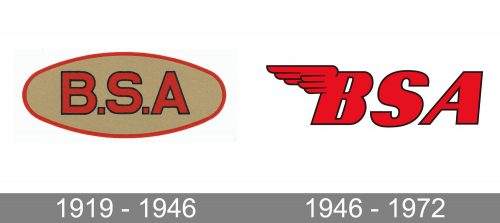 The classic BSA logo is fundamentally a monogram. Its three letters identify the Birmingham Small Arms name, while the most recognizable later version adds a stylized wing to the B.No authoritative BSA source located for this article provides a formal symbolic explanation for that wing. It is therefore safer not to claim that it officially represents speed, freedom, flight or performance.Its practical branding value is clearer: the wing transforms a short three-letter industrial abbreviation into a distinctive visual mark that could be recognized quickly on fuel tanks, badges, advertising and racing motorcycles.
BSA Before Motorcycles
The Birmingham Small Arms Company was created in 1861 by a group of Birmingham gunsmiths. The company acquired land at Small Heath, and its new factory was completed by 1863. [1]The BSA name therefore existed almost half a century before the company’s first complete motorcycle.This industrial background also explains why early BSA branding cannot be treated only as a motorcycle identity. The same initials belonged to a much broader engineering organization.1903 to 1910: BSA Enters Motorcycling
BSA’s official history states that the company’s motorcycle division was established in 1903. The first complete BSA motorcycle followed in 1910. [1]This corrects the frequently repeated claim that BSA began motorcycle production in 1919.BSA had already produced bicycle components and other engineering products, making motorcycles a natural extension of its manufacturing capabilities.Early BSA Lettering
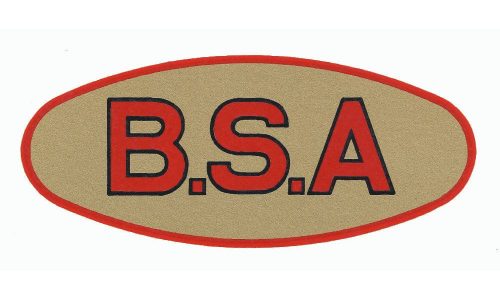 Early BSA motorcycles and advertising commonly used the company’s initials in relatively straightforward lettering. Some period treatments separated the letters with dots, appearing as B.S.A., while others used slightly different spacing and badge shapes.The illustration above is best understood as an early BSA monogram treatment rather than a logo definitively introduced in 1919. BSA had already been producing motorcycles for several years by that date.Exact start and end dates for individual early badge variations are difficult to establish because company stationery, motorcycle tank transfers and physical badges did not necessarily change at the same time.
BSA During the First World War
During the First World War, BSA became a major supplier of military equipment. Its official company history records production of rifles, Lewis guns, motorcycles, folding bicycles, machine tools, aero components, shells and other wartime products. [1]BSA-owned Daimler also produced staff cars, ambulances and commercial vehicles.Motorcycles were therefore only one part of BSA’s much broader wartime industrial activity.Interwar BSA Motorcycles
Motorcycle production expanded during the 1920s and 1930s. Models such as the Sloper, Blue Star and Empire Star helped establish BSA as an important British motorcycle producer.BSA’s own historical timeline also records the company’s receipt of the Maudes Trophy for notable motorcycling performance during the interwar period. [1]BSA During the Second World War
BSA again became a major military supplier during the Second World War.The company states that it produced 126,334 M20 motorcycles for military use, together with munitions components, Browning guns and shell fuses. [1]The BSA M20 became one of the motorcycles most closely associated with British wartime transport.The Classic Winged BSA Logo
 The classic BSA motorcycle identity uses tightly grouped italicized letters with a stylized wing projecting from the B.The supplied article dates this design to 1946, but reliable evidence for that precise introduction date is difficult to establish. A U.S. trademark record for the design describes it simply as “the letters BSA with a wing on the letter B” and claims first use from December 31, 1952. [2]For that reason, it is more accurate to associate the familiar winged mark with BSA’s postwar and 1950s identity rather than state definitively that it was introduced in 1946.
BSA in the 1950s
The 1950s became one of BSA’s strongest periods. The company acquired Triumph Engineering and reorganized its motorcycle operations, creating BSA Motorcycles Ltd in 1953.BSA states that during the decade it became the world’s largest motorcycle manufacturer, with approximately one in four motorcycles sold worldwide carrying a BSA badge. [1]The winged BSA lettering became especially closely associated with this period and with models such as the Gold Star.The BSA Gold Star
The Gold Star became one of BSA’s most celebrated motorcycles. The Gold Star name dates back to the late 1930s and became associated with high-performance single-cylinder motorcycles used both on the road and in competition.BSA’s modern company describes the Gold Star as one of the most successful models in the marque’s history, which is why the company selected it as the basis for its modern revival. [3]Racing and Competition
BSA achieved major success in competition during its peak years. The company’s official history highlights racing victories at Daytona and Catalina, while later riders also achieved important results in motocross.Jeff Smith, riding BSA machinery, won the FIM 500cc Motocross World Championship in both 1964 and 1965. BSA also records strong results by its scrambler motorcycles in events such as the Daytona beach race. [4]BSA Emblems and Motorcycle Badges
 BSA motorcycles used more than one physical badge treatment. Tank transfers, metal badges, star-shaped mounts and painted logos appeared across different models and production periods.These should not automatically be interpreted as separate corporate logos. Motorcycle manufacturers frequently adapted their identity to suit tank shapes, badges and individual model ranges.The claim that rectangular badges were universally used until 1936 and were then replaced by specific gold star-shaped emblems is not sufficiently supported by authoritative documentation reviewed for this article. It is better to treat such forms as model-specific badge applications.
What Happened to BSA?
BSA faced serious financial problems during the early 1970s as British motorcycle manufacturers struggled with competition from rapidly expanding Japanese brands and internal production problems.BSA’s official history records a trading loss of approximately £3 million in 1971 and unsuccessful attempts to recover with a revised BSA and Triumph range.The original continuous BSA motorcycle-production era ended in the summer of 1973, not simply in 1972. [1]Was BSA Revived in 1978?
No major modern revival of BSA began in 1978.The BSA name and related rights passed through several hands after the collapse of the original group, and limited motorcycles and products connected with the name appeared during later decades. However, today’s BSA company traces its meaningful commercial revival to the acquisition of BSA Company Ltd by Classic Legends in October 2016. [1]BSA and Classic Legends
Classic Legends is an Indian motorcycle company created to revive historic motorcycle marques. It owns brands including BSA, Jawa and Yezdi.BSA Company Limited is currently a subsidiary of Classic Legends Private Limited. Classic Legends is part of the Mahindra Group ecosystem. [5]The acquisition allowed development of an entirely new generation of BSA motorcycles while retaining the historic name and winged BSA identity.2021 and the Return of the BSA Gold Star
BSA officially unveiled its new-generation Gold Star at Motorcycle Live in Birmingham on December 4, 2021.The company described the motorcycle as a modern interpretation of one of its most successful historic models and emphasized continuity with the design of the original Gold Star. [6]The new Gold Star subsequently went on sale in multiple international markets, restoring BSA as an active motorcycle marque after a gap of several decades.BSA Today
BSA is again an active motorcycle brand. The modern range began with the Gold Star 650 and has since expanded.In 2025, BSA launched the Bantam 350 and continued development of the Scrambler 650. At EICMA in November 2025, the company also unveiled the new Thunderbolt, its first modern adventure motorcycle. [7] [8]The modern company continues to use the historic winged BSA lettering, making the logo a direct visual link between the original Birmingham manufacturer and the revived marque.Typography
The classic BSA motorcycle mark uses custom italicized lettering rather than a standard typed acronym. Its most recognizable feature is the stylized extension from the upper-left portion of the B, which forms a wing.A trademark description officially characterizes the mark as “the letters BSA with a wing on the letter B.” No authoritative source located for this article identifies a commercial typeface used to create the historic logo. [2]Color
The BSA logo has appeared in red, gold, black, white and metallic forms depending on motorcycle model, tank finish, printed material and period.Red became particularly familiar in BSA branding, but no authoritative historical source located for this article provides a formal color-symbolism system. Claims that red represents passion, gold means prestige or black means power should therefore not be presented as official BSA meanings.FAQ
What does BSA stand for?
BSA stands for Birmingham Small Arms, reflecting the company’s origin as a firearms manufacturer founded in Birmingham in 1861.
When did BSA start making motorcycles?
BSA established its motorcycle division in 1903 and produced its first complete motorcycle in 1910. Motorcycle production therefore began well before 1919.
What does the wing on the BSA logo mean?
The wing is the distinctive graphic feature attached to the B in the classic BSA motorcycle logo. No authoritative source located for this article provides a confirmed symbolic meaning such as speed or freedom.
When did original BSA motorcycle production end?
BSA’s official history says 63 years of continuous motorcycle production ended in the summer of 1973 after severe financial and manufacturing problems.
Who owns BSA today?
BSA Company Limited is owned by Classic Legends Private Limited, which acquired the marque in 2016. Classic Legends is associated with the Mahindra Group and also manages other revived motorcycle brands.
Disclaimer
This article is part of the educational resources provided by Logo Index, an independent archive covering logos, visual identities and graphic design history. BSA, Birmingham Small Arms and associated trademarks and brand assets remain the property of their respective rights holders where applicable.