 Darracq Logo PNG
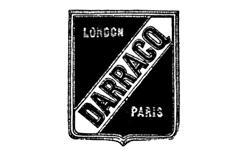
Darracq was a French motor-vehicle marque built around the businessman Pierre Alexandre Darracq, and its visual identity is thinly documented for a company of its size. At its height the firm accounted for roughly a tenth of French car production and stood as the country’s third-largest maker by 1910, according to the Ville de Suresnes history. What survives of that identity, though, is a radiator badge rather than a modern corporate logo: an early brass emblem carrying the letter D twice, and a rectangular redesign dated to 1924.
Darracq had already built and sold a bicycle business, Gladiator, before setting up A. Darracq et Cie. Accounts differ on the paperwork date. A société en commandite was formed in February 1897, while the Science Museum Group dates the enterprise to 1896. Production began in January 1898 at the Perfecta works in Suresnes, near Paris, and the earliest four-wheelers were sold under the Perfecta name, around 1,200 cars before 1902. The surname that became the marque’s identity only gradually replaced the original works name.
The documented emblem record
Nearly all badge-specific information traces back to a single specialist collector account. According to RadiatorEmblems, the first Darracq radiator emblem was a brass item showing the letter D twice, intertwined and mirrored. The same source dates a redesign to 1924, when the badge became an upright rectangle, and notes that France and the United Kingdom received different versions because the cars were sold in both markets.
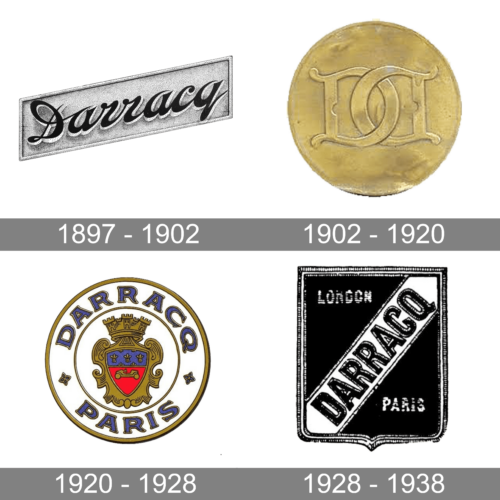
That is the substance of the verifiable chronology. The year spans often attached to Darracq emblems, including 1897, 1902, 1920 and 1928, are not tied to any emblem change by a period catalogue, parts list or archival reference. The Grace’s Guide chronology of badging is detailed on corporate history but does not describe badge redesigns either.
The double-D brass badge
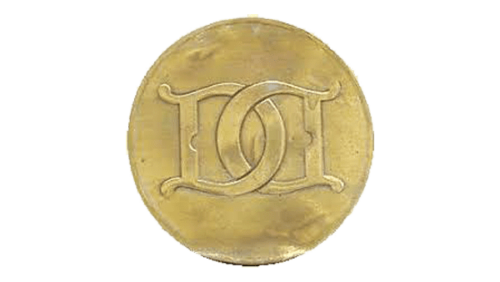
The intertwined double D is the mark most closely associated with the marque. Its arrangement is a mirrored pair of letters, and it was a metal radiator fitting rather than a printed wordmark, which is why it appears on cars rather than in catalogues and advertising.
The collector who catalogued the badge states that he could not determine why the D appears twice and that the second letter has no established connection to the name or to the company’s location. Any confident account of hidden symbolism should be read as unsourced.
The 1924 rectangular emblem
The redesign documented for 1924 replaced the round monogram with an upright rectangle. The one genuine split in the identity is geographic: French and British versions of the emblem differed, reflecting a marque that was designed and built in France but sold through a British-owned company.
The Talbot-Darracq emblem that followed stayed on radiator grilles for years after the name changed, as a 1924 Talbot-Darracq offered at auction illustrates; the badge lingered until the eve of the Second World War. Grace’s Guide also records a chassis badge on a 1938 Figoni-bodied T23 imported into the United Kingdom, which shows how long the marking survived in British-market cars.
Wordmarks and the limits of the record
Earlier Darracq material is best understood as a wordmark: the founder’s surname set in type. A diagonal script treatment resting on a silver parallelogram has been described, but no period source located supports that specific arrangement, so the safest reading is that the surname carried the brand before the radiator badges did.
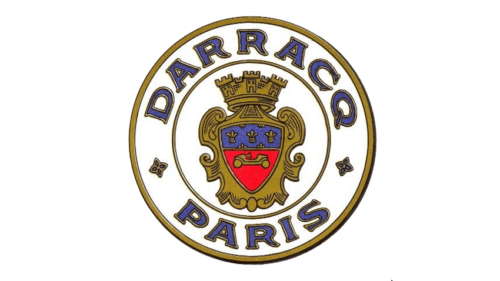
A round emblem with an ornate crowned shield in gold, red and blue is sometimes dated to 1920. Where an undated artwork appears inside a timeline, it represents a design stage the record does not place.
One related point is often folded into Darracq logo discussion: radiator-cap figures. A mascot mounted on the cap was normally an owner’s personal talisman, bought separately from the car, and is not the company’s badge.
When the name and the badge changed hands
Control of Darracq passed to British investors in 1902 and 1903, and Darracq himself stepped back as managing director, retiring from the business in the summer of 1912. The Suresnes operation was restructured as Société Anonyme Automobiles Darracq in 1916, switched to munitions and aircraft during the First World War, then took over Clement-Talbot in 1919, with its cars marketed as Talbot-Darracq.
The 1920 merger with Sunbeam and Clement-Talbot created STD Motors. The Darracq name was dropped from French products in 1922, when the Suresnes business was renamed Automobiles Talbot, as the Spanish-language record of the British company notes. Cars built there continued to be imported into Britain badged as Darracq during the 1920s and early 1930s, and the last car to carry the Darracq name was built in 1928. After STD collapsed in 1935, Talbot S.A. passed to Antonio Lago and the STD interests went to Rootes, but Suresnes cars could still be badged Darracq on import into Britain until 1939 to avoid conflicting with Rootes’ Talbot rights. The badge outlasted the marque.
FAQ
What did the Darracq logo look like?
The best-documented Darracq mark is a brass radiator emblem showing the letter D twice, intertwined and mirrored. A second version was introduced in 1924 as an upright rectangle, and French and British cars used different versions of it.
Why does the Darracq emblem show two Ds?
The specialist who catalogued the emblem could not determine why the D appears twice or what the second letter refers to.
When was the Darracq emblem redesigned?
The one dated redesign is 1924, when the round double-D badge gave way to an upright rectangular emblem. Dates such as 1897, 1902, 1920 and 1928 are circulated for Darracq emblems but are not supported by period catalogues or archival references.
Was the Darracq radiator mascot part of the logo?
No. Figures mounted on the radiator cap were typically personal mascots chosen and paid for by the owner, not factory branding applied by Darracq.
When did Darracq stop making cars?
The Darracq name was dropped from French-built cars in 1922, when the Suresnes works was renamed Automobiles Talbot. The last car built under the Darracq name appeared in 1928, although cars imported into Britain could still be badged Darracq until 1939.
Disclaimer
This article is part of the educational resources provided by Logo Index, an independent archive covering logos, visual identities and graphic design history. Darracq and associated trademarks and brand assets remain the property of their respective rights holders where applicable.