Jaguar is a British luxury car marque whose visual identity rests on an animal, a wordmark and a restless record of redesigns. The brand now sits inside Jaguar Land Rover, owned by India’s Tata Motors, but its badges carry a much older story: one that begins with a sidecar business in Blackpool and runs through a leaping cat, several winged emblems, a snarling face, and a 2024 identity that retired much of what came before.
 Jaguar Logo PNG
Where the name and the badges come from
The company did not start out as Jaguar. On 4 September 1922, William Lyons (1901–1985) and William Walmsley (1891–1960) founded the Swallow Side Car Company at Blackpool, according to the Jaguar Heritage archive. The business became the Swallow Side Car and Coach Building Company in 1926, moved to Foleshill, Coventry in 1928, and was registered as a limited company, Swallow Coachbuilding, in 1930. SS Cars Limited was incorporated on 10 October 1933, with a public share issue following in January 1934 as Walmsley left the firm.
The Jaguar name appeared in 1935, first as a model designation on the SS Jaguar 2.5 Saloon, as Jaguar’s own account of its history records. The corporate rename to Jaguar Cars Limited followed on 11 November 1937, and the name became the operating company’s identity in April 1945, once the SS initials were dropped.
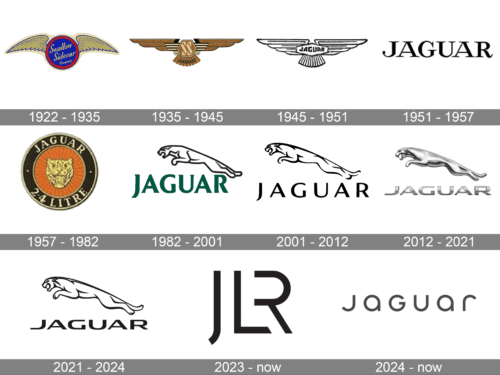
Early badge work was modest. After the war the marque used a winged badge and a flattened hexagon containing the JAGUAR logotype, with versions appearing on the Mark VII, on XK120 hubcaps and on the D-Type’s nose, as Hemmings documents.
The Leaper
The best known Jaguar emblem is the Leaper, a jaguar caught mid-stride. It was created at Lyons’s request in 1938. Public relations chief Bill Rankin produced an initial version, and the artist F. Gordon Crosby supplied the accepted design, announced in the 23 December 1938 issue of Autocar and sold as a radiator-cap mascot for two guineas, according to Magneto magazine.
The mascot was revised over the decades: a bonnet-mounted second version in 1955 with outstretched rear legs, a smaller third version in 1965 for the Mark X, and a lapse after around 1970 before a leaper returned on the 1994 XJ (X300). The dates and authorship come from the same magazine account.
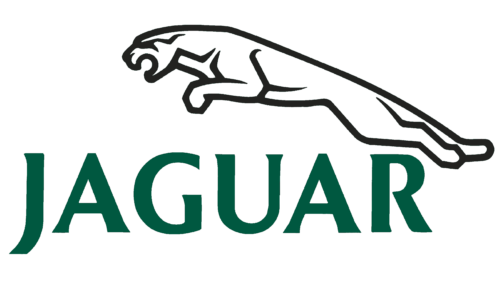
A separate two-dimensional graphic leaper, used more for merchandising and print, is loosely dated to 1982 in some accounts. That date applies to the flat graphic form, not to the mascot itself, which dates to 1938.
The Growler
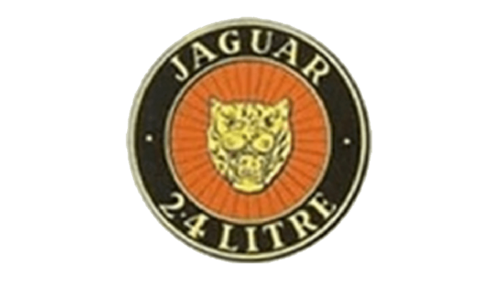
A second Jaguar emblem is the Growler: a circular grille or bonnet badge showing a snarling, tooth-baring jaguar head inside a ring lettered “Jaguar Cars Ltd Coventry,” with model and displacement variants. Hemmings documents the badge’s form and role, but the year of its first appearance is not firmly established by a strong source; several secondary pages give 1957, which is best treated as approximate rather than confirmed.
Ownership, and how it shaped the identity
Jaguar’s corporate ownership changed repeatedly, and each change brought shifts in how the brand was drawn and presented. The company took over Daimler in May 1960, merged with BMC in July 1966 to form British Motor Holdings, and joined Leyland in January 1968 to create British Leyland, which was effectively nationalised in 1975. Jaguar was floated on the London Stock Exchange in 1984, and Ford’s offer was accepted in December 1989, making Jaguar a wholly owned Ford subsidiary. Ford added Land Rover in 2000, then sold both brands to Tata in 2008, creating Jaguar Land Rover. These dates follow the Jaguar Heritage administrative history.
The 2002 and 2012 updates
Under Ford, Jaguar’s badge was given a metallic burnish around 2002 in work attributed to the consultancy The Partners, as reported by Autoblog. A more substantial overhaul came in 2012, tied to the “Alive” campaign and the agency Spark44, which introduced a three-dimensional metallic leaper alongside an updated metallic wordmark. Jaguar described it as the most extensive change to its identity in forty years.
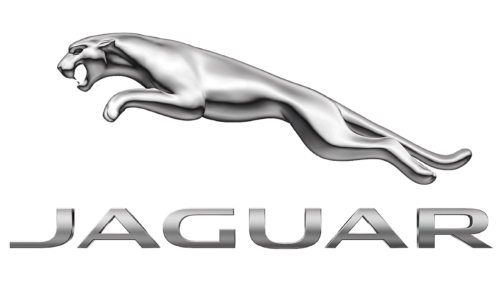
Pedestrian-safety rules pushed raised bonnet ornaments off several markets around this period, which affected where the physical leaper could appear. That was a regulatory pressure on the mascot’s use rather than the stated rationale for the 2012 logo update.
The 2024 identity
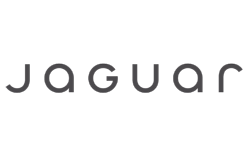
Jaguar announced a full identity reset on 19 November 2024 and revealed a concept car built around it on 2 December 2024 at Miami Art Week. The system, presented under the banner “Exuberant Modernism,” has four named elements: a “Device Mark,” a wordmark that mixes upper and lower case in a custom typeface; a “Strikethrough” graphic code of horizontal lines; a “Maker’s Mark” placing the leaper over the strikethrough; and an “Artist Mark,” a circular monogram built from stylised j and r letterforms. The roaring Growler face was retired, and the palette was re-centred on red, yellow and blue. The element names and details come from coverage in Car and Driver and Autocar Professional.
The company ties the reset to a line attributed to its founder: that “a Jaguar should be a copy of nothing,” shortened in the campaign to “Copy Nothing.” That framing is documented in Jaguar’s own presentation of the rebrand, reported by Yahoo and others. Most other published “meaning” claims about the 2024 palette and symbols are brand interpretation rather than documented fact. For a focused look at that change, see our breakdown of the 2024 Jaguar redesign.
Typography and color
What can be stated with confidence about Jaguar’s typography is limited. The 2012 system used a 3D metallic leaper with a metallic wordmark. The 2024 wordmark is a custom typeface mixing cases, paired with a circular monogram and the strikethrough line motif, presented in brass and gold tones against a primary-color palette. The 2024 typeface is described in coverage as custom, reportedly nicknamed “Jaguar Exuberant.” Widely circulated claims that name specific commercial fonts as the basis of the Jaguar wordmark are not verified.
JLR’s corporate mark
Jaguar Land Rover has its own corporate identity, distinct from the Jaguar brand identity. The “JLR” mark belongs to the parent group rather than to Jaguar itself, so it should not be read as a Jaguar badge redesign.
Disclaimer
This article is part of the educational resources provided by Logo Index, an independent archive covering logos, visual identities and graphic design history. Jaguar and associated trademarks and brand assets remain the property of their respective rights holders where applicable.