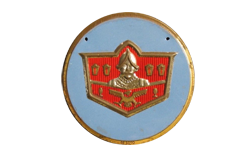
Marquette is one of the shortest stories in American car branding. The name belonged to a companion make sold through Buick dealers for a single model year, and its identity survives mainly as one enamel radiator badge rather than a family of logos, wordmarks and secondary marks.
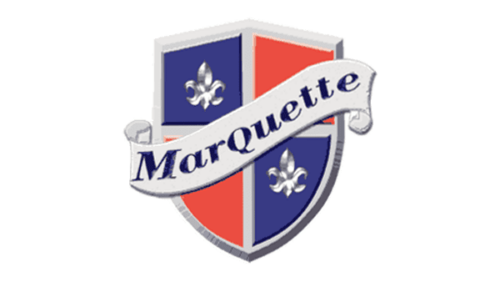 Marquette Logo PNG
Meaning and history
The badge most closely tied to the marque is the radiator emblem of the 1930 Marquette: a heraldic crest or shield carrying the word MARQUETTE across a scroll, executed in black and red enamel with white or argent elements and a fleur-de-lis. Surviving examples are held in museum collections, including the Smithsonian’s National Museum of American History and the Shawano County Historical Society, and a badge of this type is shown in the Franschhoek Motor Museum’s Marquette collection entry. Two Smithsonian catalogue records describe the device in somewhat different heraldic terms, so the description here stays general. No reliable source explains what the crest, its quarters or the fleur-de-lis were meant to convey, and neither a typeface nor an enamel colour standard is documented for the marque.
The crest sat at the centre of a radiator grille that remains Marquette’s most recognisable styling feature: a herringbone mesh. Auction catalogues of the 1930 Marquette Model 35 treat the herringbone grille as the car’s defining front-end element, which makes the grille as much a part of the brand’s visual signature as the enamel badge.
A name applied more than once
“Marquette” was used on at least three unrelated automobiles, which is where conflicting dates come from. It first appeared as a model name on Berwick’s electric car in 1904, not as a company founding. A separate Marquette Motor Company in Saginaw, Michigan, followed from William C. Durant’s acquisition of the Rainier Motor Car Company in May 1909 and lasted until General Motors closed it in 1912, as the record of the Marquette automobile sets out. The Marquette that most readers mean is the third: a marque of the Buick division rather than a stand-alone subsidiary.
The 1930 Marquette and its badge
Buick’s Marquette came out of Alfred P. Sloan’s companion make programme, positioned below Buick and above Viking. It was shown in May 1929 and production began on June 1, 1929 as a 1930 model, according to the New York Times launch report, and the line was withdrawn at the end of the 1930 model year, as summarised in Consumer Guide’s account of the companion brands. About 35,007 cars were built in the United States and roughly 6,535 more by GM Canada. The engineering was shared GM hardware, including a 212.8 cu in flathead six and Fisher bodies, and after the badge was retired the engine tooling went to Opel. Launch prices are reported differently across sources, from about $965 to $1,035 f.o.b. at the time of launch to roughly $990 to $1,060 in later auction catalogues, so no single figure is definitive.
Badge variations
Some Marquette-based Series 30 cars sold in South America are reported to carry a shield lettered BUICK rather than Marquette, and a few late cars are said to have used the standard Buick emblem. Available evidence points to a market-specific or late-production variation rather than a redesign. Because the marque existed for effectively one model year, no sequence of badge revisions is documented.
What remains of Marquette’s identity is compact: one enamel crest, one scroll-borne name and one herringbone grille. That is enough to identify the car, and it is also the full extent of what the surviving record supports.
Disclaimer
This article is part of the educational resources provided by Logo Index, an independent archive covering logos, visual identities and graphic design history. Marquette and associated trademarks and brand assets remain the property of their respective rights holders where applicable.