 MG Logo PNG
MG takes its name from Morris Garages, the Oxford sales and service business that William Morris owned. The cars that made those two letters famous were the work of Cecil Kimber, who joined as sales manager in 1921 and became general manager the following year, turning a garage operation into a sporting marque. Morris kept personal ownership of the company until 1935, when it passed to Morris Motors. Grace’s Guide
What the marque left behind visually is unusually consistent: an octagon built from a straight-line “MG” monogram, in use in some form since the mid-1920s. An MG distributor’s badge history page traces the shape to 1924 and notes how little its outline has changed since.
The first badges and the first octagon
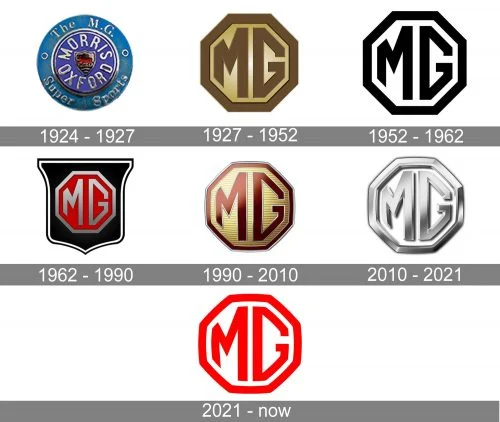
The earliest cars did not wear a plain octagon. Their badge was circular, with “MORRIS OXFORD” lettering arranged around a small MG octagon at the centre, as Hemmings’ history of the badge describes it. The octagon motif was already appearing in MG advertising in 1923 and 1924, and on the May 1924 Super Sports Morris advertisement, so the two designs overlapped rather than replacing one another in a tidy sequence. Hagerty records the octagon in a 1923 Isis advertisement.
The monogram is credited to Edmund “Ted” J. F. Lee, a Morris Garages cost accountant who drew the angular shape in the early 1920s, according to Jonathan Wood’s account of the badge’s origins. Lee’s octagon enclosed two letters cut from the same thickness of line as the frame around them, an approach that sits squarely within the geometric taste of the period.
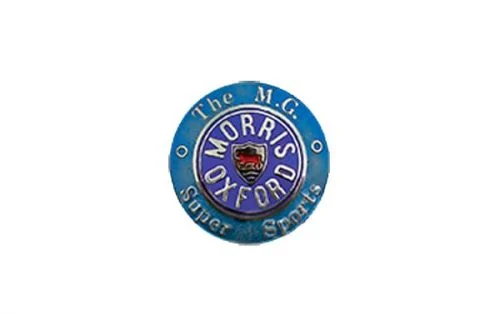
The original finish was reddish-brown lettering and outline on a cream ground. That colouring has been retold in some places as brown and gold, but the documented colours are the duller, more muted pair.
1927: the octagon stands alone
The circular enclosure disappeared in 1927, leaving the octagon as the marque badge in its own right, the form it has largely kept ever since. One commonly repeated detail dates formal trademark registration to 2 April 1928, though that claim rests on secondary reporting and sits awkwardly beside the March 1928 incorporation of MG Car Company Limited. Motor16
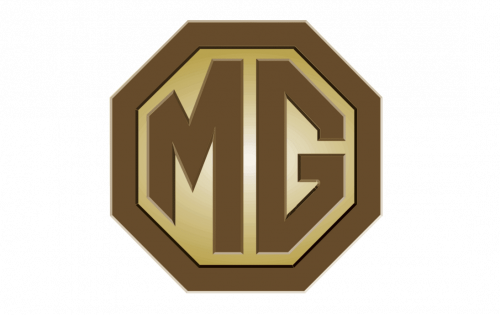
Through the middle of the century the badge was rendered in black over white, a treatment associated with cars such as the MGA from the mid-1950s. Hemmings
1962: the octagon inside a shield
For the MGB, from 1962 to 1963, the octagon was set inside a shield-shaped enclosure with a chrome outline. Descriptions of that badge’s colours vary: Hemmings describes the octagon in red against a black shield, while other accounts give a red ground with gold letters. The enclosure itself is well documented; the exact palette is reported inconsistently. Hemmings
The ownership changes behind the badge
The mark outlasted a long series of owners. Morris Motors was absorbed into the Nuffield Organisation and then into BMC in 1952, and BMC became part of British Leyland in 1968. British Leyland shelved the MG brand in 1980 when MGB production ended, and the octagon returned on the MG Metro in 1982. Classics World The marque passed to MG Rover in 2000; after MG Rover collapsed in April 2005, Nanjing Automobile bought the MG brand, the Longbridge plant and Powertrain for £53 million in July 2005. China Daily Nanjing’s merger with SAIC, signed on 26 December 2007, brought MG under SAIC Motor. China Daily
The revived cream-and-brown badge
The RV8 of 1994 brought back a modernised cream-and-brown octagon, this time crossed by thin horizontal lines. Hemmings The revival is sometimes dated loosely to the early 1990s, so the badge from that period is better placed approximately than to a single year.
2010: a silver, three-dimensional octagon
By 2010 the badge had become a three-dimensional silver octagon with matching silver letters, set on a transparent or white background and paired with an “MG” wordmark beneath it. Motor16 This is the identity most associated with MG’s early years under SAIC ownership.
2021: the flat octagon
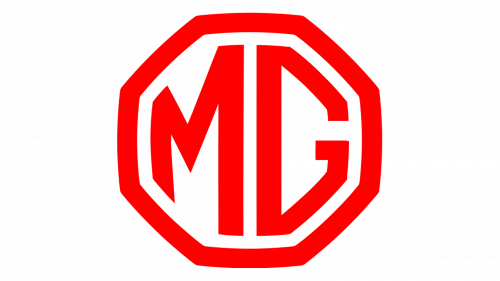
MG unveiled a flattened version of the badge on 7 April 2021: the frame became thinner and the monogram inside grew larger, giving the octagon a cleaner, more two-dimensional presence. The first production car to wear it was the MG ONE, which debuted on 30 July 2021. Motor16
A softer, rounder octagon shown at the 2017 Shanghai motor show on the E-motion concept previewed some of that thinking, but it remained a concept study rather than a replacement for the production badge. GoAuto
Throughout all of it, the constant has been the octagon and its letters rather than colour or finish. The badge has been cream, black and white, silver and, in its current form, flat, and the geometry has barely moved.
FAQ
What does MG stand for?
MG stands for Morris Garages, the Oxford business owned by William Morris from which the marque grew. The cars themselves were developed by Cecil Kimber, who ran the company from 1922.
Why is the MG logo an octagon?
The octagon is a geometric device built around the “MG” initials, drawn in the early 1920s. The surviving accounts describe it as a shape of its period rather than a symbol carrying a coded meaning.
When did MG last change its logo?
The current badge was unveiled on 7 April 2021 and first appeared on a production car, the MG ONE, on 30 July 2021.
Disclaimer
This article is part of the educational resources provided by Logo Index, an independent archive covering logos, visual identities and graphic design history. MG and associated trademarks and brand assets remain the property of their respective rights holders where applicable.