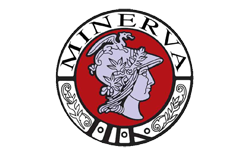
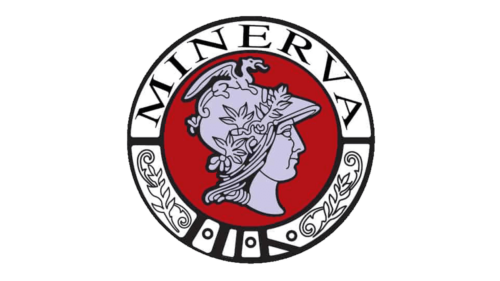
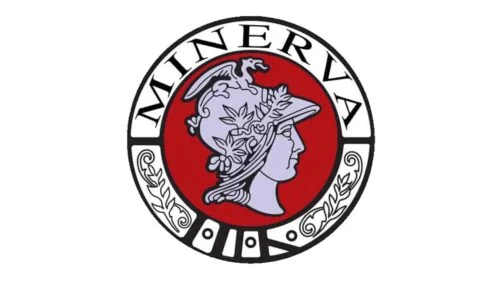
Minerva was a Belgian luxury-car marque built in and around Antwerp, and its visual identity rests almost entirely on a single figure: the Roman goddess it was named after. The brand’s emblem and its best-known radiator mascot both show a helmeted female head, and the mascot became a signature of the marque’s eight-cylinder cars in the 1920s and early 1930s.
 Minerva Automobile Logo PNG
Meaning and history
The company was founded in 1897 by Sylvain de Jong (1868–1928), a Dutch-born bicycle maker who had settled in Antwerp. It began with bicycles, moved into motorcycles, and added its first car in 1902, with volume car production following in 1904. The name came from the Roman goddess Minerva, associated with wisdom and the crafts, and a museum record for the marque describes the emblem itself as a helmeted woman’s head.
That choice of name is the foundation of the whole identity. Rather than a geometric monogram or an abstract device, Minerva adopted a classical figure that could be rendered as a radiator ornament, a mascot, a badge and, later, a poster motif.
The emblem and the radiator mascot
The earliest visual signature that can be traced is an emblem and radiator ornament documented on a 1913 model, recorded in the image caption of the Dutch Wikipedia entry on the marque. The dating rests on that single caption, so it is best treated as an approximate first appearance rather than a firm launch date.
What is much better documented is the mascot. From 1922, Minerva cars carried a radiator mascot of the head of the Roman goddess Minerva, designed by the Belgian sculptor Pierre de Soete (1885–1948), according to the ArchiveGrid collection record and the Dutch Wikipedia account of the marque. The figure is described as copper-plated hollow-cast brass, roughly 150 mm tall with an integrated radiator cap, signed “P. De Soete,” and carrying a large “M” cast into its base with a smaller M beneath. Auction house H&H Auctioneers catalogues the same figure on Minerva’s AL-series cars, and the design appears on the marque’s CV and AL-series eight-cylinder models. Sources place its use from about 1923 to 1934, which fits the 1922 debut date the Dutch sources give.
The mascot therefore did double duty as both an ornament and a small piece of branding: the “M” in the base tied the sculpture directly to the Minerva name, while the goddess’s helmeted profile carried the classical reference that the company had chosen in 1897.
Badges, caps and later marks
Away from the mascot, Minerva used scripted lettering. Radiator caps carried a scripted “M” or “MM,” the latter standing for Minerva Motors, as recorded in auction catalogues of the marque’s mascots and badges. No reliable source has been found for a formal wordmark redesign, a credited brand typeface or an official colour code, so the lettering is best described as a consistent scripted monogram rather than a documented design system.
The identity changed after the Second World War, when Minerva assembled Land Rovers under licence. Surviving vehicles from that period wore a grille badge reading “MINERVA / License Rover,” roughly 19 cm across, and later versions replaced the Rover wording with a small Land Rover oval. That redrawing is recorded in a collector listing rather than in a corporate record, so it is treated here as a market description of the surviving badges.
Minerva-badged production ended with the last vehicles built in June 1956, as reported by Belgian public broadcaster VRT, and the company was wound up and the factory closed permanently in 1958, according to the Society of Automotive Historians Journal. The goddess mascot had disappeared from the cars long before that: it belonged to the marque’s independent luxury era, not to its post-war Land Rover work, and the emblem’s later history is largely the story of the lettering and the grille badge taking over.
For collectors and historians, the surviving mascots and badges are the clearest record of how Minerva presented itself. The name supplied the symbol, a Belgian sculptor gave the symbol its definitive form in 1922, and the marque’s later badging reflects a company that had already moved on from the cars that made the figure famous.
Disclaimer
This article is part of the educational resources provided by Logo Index, an independent archive covering logos, visual identities and graphic design history. Minerva Automobile and associated trademarks and brand assets remain the property of their respective rights holders where applicable.