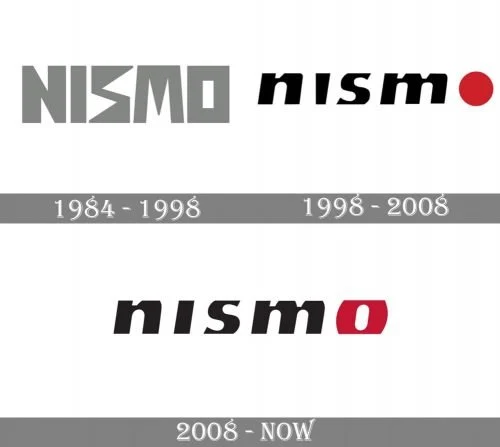
Nismo is the motorsport, tuning and performance division of Nissan, and its badge has passed through only three documented stages since the division was founded. The changes were incremental: a tricolour racing wordmark, then a solid red circle standing in for the final letter, then that same red element reshaped so it reads unmistakably as an O. Red has anchored the identity for the better part of three decades.
 Nismo Logo PNG
Nismo is the working name of Nissan Motorsport International Co., Ltd., established on 17 September 1984 in Omori, Tokyo, and now based in the Yokohama area. Nissan describes the name as an abbreviation of “Nissan Motorsport(s) International” and marked the division’s 40th anniversary on 17 September 2024 (Nissan’s anniversary announcement; Nismo’s own notice).
Meaning and history
Nismo’s official history separates the badge into three eras: 1984 to 1997, 1997 to 2004, and 2004 onward. The final stage was introduced at the division’s 20th anniversary and announced in February 2004 (Nismo’s 2004 announcement). The wordmark stayed readable throughout; what shifted was how much of Nissan’s racing livery travelled with it, and how the final letter was drawn.
1984 to 1997: the tricolour original
The founding logo took the tricolour used by Nissan’s works racing teams, red, blue and white, and Nismo’s history describes its lettering as sharp, with a sense of speed (Nismo’s official history). Beyond that account, no designer, studio or typeface is documented for the mark in a reliable source, so the tricolour palette and the character of the lettering are what can be stated with confidence.
1997: the red circle “O”
The second logo began as an addition rather than a replacement. From 1995, then-president Jiro Adachi, impressed by the uniformed European works teams he saw at Le Mans, decided to add a simpler mark: lowercase “nismo” with the final letter set as a solid red circle, which Nismo compares to the hinomaru of the Japanese flag (Nismo’s official history). It was used at first only at overseas races while the tricolour version remained the official emblem, and was later adopted as the division’s second-generation logo. Nismo’s timeline bands that era from 1997 to 2004; the precise month the mark took over is not firmly documented, though one secondary timeline places it in June 1997.
2004: the current logo
The mark was revised for Nismo’s 20th anniversary under president Yuichi Sanada. The red element was kept but reshaped so that it would read clearly as a letter O, after reports that overseas readers were taking the word as “nism” or “nisum” (Nismo’s official history). The revision was announced on 17 February 2004 and the logo was in use from 10 February 2004, according to Nismo’s announcement, and it was reported at the time by Response. This remains the current logo.
Across all three stages, red is the element that survived: first as one of three colours in the 1984 mark, then as the single accent inside the lowercase wordmark from 1997, and finally as the reshaped letter introduced in 2004. The wordmark itself has stayed the constant, which is why the badge still reads as one continuous identity rather than a series of unrelated marks.
Trademark record
Nissan’s US filings trace the identity without explaining it. The word mark NISMO was filed on 16 February 1988 and registered on 25 April 1989 as registration 1,536,313 in the name of Nissan Jidosha K.K. (USPTO record via Justia). A separate logo mark was filed on 30 January 2004 and registered on 27 September 2005 as registration 3,001,028; the record describes a drawing that includes shaded circles and lists the pseudo-mark “NISSAN MOTOR SPORTS” (USPTO record via Justia). That registration was cancelled under Section 8 in 2012. The records confirm the applicant, the filing and registration dates and the marks as drawn, and no more.
Disclaimer
This article is part of the educational resources provided by Logo Index, an independent archive covering logos, visual identities and graphic design history. Nismo and associated trademarks and brand assets remain the property of their respective rights holders where applicable.