 Plymouth Logo PNG
Meaning and history
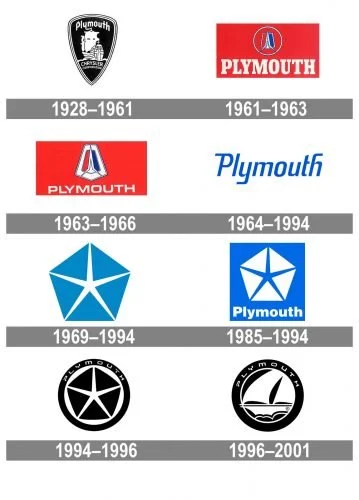
Plymouth was a Chrysler automobile brand introduced in 1928. Its name evoked Plymouth Colony, and the Mayflower became its defining early emblem. The identity shifts between the ship, abstract geometric devices, Chrysler’s corporate Pentastar and, near the end, a return to the vessel. The dates in the headings identify the stages in this visual sequence.
1928 – 1961
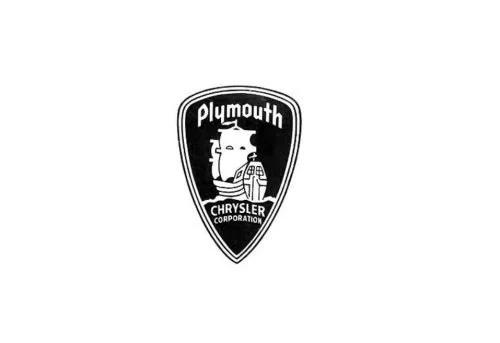
The badge shown here places a ship inside a dark, pointed shield, with “Plymouth” above and “Chrysler Corporation” below. Plymouth’s Mayflower motif appeared on early cars, including radiator emblems, and later on other vehicle details. Hemmings connects the ship to the brand name’s association with Plymouth Colony, while the company’s timeline also records the Mayflower emblem in the marque’s early identity (Hemmings; Stellantis North America).
1961 – 1963
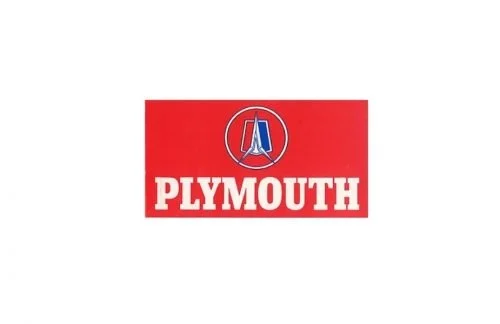
This stage replaces the shield-and-ship composition with a red rectangular field, a small upright geometric emblem and a large white “PLYMOUTH” wordmark. The name is the strongest element, while the compact symbol adds a contrasting graphic device.
1963 – 1966
The next image keeps the red rectangle and white capitals but changes the emblem above the name. Its angular, divided form is larger and more prominent than the symbol in the preceding stage.
1964 – 1994
Here the identity is reduced to a blue italic “Plymouth” wordmark. Without a surrounding badge or pictorial emblem, the lettering alone carries the name.
1969 – 1994

The five-point star shown here is Chrysler’s corporate Pentastar, rather than a Plymouth-specific symbol. Chrysler introduced it in 1962; Robert Stanley designed it at Lippincott & Margulies under the direction of Chrysler president Lynn Townsend, according to the Detroit Free Press. Its appearance in the Plymouth sequence reflects the brand’s place within Chrysler.
1985 – 1994
This version combines the star-and-pentagon device with a blue square and a white “Plymouth” wordmark beneath it. Compared with the standalone star in the preceding stage, the complete lockup gives the corporate symbol and brand name a single, compact frame.
1994 – 1996
The star-and-pentagon motif is now enclosed in a circular black-and-white badge, with “Plymouth” following the upper curve. This roundel makes the mark more self-contained than the square composition before it.
1996 – 2001
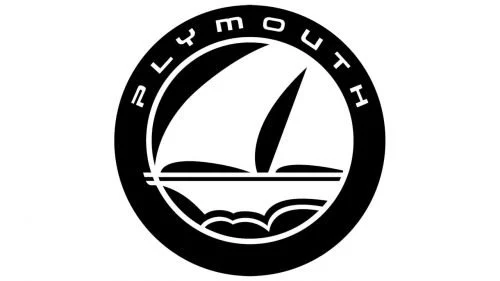
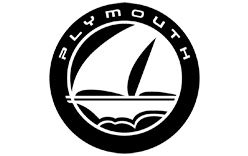
The Mayflower returns in a round badge: a sailing ship sits inside a dark circle, with the brand name around the rim. Hemmings dates the sailing-ship badge’s debut to 1995, while the stage shown here is labeled 1996–2001. Both accounts place the ship’s return near the end of Plymouth’s history. DaimlerChrysler announced that Plymouth would be phased out at the end of the 2001 model year, as reported by the Los Angeles Times. The Henry Ford museum preserves Plymouth radiator-emblem and Mayflower-logo material from the brand’s earlier history (The Henry Ford).
View the Plymouth logo archive entry.
Disclaimer
This article is part of the educational resources provided by Logo Index, an independent archive covering logos, visual identities and graphic design history. Plymouth and associated trademarks and brand assets remain the property of their respective rights holders where applicable.