 Renault Sport Logo PNG
Renault Sport was Groupe Renault’s motorsport and performance division, associated with racing and road cars such as the Clio R.S. and Megane R.S. Its visual identity shifted from a full-name wordmark to the abbreviated R.S. double diamond. Renault Sport Cars became Alpine Cars in 2021, as Renault Group announced in its name-change release.
Meaning and history
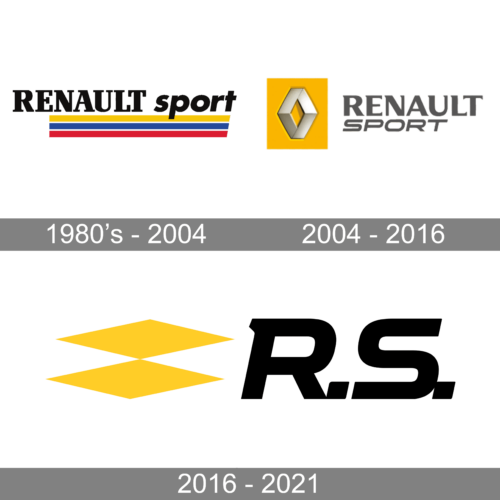
Renault Sport was formed at the end of 1976 from Renault’s Alpine competition and Gordini activities. The division was renamed Renault Sport Technologies in 2002, then split into Renault Sport Racing and Renault Sport Cars in 2016, according to the recorded organizational history. The logo evolved from a name-led mark to the R.S. abbreviation.
1980’s – 2004
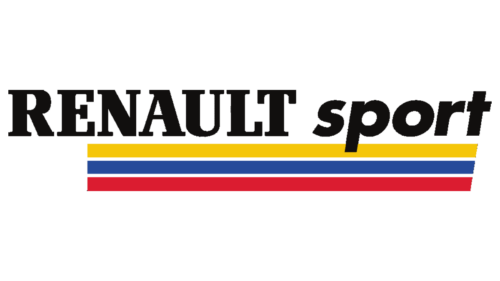
This stage uses the full Renault Sport name in a broad horizontal arrangement. “RENAULT” is prominent, with “sport” beside it; three colored horizontal bars sit underneath. The lettering and stripes make this version read as a wordmark rather than a standalone symbol. The heading dates this archive stage, but the mark’s visual details are the clearest point of comparison.
2004 – 2016
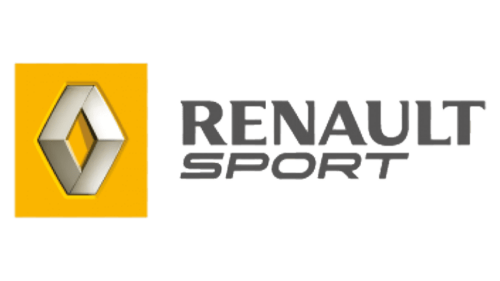
The next stage gives the Renault diamond a more prominent role. A metallic-looking diamond sits within a yellow block at the left, while “RENAULT SPORT” appears in two lines to its right. Compared with the preceding horizontal wordmark and colored rules, this layout is more badge-like and uses the diamond as its main graphic feature.
2016 – 2021
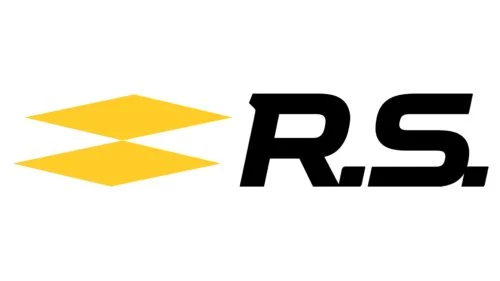
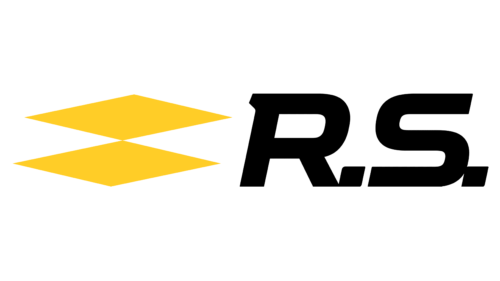
The final archived stage pairs two yellow diamonds with bold, italic “R.S.” lettering. The full Renault Sport name and the earlier yellow badge layout are absent. Renault’s 2016 Formula One livery introduced a diamond pattern described as part of a new brand identity; the double-diamond R.S. logo was reported with the R.S.17 reveal in 2017. Renault commercial director Thierry Koskas described the motif as a reference to sports cars from the 1960s and 1970s that carried two diamonds, and as a bridge between racing and road cars, Sport Auto reported.
The archive’s 2016–2021 label groups the later R.S. design into one stage. A related Formula One team identity changed in 2019: the team became Renault F1 Team and its logo dropped “Sport” and the yellow background, according to Autobild. This team change is distinct from the road-car identity shown above.
Color and symbolism
Yellow and black were associated with Renault Sport’s Formula One identity. Renault linked the colors to the RS01, its first Formula One car, which entered the series in 1977; its 2016 R.S.16 livery combined yellow-gold and black with a diamond pattern described as part of the new identity in Renault Group’s account. For the later double-diamond mark, Renault’s stated explanation connects the motif to earlier Renault sports cars and links competition with road cars.
From Renault Sport to Alpine
Renault announced Alpine as the business unit for its sportscars in January 2021, with Renault Sport Cars and Renault Sport Racing absorbed into it, the Alpine newsroom reported. Renault Sport Cars became Alpine Cars on 1 May 2021, Renault Group confirmed. The Megane R.S. Ultime, launched in 2023, was the final R.S.-badged model, according to Renault’s announcement.
View the Renault Sport logo archive entry.
Disclaimer
This article is part of the educational resources provided by Logo Index, an independent archive covering logos, visual identities and graphic design history. Renault Sport and associated trademarks and brand assets remain the property of their respective rights holders where applicable.