Tazo was founded in Portland, Oregon, in 1994 by tea blender Steven Smith and co-founder Steve Lee. Its logo has moved from a framed, ornate wordmark to a simpler typographic mark. The brand passed from Starbucks to Unilever in 2017, then to CVC Capital Partners in 2022 as part of Unilever’s tea portfolio sale; it is now within Lipton Teas and Infusions, according to FoodNavigator.
 Tazo Logo PNG
Meaning and history
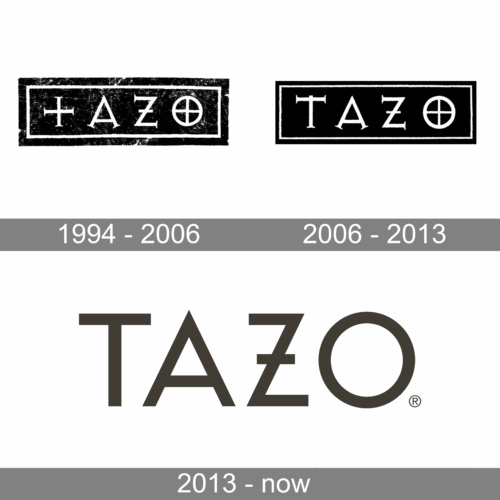
The original identity was created by Portland’s Sandstrom Partners. The agency describes the brief as “Marco Polo meets Merlin,” and its designer Steve Sandstrom characterized the intended look as coded and alchemical, rather than as a literal set of ancient symbols (Sandstrom Partners).
1994 – 2006
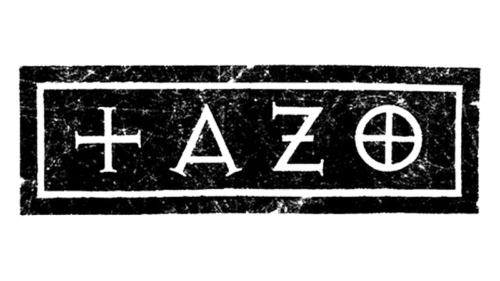
The first mark places white TAZO lettering inside a double rectangular frame on black. Its fine, decorative strokes and unusual letter details feel markedly different from a conventional plain wordmark. The design appeared on packaging whose flavours were distinguished with individual saturated colours. In 1996, the package won the London International Advertising Award for Best Package Design Tea, reported by the Los Angeles Times.
2006 – 2013
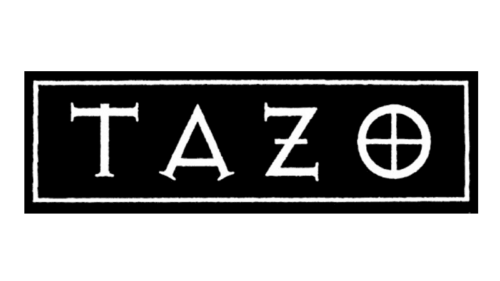
This version keeps the black field, white lettering and rectangular border, but the frame and letterforms appear cleaner and more regular than in the earlier image. A 2006 adjustment raised the T’s crosspiece to improve readability; the change refined the existing design rather than replacing its overall look. The date and purpose of that adjustment are reported in the Tazo reference entry.
2013 – Today
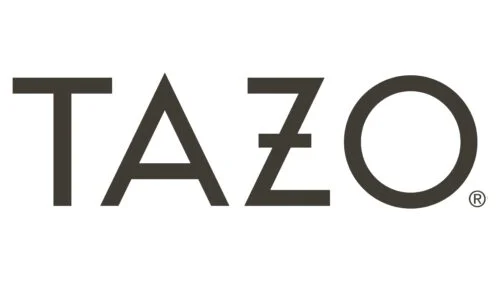
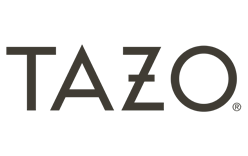
The 2013 redesign removed the enclosing box and set TAZO as a bold, widely spaced sans-serif wordmark. The Z’s crossbar remains a distinctive feature, described as a nod to the earlier lettering. Starbucks produced the redesign in-house, as Fonts In Use records. Designer Amy Lam also describes leading the project, which covered more than 200 products, on her portfolio.
A later packaging refresh retained the white canvas and existing logo while adding vivid tea-splash graphics and clearer product-segment coding across more than 160 products. The packaging case study by DDW describes those changes; it did not report a replacement of the wordmark.
Lettering and colour
The contrast between the early and later designs is mainly one of form and presentation. The original’s decorative lettering sits inside a black frame, while the 2013 mark relies on open space and simpler sans-serif characters. Sandstrom Partners’ account supports a coded, alchemical design intention, but not a specific symbol-by-symbol reading. On packaging, colour also helps distinguish flavours: it shifts from accents around the early black box to more prominent illustrations and splashes in later designs.
Ownership and the identity
Starbucks acquired Tazo in 1999, and Unilever acquired it from Starbucks in 2017, according to the sale announcement. Unilever later sold its tea business, including Tazo, to CVC Capital Partners in 2022, as reported by FoodNavigator. These ownership changes were distinct from the documented 2013 redesign: the later packaging refresh changed the surrounding graphics while retaining the wordmark.
Disclaimer
This article is part of the educational resources provided by Logo Index, an independent archive covering logos, visual identities and graphic design history. Tazo and associated trademarks and brand assets remain the property of their respective rights holders where applicable.