BTS is a seven-member South Korean group whose name abbreviates Bangtan Sonyeondan, commonly rendered in English as “Bulletproof Boy Scouts” or “Bulletproof Boys” (Rolling Stone Italia). The group debuted on 12 June 2013 with the EP 2 Cool 4 Skool (Guinness World Records).
 BTS Logo PNG
Meaning and history

The visual timeline moves from a detailed vest emblem to album-era circle designs and, in 2017, a pared-back door symbol. The 2017 identity added “Beyond the Scene” as an English meaning for BTS; it did not rename the group, Billboard reported, citing Big Hit’s explanation (Billboard).
2013 – 2016
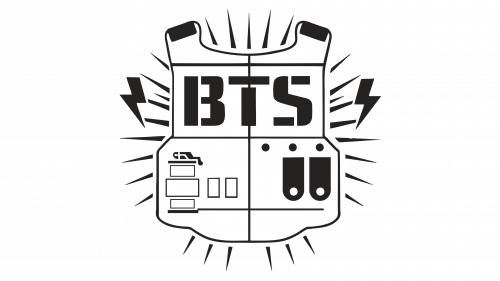
This emblem depicts a vest marked “BTS,” surrounded by sharp rays and lightning-bolt details. Its literal, intricate construction contrasts with the simpler geometric marks in the later stages. The Korean group name is commonly translated as “Bulletproof Boy Scouts,” a context that helps explain the vest imagery without treating it as a description of the later door mark (Rolling Stone India).
2016
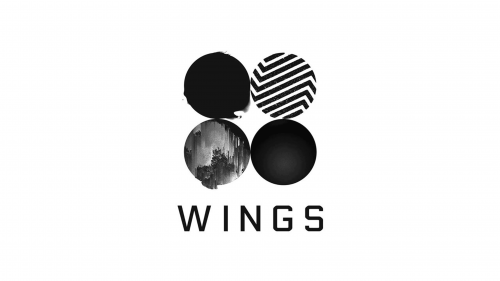
The WINGS artwork pairs four differently textured circles with the word “WINGS.” The K-Design Award record describes the dots as a relationship diagram of BTS members and links the design to the four W.I.N.G album versions and Hermann Hesse’s Demian. It credits the work to BigHit Entertainment with VBstudio and names ChulHwee Kim and Changyul Lee as designers; the award record lists it as a 2017 Gold Winner (K-Design Award).
2017
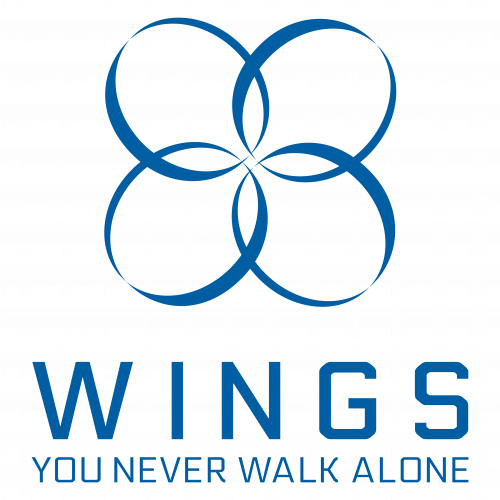
This WINGS and You Never Walk Alone artwork replaces the separate textured circles with four outlined, overlapping blue ellipses. The tighter, interlocking arrangement makes a more compact symbol than the four distinct circles. Rolling Stone India places the knot-style design in the You Never Walk Alone repackage’s visual evolution (Rolling Stone India).
2017 – now
The 2017 identity uses two mirrored pairs of trapezoid-like shapes to suggest half-open doors. The paired forms create a vertical emblem above the BTS wordmark; the related image shows the mark against a circular field. This is a major simplification from the vest’s illustrative details and the WINGS artwork’s textures. The heading is retained as part of the visual timeline, but the available status information does not establish whether this mark is in use today.
Big Hit described the door as symbolizing young people who do not settle for their current reality but open the door and move forward to grow, as reported by Billboard (Billboard). The fandom name ARMY is also part of the identity: the 2017 BI introduced signatures for both BTS and ARMY, and Korean outlet OSEN described the ARMY design as what the members face when they open the door (OSEN).
Design process and wordmark
Reports describe the new identity as a year-long process involving Big Hit staff and executives, BTS members, research and focus-group interviews, as well as fan input. The design consulting firm was not named in the coverage (Soompi; OSEN). The wordmark shows bold, highly stylized uppercase letters, while the door logo uses a more restrained uppercase treatment. The 2017 reveal video included the words “SEE YOU THERE,” a door silhouette and the narration “Beyond The Scene, BTS,” according to Billboard and Soompi (Billboard; Soompi).
Disclaimer
This article is part of the educational resources provided by Logo Index, an independent archive covering logos, visual identities and graphic design history. BTS and associated trademarks and brand assets remain the property of their respective rights holders where applicable.