 BCS Championship Game Logo PNG
Meaning and history
The BCS National Championship Game decided the NCAA Division I FBS football national champion during the Bowl Championship Series era. From the 2006 season, it became a standalone game, and its badges changed from year to year as the title sponsor and host site changed. The BCS was created for the 1998 season and was replaced by the College Football Playoff beginning with the 2014 season, according to CNN’s BCS history.
The sequence is built around a consistent practical pattern: each badge pairs the BCS championship wording with that game’s sponsor and host location. The title sponsor matched the host bowl’s sponsor. Sports Reference lists Tostitos for the 2007 game in Glendale, Allstate for 2008 in New Orleans, FedEx for 2009 in Miami Gardens, and Citi for 2010 in Pasadena, followed by Tostitos, Allstate, Discover and Vizio for the next four editions (Sports Reference; see also MediaPost’s sponsorship report).
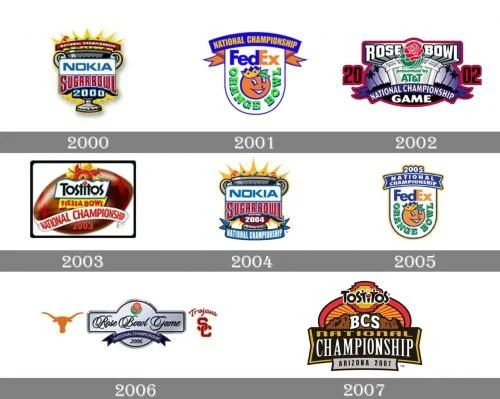
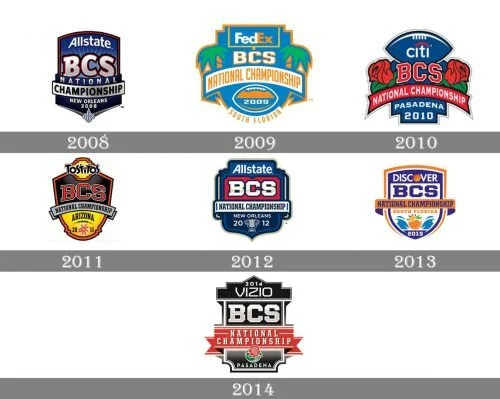
The same championship wording was placed in a succession of distinct crests. Sponsor marks sit prominently in each design, while colors, borders, illustrations and the position of the year vary.
2008
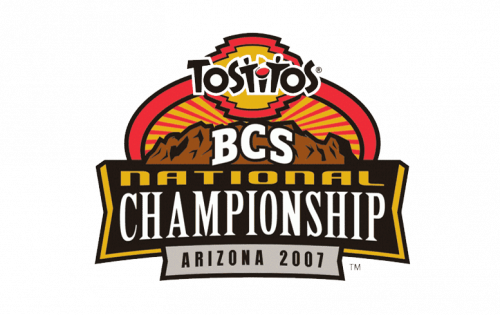
The badge beneath this heading reads “Arizona 2007” and carries the Tostitos name, yellow and red rays, a dark central banner and mountain shapes. That artwork corresponds to the 2007 Glendale game, not the 2008 New Orleans game, which had Allstate as its title sponsor. The heading is retained, but the date visible in the badge distinguishes the earlier edition (Sports Reference).
2009
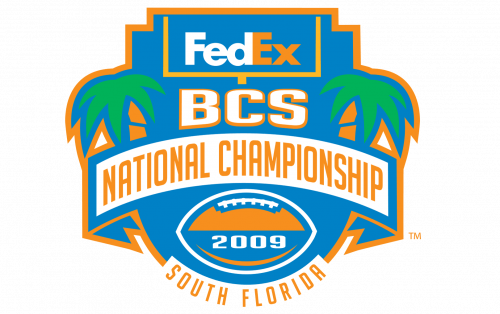
The 2009 badge uses a bright blue field edged in orange. FedEx appears in a framed panel above the championship wording; palm graphics flank the center, and a football carries the year. “South Florida” curves along the bottom. FedEx was the title sponsor for the Miami Gardens game (Sports Reference).
2010
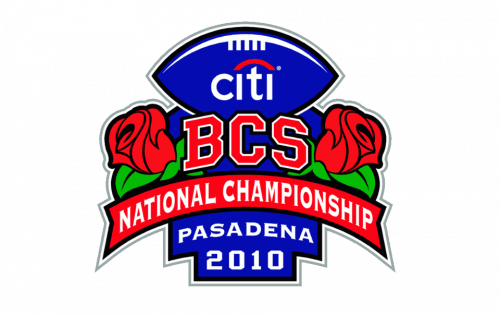
In 2010, the palette shifts to blue, red and white. The Citi mark sits on a football shape above the BCS letters, with red roses on either side. A red “National Championship” ribbon crosses the crest, and “Pasadena 2010” appears below. Citi sponsored the Pasadena game that year (Sports Reference).
2011
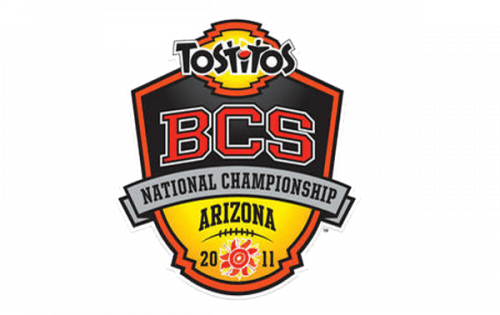
The 2011 crest returns to Tostitos and Arizona. A dark gray upper field frames large red BCS letters; the yellow lower section contains “Arizona” and the year, with a sun-like graphic between the year’s digits. The Glendale game again carried Tostitos sponsorship (Sports Reference).
2012
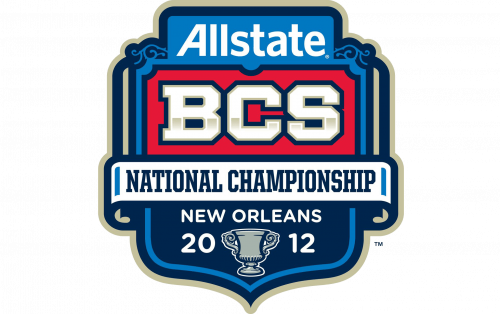
Blue becomes the dominant color in the 2012 badge. The Allstate wordmark tops a red panel containing BCS, while a silver cup sits near the base above “New Orleans” and the year. Allstate sponsored the New Orleans game (Sports Reference).
2013
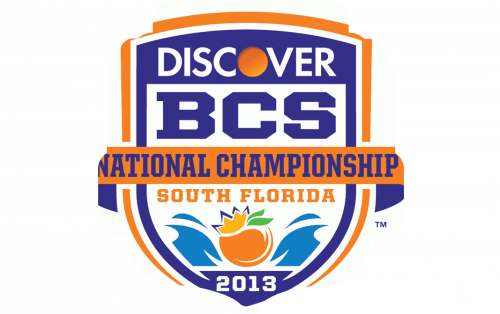
The 2013 design places Discover above BCS in a white, blue and orange crest. A broad championship banner crosses the middle; “South Florida” and the year sit below, over blue wave shapes and an orange graphic. Discover was the title sponsor for the Miami Gardens game (Sports Reference).
2014
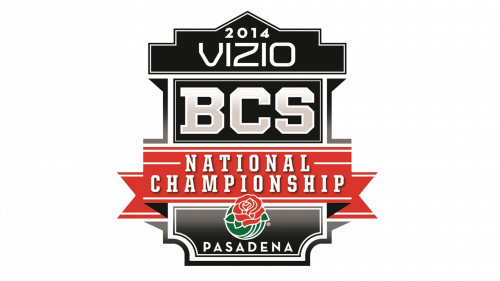
The final BCS badge is a black, white and red design for the Pasadena game. “2014” sits above the Vizio name, with large BCS lettering, a red “National Championship” ribbon and a rose graphic below. The game was named the 2014 Vizio BCS National Championship; Sports Business Journal reported that Vizio’s Rose Bowl presenting deal also included a new logo for Rose Bowl and BCS-related materials (Sports Business Journal). The 2014 game was the last BCS championship; the College Football Playoff succeeded the BCS for the 2014 season (CNN).
Changing sponsors, colors and crests
Across the stages, the abbreviation remains the visual anchor, but the badges do not follow one fixed template. BCS appears in different sizes and treatments, surrounded by sponsor names, championship wording and host-location details. The palette ranges from the yellow and red of the Arizona badge to the blue and orange of 2009, the blue and red of Pasadena and New Orleans, and the black and red of 2014.
Illustrations change with the compositions: the sequence includes palms, roses, a sun-like motif, a cup, waves and a rose. These are visible features of individual badges; the documented pattern is the recurring combination of sponsor and host location, not a single uniform design system. The run ended with the 2014 Vizio badge, alongside the end of the BCS championship era.
Disclaimer
This article is part of the educational resources provided by Logo Index, an independent archive covering logos, visual identities and graphic design history. BCS Championship Game and associated trademarks and brand assets remain the property of their respective rights holders where applicable.