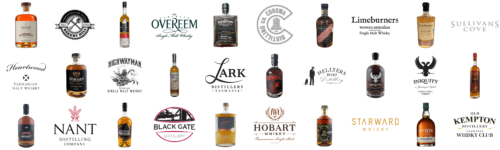
 Australian Whisky Brand Logos
Australia’s modern whisky industry developed through several distinct regional stories rather than one national style. Tasmania became especially important through producers such as Lark, Sullivans Cove and Hellyers Road, while Starward built a Melbourne identity around Australian wine barrels, Limeburners established single malt production in Western Australia, and Corowa converted a historic flour mill in New South Wales into a working distillery.
The logos shown here should therefore be understood through those individual histories. Generic ideas such as “premium typography,” “Australian terroir” or “innovation through design” do not explain why the brands look different or how their identities developed.
Major Australian Whisky Brands
Sullivans Cove
Sullivans Cove began producing whisky in Tasmania in 1994 and has maintained a strong focus on long maturation and single-cask releases. [1]
The brand became internationally significant in 2014 when a French Oak ex-tawny cask won World’s Best Single Malt at the World Whiskies Awards. Sullivans Cove says it was the first distillery outside Scotland and Japan to win that title. [2]
Further World’s Best Single Cask Single Malt awards followed in 2018, 2019 and 2026. This award history is a more meaningful part of the brand’s identity than vague claims that the logo itself symbolizes Tasmanian authenticity or premium quality.
Lark
Lark is one of the foundational names of modern Australian whisky. Bill Lark began considering Tasmanian single malt production after a fishing trip in 1989, but the legal environment initially prevented the kind of small-scale distillery he wanted to establish. [3]
Bill and Lyn Lark successfully challenged distilling restrictions that had effectively limited the Tasmanian industry since 1839. Lark Distillery was subsequently established in 1992 and became an important catalyst for the island’s modern whisky revival. [4]
Current production emphasizes Tasmanian ingredients, including barley from Devonport, local peat and applewood-smoked water. The Lark name itself comes from the founding family rather than from an invented whisky concept.
Starward
David Vitale founded Starward in Melbourne in 2007 with the goal of creating a distinctly Australian whisky rather than reproducing a Scottish model. [5]
The company’s best-known production choice is extensive maturation in Australian red-wine barrels. Starward sources ingredients and casks largely from within a day’s drive of its Port Melbourne distillery. [6]
The producer also deliberately emphasizes Melbourne’s changing temperatures. Starward says the frequent expansion and contraction of its barrels influences maturation and is central to its house style.
The Starward wordmark and star-related identity should therefore be understood within a deliberately modern Melbourne brand rather than treated generically as a logo representing experimentation.
Heartwood
Heartwood is an important exception on this list because it is not a conventional distillery. Tim Duckett operates Heartwood as an independent whisky bottler and maturation business in Tasmania.
Heartwood purchases new make and whisky from other producers, selects specific casks and manages maturation in its own bond store south of Hobart. The company works with numerous cask types including sherry, Port, bourbon, Muscat, Tokay and PX. [7]
This model makes Heartwood closer to the independent bottling tradition known from Scotland than to a vertically integrated whisky distillery. Its identity is therefore built around cask selection and maturation rather than a proprietary still house or geographic distillery site.
Hellyers Road
Hellyers Road developed from a very different Tasmanian industry. A group of family-owned dairy farms formed a cooperative in northwest Tasmania in 1956. In 1997, the business diversified by establishing a whisky distillery. [8]
The name comes from the historic Hellyers Road, which ran from Tasmania’s Bass Strait coast toward the mountainous interior.
The distillery describes itself as Australia’s oldest continuously operating whisky distillery. Whether that description is interpreted narrowly depends on how historical closures and ownership changes at other Australian operations are counted, but the 1997 establishment date is well documented.
The name’s direct connection with an actual local road provides more useful identity context than interpreting the logo as a metaphorical “journey of whisky discovery.”
Limeburners
Limeburners is produced by Great Southern Distilling Company in Albany, Western Australia. Founder Cameron Syme established the company during the 2000s after years of researching whisky production, and Limeburners was first distilled in 2005. [9]
The distillery operates beside Princess Royal Harbour and uses barley from Western Australia’s Great Southern region and water from limestone aquifers beneath Albany. Peated releases use locally collected peat from the Walpole area. [10]
The Albany cellar door opened in 2007, and all current Limeburners single malt continues to be made at the site. [11]
Bakery Hill
Bakery Hill was founded in Melbourne in 1999 by former chemistry teacher David Baker. Baker has said that part of his motivation was to challenge the idea that world-class single malt whisky depended on uniquely Scottish air or water. [12]
The brand name was inspired by Bakery Hill and the Eureka Stockade, linking the identity with a specific episode in Victorian history. [13]
Bakery Hill has remained family-owned and focuses on single malt rather than building a large multi-spirit portfolio. Its own description emphasizes longer maturation and bottling casks individually rather than blending them simply to maintain a fixed release schedule.
Corowa Distilling Co.

Corowa Distilling Co. occupies a restored 1920s flour mill beside the Murray River in Corowa, New South Wales. The building had closed as a mill in 1970 and remained derelict for decades. [14]
The founders approached the local council with a proposal to convert the property into a whisky distillery. The council ultimately sold the building to them for A$1 on the condition that it be restored and brought back into productive use. [15]
Corowa produced its first whisky in 2018. The company also emphasizes local agricultural inputs, including grain from nearby farmers and Murray River water. [16]
The Corowa name and historic mill therefore provide a concrete local identity without requiring generic claims that the logo itself represents authenticity.
Black Gate
Black Gate Distillery is a small producer in Mendooran in central western New South Wales. The husband-and-wife operation was established in 2009 and produces both Australian single malt whisky and dark rum. [17]
The distillery uses small direct-fired copper pot stills and produces only relatively limited annual volumes. Black Gate describes its production style as traditional and deliberately small-scale.
The logo itself uses a stylized gate motif above the BLACK GATE name, providing a direct visual interpretation of the brand name. No additional symbolic meaning needs to be assigned to it.
Why Tasmania Matters to Australian Whisky
Tasmania became the most influential center of Australia’s modern whisky revival largely because of the work of early producers such as Lark and the wave of distilleries that followed.
Bill and Lyn Lark’s challenge to restrictive distillation laws created new opportunities for small producers during the early 1990s. Sullivans Cove began production in 1994, while Hellyers Road followed in 1997. [3]
International attention increased dramatically after Sullivans Cove won World’s Best Single Malt in 2014. That result demonstrated that Australian single malt could compete internationally rather than simply exist as a local curiosity. [2]
Australian Wine Casks and Whisky
Australia’s wine industry has also influenced whisky maturation, but not every producer uses wine barrels in the same way.
Starward makes the connection especially central to its identity by sourcing Australian red-wine casks and using them as a defining component of its core whisky style. [6]
Sullivans Cove has achieved some of its most famous results with ex-tawny casks, including the French Oak cask that won World’s Best Single Malt in 2014. Heartwood works with an even wider range of wine and fortified-wine casks through its independent maturation model.
Wine-cask use is therefore significant in Australian whisky, but it should be documented producer by producer rather than treated as a universal national characteristic.
What Australian Whisky Identities Actually Have in Common
- Many have direct geographic identities: Corowa takes its name from its New South Wales town, while Hellyers Road references a real Tasmanian route.
- Modern history matters more than invented heritage: Lark dates to 1992, Sullivans Cove to 1994 and Bakery Hill to 1999.
- Production models vary: Heartwood is an independent bottler, while Starward, Black Gate and Corowa operate their own distilleries.
- Wine casks are important but not universal: Starward deliberately centers Australian wine barrels, while other producers use bourbon, fortified wine and multiple cask types.
- Regional climates differ dramatically: Tasmania, Melbourne, Albany and inland New South Wales cannot accurately be described as one Australian maturation climate.
Why Generic Australian Whisky Logo Symbolism Falls Short
Bold typography does not prove innovation, a premium bottle does not automatically represent craftsmanship, and references to landscape do not establish terroir unless the producer actually connects its identity with that place.
The documented stories are stronger. Lark helped reopen Tasmania to small-scale whisky production. Sullivans Cove changed international perceptions with its 2014 award. Starward built a Melbourne-specific model around Australian wine barrels. Bakery Hill was named for a historic Victorian location, Corowa occupies a flour mill purchased for one dollar, and Black Gate uses a literal gate as part of its identity.
Those details make the brands distinct without repeating the same generic design language.