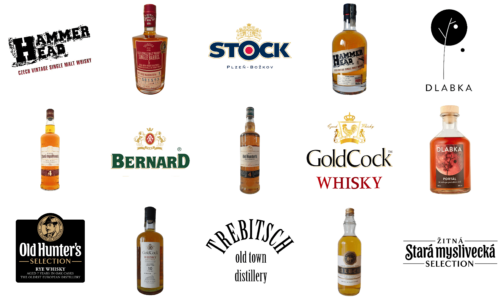
 Czech Whisky Brand Logos
Czech whisky is a relatively small category, but its history is more complicated than it first appears. Gold Cock traces its roots to socialist-era production in Moravia, Hammer Head came from whisky distilled at Prádlo in 1989, Trebitsch represented a newer wave of Czech single malt, and Stará Myslivecká has developed a rye-whisky identity under the English name Old Hunter’s Rye.
Not every name commonly included in lists of Czech whiskies is actually a separate whisky brand. Stock Plzeň is a spirits producer rather than a whisky label, Stará Myslivecká and Old Hunter’s refer to the same brand family, and Bernard’s official material documents a whisky project rather than the long-established portfolio implied by some older descriptions.
Major Czech Whisky Brands and Identities
Gold Cock
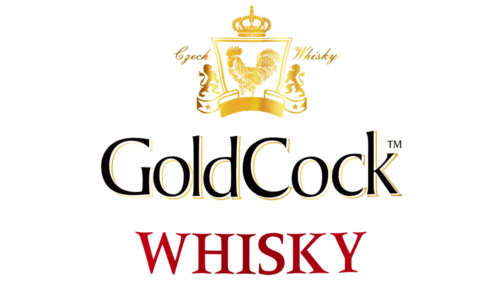
Gold Cock has one of the strongest documented histories among Czech whisky brands. Its roots go back to the early 1970s at the Těšetice plant near Olomouc. Preparations for whisky production began in 1972, with the first distillation following in December 1973. [1]
An earlier whisky was sold as King Barley, but in 1978 the producers developed a version suitable for export to the Soviet Union and named it Gold Cock. The original label featured a rooster constructed from golden ears of grain. Gold Cock explicitly says the image represented the fertility of the Haná region, where the barley used for production originated. [1]
Production at Těšetice eventually declined, and the last whisky there was distilled in 2002. Rudolf Jelínek later acquired the Gold Cock trademark, part of the equipment and remaining whisky stocks. Whisky production resumed at Vizovice, with the first new distillation there taking place in 2008. [1]
The modern producer continues to emphasize Czech ingredients. Gold Cock says its whisky uses Czech barley and that much of its maturation takes place in barrels produced by Moravian coopers. Its 10-year single malt is bottled at 49.2% ABV, referencing the latitude that passes through Vizovice. [2]
Trebitsch
Trebitsch emerged as a modern Czech whisky producer associated with Třebíč and marketed products including Czech single malt whisky. The identity uses an English-language whisky presentation alongside a name derived from the historical German form of Třebíč.
Unlike Gold Cock, reliable current primary material documenting the detailed origin or official symbolism of the Trebitsch logo is limited. The mark should therefore be described as a name-based whisky identity rather than assigned generic concepts such as craftsmanship, heritage or luxury.
The brand’s recent corporate history has also been unstable. Current business listings still identify TREBITSCH old town distillery in Třebíč as a Czech whisky producer, while specialist retailer material reports that the company entered insolvency in 2024 and that later production continued under a different identity. Because the available sources do not provide a clear current primary-source chronology, claims about Trebitsch’s present status should be treated cautiously.
Hammer Head
Hammer Head is an important historical Czech whisky rather than a current expanding brand. The whisky was distilled at the Prádlo distillery in western Bohemia, with its first distillation taking place in 1989. [3]
Some stocks remained in barrels for decades. Releases included 23, 25 and 28-year-old expressions, allowing whisky distilled around the end of the communist period to reach the market much later. [4]
Hammer Head production has since ended. Specialist material associated with the distillery states that the brand was discontinued in favor of whisky carrying the Prádlo name, connecting new releases more directly with the distillery and village where the spirit is produced. [5]
The Hammer Head logo therefore belongs to a specific historical chapter of Czech whisky rather than representing a contemporary experimental whisky producer, as the previous article suggested.
Stará Myslivecká
Stará Myslivecká is produced by Palírna U Zeleného stromu, a Czech distilling company that traces its production heritage in Prostějov back several centuries.
Its current range includes rye-based expressions marketed internationally as Old Hunter’s Rye. The producer’s English-language website presents products including Old Hunter’s Rye Single Barrel, Reserve, Selection and Bourbon Cask. [6]
This creates an important naming distinction. Stará Myslivecká and Old Hunter’s should not be treated as two unrelated Czech whisky brands. Old Hunter’s Rye is the international identity used for products within the Stará Myslivecká brand family.
The supplied Stará Myslivecká logo should therefore be understood within that wider bilingual identity rather than through broad claims that its typography automatically symbolizes centuries of tradition.
Stock Plzeň
Stock Plzeň is not itself a Czech whisky brand. It is one of the country’s major spirits producers, with a history connected to the wider Stock spirits business that originated in Trieste during the late 19th century. [7]
The Plzeň operation produces a broad portfolio of spirits, most famously including Fernet Stock. Its relevance to Czech whisky comes partly through the Prádlo distillery, which is associated with Stock and produced Hammer Head. [8]
The logo shown above is therefore a corporate identity, not a whisky product logo. It should be included as producer context rather than counted as another Czech whisky brand.
Old Hunter’s
Old Hunter’s is the international English-language identity connected with Stará Myslivecká and Palírna U Zeleného stromu.
The producer currently markets several products explicitly as Old Hunter’s Rye, including Single Barrel, Selection, Reserve and Bourbon Cask expressions. [6]
For an international audience, Old Hunter’s is useful to discuss because it demonstrates how a long-established Czech spirits name can be adapted for export. It should not, however, be counted separately from Stará Myslivecká when calculating the number of independent Czech whisky brands.
Bernard
Bernard requires another important category correction. Bernard is primarily a Czech family brewery, not an established whisky company. Its official website continues to present beer as the core business. [9]
The brewery did begin a genuine whisky project in 2022. Bernard prepared an un-hopped malt wash from barley malt produced by its own malt house and had it distilled at Zámecké sady Chrámce. Most of the spirit was placed into three 190-liter American oak barrels that had previously held bourbon. Bernard said the eventual product would be a single malt whisky. [10]
In October 2023, Bernard sold 460 small bottles of the still-unaged spirit as “new make.” The brewery explicitly called it a preview of its future Whisky Bernard and noted that whisky must mature for at least three years before receiving the name. [11]
Current Bernard material also promotes beer spirits and barrel-aged beer distillates. No current official source located for this article clearly establishes a regular released Bernard whisky portfolio, so describing Bernard as one of the country’s established whisky brands would go beyond the available evidence.
What Czech Whisky History Actually Looks Like
Czech whisky does not follow one continuous national tradition. Several quite different stories overlap.
- Gold Cock: production began in socialist Czechoslovakia during the 1970s and was later revived by Rudolf Jelínek.
- Hammer Head: derived from spirit distilled at Prádlo in 1989 and later released after very long maturation.
- Stará Myslivecká and Old Hunter’s: represent a Czech rye-whisky identity built within a much older distilling company.
- Trebitsch: belongs to the newer generation of Czech whisky projects and has experienced a more turbulent recent business history.
- Bernard: is primarily a brewery that entered whisky production experimentally in the 2020s.
This variety is more informative than treating all Czech whisky companies as examples of the same emerging national style.
Local Ingredients and Czech Identity
Some Czech producers do deliberately emphasize domestic materials, but this should be documented brand by brand.
Gold Cock is the clearest example. The producer says its current whisky uses Czech ingredients, including domestic barley, and maturation includes barrels made from Czech or Moravian oak. The original Gold Cock rooster itself was created from ears of grain to reference the fertile Haná agricultural region. [2]
Bernard also uses malt from its own malt house for its whisky project. However, the broad claim that Czech whisky as a category is defined by beer barrels or by one shared production method is not supported by the individual histories.
Why Generic Czech Whisky Logo Symbolism Is Misleading
Gold does not automatically represent whisky, traditional lettering does not prove centuries of brand heritage, and an aggressive-looking logo does not indicate a stronger-tasting spirit.
The actual stories provide more useful identity information. Gold Cock’s rooster has a documented agricultural meaning. Hammer Head belongs to a specific 1989 distillation story. Old Hunter’s is an English adaptation of Stará Myslivecká, while Stock Plzeň is a producer rather than another whisky label.
These distinctions make the brands more interesting without assigning the same generic ideas about craftsmanship, innovation and authenticity to every logo.