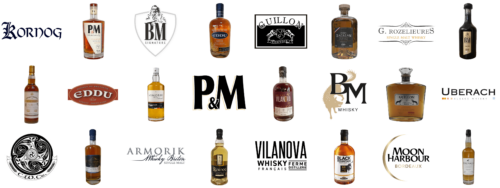
 French Whisky Brand Logos
French whisky does not come from a single historic center or follow one visual formula. Producers have emerged in Brittany, Lorraine, Champagne, Bordeaux, Corsica and Alsace, often building their identities around specific places, ingredients or distilling histories.
Armorik grew from one of the earliest modern French whisky projects, Eddu was created around Breton buckwheat, Rozelieures developed an unusually integrated farm-to-bottle operation in Lorraine, and Moon Harbour deliberately connects its whisky with Bordeaux’s wine culture. These documented stories explain the brands more accurately than generic claims that serif lettering represents craftsmanship or gold automatically communicates premium quality.
Major French Whisky Brands
Armorik
Armorik is produced by Distillerie Warenghem in Lannion, Brittany. Léon Warenghem founded the distillery in 1900, initially producing plant-based liqueurs. The company moved into whisky much later under Gilles Leizour. [1]
Warenghem launched WB, a blend of malt and grain whisky, in 1987. In 1993 it built what it describes as the first French distillery devoted specifically to whisky production. Armorik followed in 1998 and is identified by Warenghem as the first single malt from both Brittany and France. [1]
The brand also has documented Breton connections beyond its name. Armorik uses water from the Rest Avel spring beneath the distillery, French and Breton cereals, and some expressions mature in Breton oak. The company participated in the creation of the Whisky Breton geographical indication in 2015. [2]
No authoritative source located for this article assigns a specific symbolic meaning to the construction of the Armorik wordmark itself.
Kornog
Kornog is a peated single malt associated with the Celtic Whisky Distillery at Pleubian on the northern coast of Brittany. The operation was created by Martine and Jean Donnay and developed from the Celtic Whisky Compagnie founded in the late 1990s.
The distillery’s unpeated single malt became known as Glann ar Mor, while its peated whisky was launched under the Kornog name. “Kornog” means “west wind” in Breton, while “Glann ar Mor” refers to the edge of the sea. [3]
This provides a genuine linguistic and geographic identity. The name connects the whisky with Brittany more directly than speculative interpretations of the logo’s typography or landscape imagery.
G. Rozelieures
Rozelieures is produced in the small Lorraine village of the same name by the Grallet-Dupic family. The family traces its agricultural history to 1860 and its distilling activity to the late 19th century. [4]
The modern whisky project emerged much later. The family’s first G. Rozelieures single malt was commercially released in 2007 and is described by the producer as the first whisky produced in Lorraine. [5]
Rozelieures is especially unusual because the company controls almost the complete production chain itself. It grows its own barley, operates its own maltings, performs fermentation and distillation on the estate, matures the whisky in several warehouses and bottles it at the distillery. [6]
The Rozelieures name therefore has a literal geographic origin rather than functioning as an invented luxury brand name.
Eddu
Eddu is produced by Distillerie des Menhirs in Plomelin, Brittany. Its defining feature is not simply unusual branding but an unusual raw material: buckwheat.
Founder Guy Le Lay developed the project with specialists in malting, fermentation and distillation. The company explains that “Eddu” means “buckwheat” in Breton. [7]
Eddu Silver was launched in 2002 as what the distillery describes as the world’s first pure buckwheat whisky. It is produced entirely from buckwheat and matured in French ex-Cognac barrels. [8]
The Eddu name consequently contains a documented product and regional connection. There is no need to describe the logo generically as a symbol of innovation when the name itself explains what makes the whisky unusual.
Guillon
Distillerie Guillon is based at Louvois in the Montagne de Reims area of Champagne. Thierry Guillon established the project in 1997 with the goal of producing a French malt spirit in a region better known internationally for wine. [9]
The distillery sits within a forested area of the Montagne de Reims Regional Natural Park. In 2026, ownership changed when Raphaël Mantel acquired the company. [9]
Guillon’s identity therefore has a genuine connection with Champagne geography, but descriptions such as “luxury,” “sophistication” or “refinement” should not be attributed to the logo unless the producer documents those meanings.
Moon Harbour
Moon Harbour is a Bordeaux whisky producer whose identity is directly connected with the city. Its name refers to Bordeaux’s historic nickname, the Port de la Lune, or Port of the Moon, created by the crescent shape of the Garonne river through the city.
The project was launched during the 2010s by Jean-Philippe Ballanger and Yves Medina. The distillery operates beside Bordeaux’s former submarine base and uses a Second World War bunker as a maturation cellar. [10]
Moon Harbour also makes deliberate use of the surrounding wine region. Its Signature single malt is produced in Bordeaux and matured in Bordeaux wine barrels, while expressions such as Dock 3 use barrels from Château La Louvière. [11]
The Moon Harbour name therefore provides a documented Bordeaux reference rather than merely suggesting a vaguely maritime whisky identity.
P&M
P&M is produced in Corsica and represents one of the earliest whisky projects from the Mediterranean island. The Fédération du Whisky de France traces production to 1999 at Domaine Mavela, now associated with the L.N. Mattei distillery. [12]
The producer uses the island’s water, climate and wine industry as parts of the maturation story. P&M whisky has been aged in barrels previously used for Corsican wines, giving the whisky a direct production connection with another major part of the island’s agricultural culture. [12]
The P&M initials form the central visual identity, but no authoritative source located for this article provides a documented symbolic interpretation for their specific graphic treatment.
Uberach
Uberach whisky comes from Distillerie Bertrand in Alsace, a distilling house that traces its history to 1874. The name comes from the village of Uberach, now part of Val-de-Moder. [13]
The distillery produces Uberach Single Malt alongside its St Wendelin range. Its whisky production connects closely with Alsatian materials and wine culture. For example, St Wendelin expressions have been matured in barrels previously used for Pinot Gris and other Alsace wines. [14]
The company itself notes that Uberach means “beyond the water,” providing a more useful name origin than assigning generic ideas of artisanal quality to the logo.
Celtique Connexion
Celtique Connexion requires an important qualification. It is historically associated with the Celtic Whisky Compagnie created by Jean and Martine Donnay before their own Breton distillery became fully operational.
The early Celtique Connexion whiskies were not completely distilled in France. They were single malts distilled and initially matured in Scotland before being transferred to Brittany for additional maturation in wine casks. The company became particularly associated with secondary maturation in casks that had contained wines such as Sauternes.
For that reason, Celtique Connexion belongs in the history of the French whisky industry but should not be described in exactly the same way as Armorik, Eddu or Rozelieures, whose spirits are actually distilled in France.
What French Whisky Brands Actually Have in Common
The strongest connection among these producers is geographic specificity rather than one common logo style.
- Brittany: Armorik, Kornog and Eddu all use Breton language, geography or ingredients as meaningful parts of their identities.
- Lorraine: Rozelieures takes its name directly from the village where the family grows barley and distills its whisky.
- Bordeaux: Moon Harbour references Bordeaux’s Port of the Moon identity and matures whisky in local wine barrels.
- Corsica: P&M connects its production with the island’s Mediterranean conditions and wine casks.
- Alsace: Uberach and Distillerie Bertrand make use of the region’s wine-barrel culture in whisky maturation.
These regional connections are documented production and naming details. They are more useful than assuming every traditional-looking typeface represents heritage or every landscape motif represents terroir.
French Wine Casks and Whisky
France’s wine and spirits industries give whisky producers access to an unusually broad range of maturation casks, but not every French whisky follows the same method.
Rozelieures has used barrels associated with Burgundy, Sauternes, Cognac, Armagnac, Porto, Banyuls and other wines and spirits. [5] Moon Harbour deliberately matures whisky in Bordeaux wine barrels. [11] Distillerie Bertrand has used Alsace wine barrels, while Armorik combines bourbon, sherry and even locally sourced Breton oak depending on the expression.
Wine-cask maturation is therefore an important part of French whisky production, but it is a producer-specific practice rather than a universal definition of French whisky.
Why Generic French Whisky Logo Symbolism Falls Short
A serif typeface does not automatically represent craftsmanship, gold does not necessarily symbolize whisky quality, and a regional name does not prove that every visual element of a logo was designed around terroir.
There are stronger stories available. Armorik was France’s first commercial single malt. Kornog means west wind in Breton. Eddu means buckwheat and identifies the grain that made the brand unusual. Rozelieures is literally the Lorraine village where the whisky is produced. Moon Harbour references Bordeaux’s Port of the Moon, while Uberach is the name of the Alsatian village associated with its distillery.
Those documented details make each identity distinct without inventing symbolism.