 Velorex Logo PNG
Velorex Logo Meaning and History
 The story behind the Velorex identity begins before the name itself existed. The Stránský brothers built an experimental three-wheeled vehicle during the Second World War and continued developing the concept afterward. By 1950, their workshop had been incorporated into the VELO production cooperative, and production later moved to Solnice. [2]The early machines were called Oskar. In 1954, a substantially revised model appeared under the name Velorex Oskar 54, marking one of the earliest documented uses of Velorex as the vehicle’s brand name. Contemporary historical material from the Velorex community notes that “Velorex” was understood as deriving from Latin roots meaning approximately “king of wheels”. [3]By 1956, the Oskar name had been dropped from the main model designation and the vehicle was marketed as the Velorex 16/250. Later versions included the 16/175 and 16/350. Production of the famous three-wheelers ended in November 1971, followed by the four-wheeled 435-0, whose production ended in 1973. In total, historical production records list approximately 16,680 vehicles across the major models. [2]
1950–1954: The Early Oskar Identity
 The first logo shown in the surviving identity sequence is a simple typographic treatment using rounded lettering. Its construction is considerably more restrained than the later script mark, relying almost entirely on the name rather than a separate automotive emblem.The original article assigned meanings such as trust, dependability, professionalism and speed to the blue color and rounded letters. There is no reliable historical evidence that the Stránský brothers or the production cooperative officially attached those meanings to the design. It is therefore more accurate to describe the logo visually instead of treating generic color psychology as documented symbolism.This period also overlaps with the transition from the original Oskar identity toward Velorex. In 1954, the redesigned vehicle became the Velorex Oskar 54. That same year was marked by the death of František Stránský following injuries from a testing accident. Mojmír later left the cooperative, while production continued without the founders. [1] [3]
1954–1973: The Script Velorex Wordmark
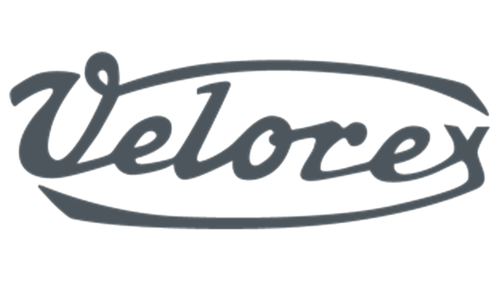
 The later Velorex identity uses a much more distinctive script wordmark. The name is drawn as a continuous, flowing signature-like form, beginning with an enlarged capital “V” and extending into connected lowercase characters. A long stroke beneath the lettering visually finishes the composition.Compared with the earlier mark, this version gives Velorex a more individual visual signature. It does not rely on an additional shield, mascot or mechanical symbol. Instead, the lettering itself becomes the identifying graphic element.No reliable source identified for this article names the designer of either historical Velorex logo or identifies a commercial typeface. The lettering should therefore be treated as a historical wordmark rather than attributed to a particular font or designer without documentary evidence.
What Does the Name Velorex Mean?
The name is one of the more interesting aspects of the brand’s identity. Historical documentation from the Czech Velorex community records the appearance of the Velorex name in 1954 and describes it as deriving from Latin, with the sense of “king of wheels.” [3]That explanation is much more useful than trying to derive symbolic meaning from the logo’s colors or letter shapes. The name itself directly connects the identity to wheeled transport and was introduced as the original Oskar project matured into a larger production program.From Oskar to Velorex
The shift from Oskar to Velorex was tied to the vehicle’s development rather than simply a cosmetic logo redesign. The brothers’ early machines carried the Oskar name, while the redesigned 1954 model became Velorex Oskar 54. After the move to smaller 16-inch wheels, the model became the Velorex Oskar 16 and then, from 1956, the Velorex 16/250. [3]The marque went on to become closely associated with its fabric-bodied three-wheelers. Historical records list around 12,000 examples of the Velorex 16/350 alone, making it by far the most numerous version. [2]The Three-Wheeler Behind the Logo
Velorex’s unusual construction is a major reason the brand remains recognizable today. The classic vehicles used a tubular frame covered with artificial leather rather than conventional steel body panels. The design created an exceptionally lightweight machine and helped make the vehicle suitable for relatively small motorcycle engines.The Czech Municipal Museum in Česká Třebová preserves the history of the marque and displays an almost complete development sequence, including early prototypes, the Velorex 16/250, 16/175, 16/350 and the later four-wheeled 435-0. [1]Why the Velorex Identity Endured
The Velorex logo is relatively simple compared with the elaborate badges used by many European car manufacturers of the same era. Its strongest identifying feature is the unusual brand name itself, reinforced in later years by the flowing script wordmark.Its continued recognition today is also closely tied to the unmistakable vehicle carrying it. Velorex clubs and enthusiast communities remain active decades after production ended, while preserved cars, museums and historical gatherings have kept both the vehicle and its name visible within Czech motoring culture. [4]FAQ
What does Velorex mean?
Historical Velorex material describes the name as deriving from Latin with the approximate meaning “king of wheels.” The name began appearing on the vehicles in 1954. [3]
Who created Velorex?
Velorex developed from the work of Czech brothers František and Mojmír Stránský, who began experimenting with small three-wheeled vehicles during the 1940s. [1]
Was Velorex originally called Oskar?
Yes. The early vehicles were known as Oskar. The Velorex name appeared with the Velorex Oskar 54 in 1954, and by 1956 the principal model was marketed as Velorex 16/250. [3]
When did Velorex stop making three-wheelers?
Production of the three-wheeled Velorex ended in November 1971. The later four-wheeled 435-0 remained in production until 1973. [2]
Who designed the Velorex logo?
No reliable historical source identified for this article names the designer responsible for the Velorex wordmarks.
Disclaimer
This article is part of the educational resources provided by Logo Index, an independent archive covering logos, visual identities and graphic design history. Velorex and associated historical trademarks and brand assets remain the property of their respective rights holders where applicable.