 Wanderer Werke AG Logo PNG
Wanderer Logo Meaning and History
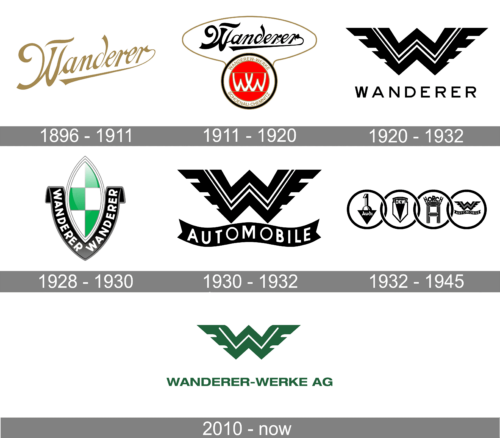 Wanderer began as a bicycle repair business in Chemnitz in 1885 and soon started manufacturing bicycles under the Wanderer name. The company became Wanderer-Fahrradwerke AG in 1896, produced its first motorcycle in 1902 and entered automobile production in 1913. [1]Across those different products, Wanderer used several identities rather than one unchanged logo. Early marks relied on ornate script lettering, while later automotive badges increasingly used the distinctive double-W monogram that became closely associated with the marque.
1896 to 1911
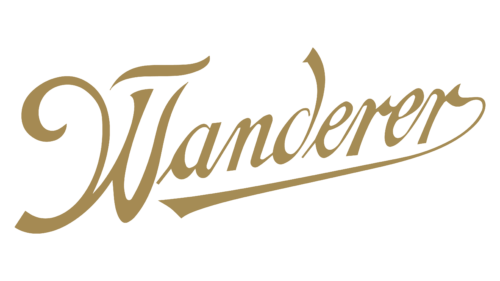 The early identity used the Wanderer name in flowing script lettering. Its large initial W and connected letterforms gave the mark a handwritten appearance, reflecting the decorative branding style common around the turn of the twentieth century.No reliable primary source located for this article assigns symbolic meaning to the gold treatment shown in surviving reproductions, so it is better understood as a visual finish rather than evidence of concepts such as luxury or tradition.
1911 to 1920
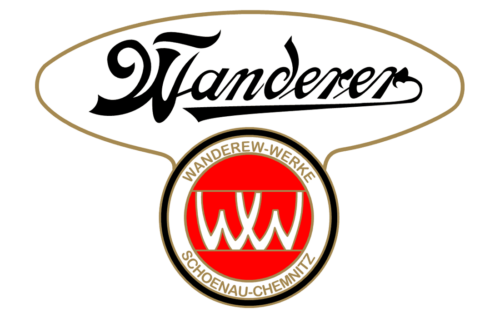 Later versions combined the Wanderer script with a circular company badge and the wording Wanderer-Werke Schönau-Chemnitz. The emblem introduced a double-W monogram, giving the company a compact symbol that could be used independently of the full script name.
1920 to 1932
 By the 1920s, the double-W motif had become much more geometric. Two angular W forms were combined into a symmetrical emblem above the WANDERER wordmark.The double-W is the clearest identifiable feature of Wanderer’s automotive identity. Although its pointed construction can visually suggest chevrons or movement, no authoritative source located for this article documents speed or progress as its official meaning.
1928 to 1930
 Wanderer also used shield-shaped badges during the late 1920s, including versions with patterned fields and the company name placed around the emblem. These badges coexisted with other Wanderer marks rather than representing a simple, strictly linear corporate redesign sequence.
1930 to 1932
 The angular double-W appeared prominently on automobile badges around the beginning of the 1930s, sometimes accompanied by an AUTOMOBILE banner. The design clearly identified the automotive arm of a company whose activities still extended beyond cars.
Wanderer and Auto Union
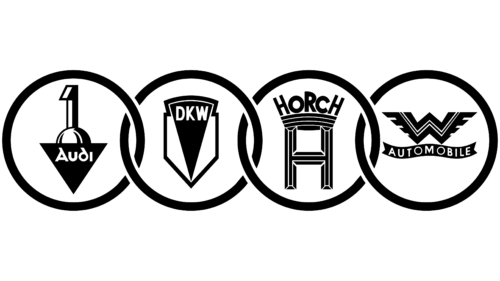 On June 29, 1932, Audi, DKW and Horch were combined to form Auto Union AG, while Auto Union simultaneously concluded a purchase and lease agreement for the automotive division of Wanderer Werke. The four marques became the brands represented by Auto Union’s four interlocking rings. [2]Within Auto Union, Wanderer was positioned mainly in the mid-range passenger-car segment. Audi notes that Wanderer ranked second behind DKW within the group in terms of unit sales and revenue during the late 1930s. [1]This distinction is important: Wanderer Werke did not simply disappear as an entire company in 1932. It was specifically its automobile business that became part of the Auto Union structure.
The End of Wanderer Automobiles
Automobile production under the Wanderer name ended during the Second World War. Audi Tradition records that the last Wanderer automobile was built in 1942 and that no further cars were produced under the Wanderer name after the war. [3]The marque nevertheless remains important to modern Audi history because Wanderer was one of the four companies represented by the Auto Union rings that eventually became the Audi emblem. [4]Modern Wanderer Branding
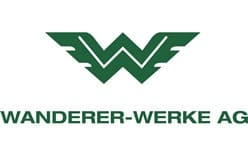
 Later uses of the Wanderer name have appeared outside the historic automobile business, including bicycle-related branding. These should not be treated as a continuation of Wanderer automobile production, which ended in 1942.The modern graphic shown here uses a green W-based emblem with horizontal extensions and a sans-serif WANDERER-WERKE AG wordmark. No reliable historical source located for this article establishes symbolic meanings such as growth, speed or fresh starts for the green color or wing-like forms.
Typography and Design
Wanderer’s visual identity changed considerably over its long industrial history. Early marks used decorative script lettering, while the automotive period increasingly relied on geometric monograms, shields and uppercase lettering.No authoritative source located for this article identifies the exact typefaces or individual designers responsible for these historical marks. The safest description is therefore based on their visible construction rather than speculative font matching.FAQ
What does the Wanderer logo mean?
The best-known Wanderer automotive emblem is built around a double-W monogram representing the Wanderer name. No reliable primary source provides a broader symbolic interpretation for its angular forms.
When was Wanderer founded?
Johann Baptist Winklhofer and Richard Adolf Jaenicke founded the business in Chemnitz in 1885. It initially worked with bicycles and later expanded into motorcycles, automobiles, office machinery and machine tools. [1]
Was Wanderer one of the four Auto Union brands?
Yes. Audi, DKW, Horch and Wanderer formed the four-brand structure of Auto Union in 1932, and the four companies are represented by the four interlocking rings. [2]
When did Wanderer stop making cars?
The final Wanderer automobile was built in 1942. No Wanderer cars were produced after the Second World War. [3]
Disclaimer
This article is part of the educational resources provided by Logo Index, an independent archive covering logos, visual identities and graphic design history. Wanderer, Auto Union, Audi and associated historical trademarks and brand assets remain the property of their respective rights holders where applicable.