 Wartburg Logo PNG
Wartburg Logo Meaning and History
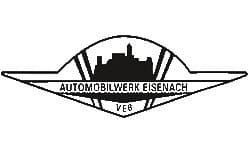
 The Wartburg emblem used by Automobilwerk Eisenach directly referenced the place behind the marque’s name. At the centre of the badge is a stylized silhouette of Wartburg Castle, the historic fortress above Eisenach in Thuringia.Beneath the castle appears the inscription Automobilwerk Eisenach, while versions of the badge also include the abbreviation VEB, identifying the manufacturer as a Volkseigener Betrieb, or state-owned enterprise of the German Democratic Republic.
Why Is It Called Wartburg?
The name has a genuine connection to Eisenach. Fahrzeugfabrik Eisenach presented its first Wartburg motor car on September 17, 1898, only days after signing a licence agreement with French manufacturer Decauville. Wartburg cars were delivered that same year and were even entered in competitions from 1899. [1]That early Wartburg marque did not continue uninterrupted. In 1904, the Eisenach factory switched its vehicles to the Dixi name. The Wartburg name later returned during the East German period, reconnecting the post-war cars with the city’s older automotive tradition. [1]The Castle Emblem
The central image in the badge is best understood as a simplified representation of Wartburg Castle rather than as a generic city skyline. The castle is the historic landmark that gave the automobile marque its name and provides the strongest documented meaning behind the logo.The surrounding geometric structure creates a compact vehicle badge, but there is no reliable primary source assigning symbolic meanings such as flight, aviation, motion or luxury to the pointed side elements. Those interpretations in older descriptions are therefore better avoided.Wartburg Under Automobilwerk Eisenach
After the Second World War, the Eisenach factory became part of East Germany’s state-owned automotive industry. It eventually operated as VEB Automobilwerk Eisenach, commonly abbreviated AWE. Wartburg production began there in the mid-1950s. :contentReference[oaicite:1]{index=1}The Wartburg 311 established the post-war marque, followed by models including the 312 and the long-running Wartburg 353. The Automobile Welt Eisenach museum records the start of 353 series production on July 1, 1966, and the production of the one-millionth 353/353W in October 1985. [1]The End of Wartburg
The final major model was the Wartburg 1.3, introduced in 1988 with a Volkswagen engine. Passenger-car production at Automobilwerk Eisenach ended on April 10, 1991, when the last Wartburg 1.3 left the factory. [1]The badge therefore represents more than a single model line. It links the Wartburg name to Eisenach, the castle above the city and a local automobile-manufacturing tradition that began in the nineteenth century.Typography and Color
The emblem uses compact uppercase lettering for AUTOMOBILWERK EISENACH together with the VEB abbreviation. On physical vehicle badges, the design appeared in metallic, cream, black and other finishes depending on production period and application.No reliable source identified for this article names a specific typeface or credits an individual designer for the emblem. Likewise, there is no documented basis for claims that cream represents luxury or silver represents quality.FAQ
What does the Wartburg logo show?
The emblem depicts a stylized image of Wartburg Castle, the historic fortress overlooking Eisenach. The badge also carries the name Automobilwerk Eisenach and, in some versions, the abbreviation VEB.
Why was the car called Wartburg?
The name came from Wartburg Castle near Eisenach. The first Wartburg motor car was presented in the city in 1898. [1]
Was Wartburg founded in 1898?
The first Wartburg-branded automobile appeared in 1898, but that early marque was replaced by Dixi in 1904. The better-known East German Wartburg brand was revived by Automobilwerk Eisenach in the 1950s.
When did Wartburg production end?
Production ended on April 10, 1991, when the final Wartburg 1.3 was built at Automobilwerk Eisenach. [1]
Disclaimer
This article is part of the educational resources provided by Logo Index, an independent archive covering logos, visual identities and graphic design history. Wartburg, Automobilwerk Eisenach and associated historical trademarks and brand assets remain the property of their respective rights holders where applicable.