 Anker Logo PNG
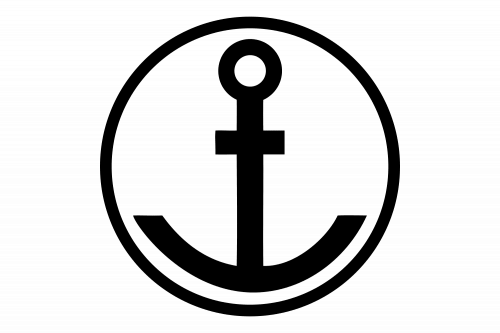
The Anker logo is built around one of the clearest name-to-symbol relationships in German industrial branding. Anker means anchor in German, and the company used an anchor as its trademark long before motorcycles became part of its product range.
The brand belonged to the Bielefeld manufacturer later known as Anker-Werke, whose roots go back to 1876. Historical trademark records show anchor-based marks associated with the company by the 1890s, making the symbol part of a much older identity than the post-war motorcycles for which collectors also know the name. [1]
Anker Logo Meaning and History
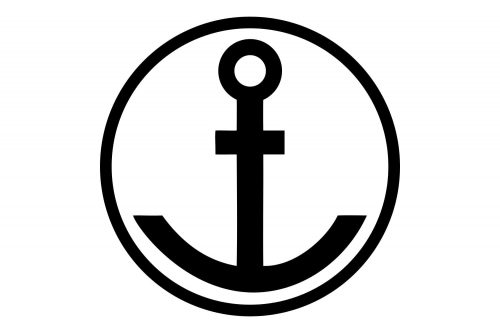
The meaning of the Anker logo is unusually direct: the central anchor visually represents the company name.
Historical trademark documentation records an upright anchor mark registered to the Bielefeld company in 1895. Later registrations also show anchor devices combined with the ANKER name. [2]
This is much stronger evidence than generic interpretations about anchors representing stability, hope or reliability. Those associations may exist in wider symbolism, but the documented reason the anchor belongs in this identity is simpler: it corresponds directly to the Anker name.
When Did the Anker Brand Begin?
The company itself was founded in 1876 in Bielefeld by Carl Schmidt as the Bielefeld Sewing Machine Factory Carl Schmidt. [1]
By 1894, the business had expanded into bicycles, and the Anker name appeared on products such as the Anker-Westfalia I sewing machine. The company later adopted Anker as part of its corporate identity. [3]
Secondary industrial-history sources date the formal Anker-Werke company name to 1906, when the existing Bielefeld business was renamed Anker-Werke AG. [4]
The Anchor Trademark
The anchor became more than an illustration on one product. It developed into the company’s recognizable trademark across different product categories.
A German trademark reference records a plain upright solid anchor registered in 1895 to the Bielefeld company. Other historical registrations show:
- the word ANKER in block lettering;
- an upright linear anchor;
- an anchor with ANKER written across its crosspiece;
- later wordmark variations.
These registrations show that the anchor-name relationship was already established decades before Anker’s post-war motorcycles. [2]
What Does the Circle Around the Anker Logo Mean?
Some versions of the Anker badge place the anchor inside a circular border.
There is no reliable historical evidence located for this article showing that the circle officially represented unity, completeness or a motorcycle wheel. It is better understood as a practical badge frame unless contemporary company documentation proves otherwise.
Circular framing was common on industrial badges because it created a compact unit suitable for metal plates, bicycle head badges, machinery and motorcycle applications.
Anker Logo on Bicycles and Machinery
Anker was not originally a motorcycle marque. The company produced several categories of goods over its long history, including:
- sewing machines;
- bicycles;
- cash registers;
- bookkeeping and office machines;
- motorized bicycles and motorcycles.
Because the same Anker name and anchor trademark could appear across these products, the visual identity was a broader corporate and product mark rather than a motorcycle-only logo. [1]
Anker and Motorcycle Production
Anker’s connection with motorcycles began earlier than the 1949 date commonly repeated in simplified histories.
Historical records list an Anker motor bicycle or motorcycle as early as 1902–1903. The company later built motorized bicycles during the 1930s, including Sachs-powered machines and the Saxonette. [5]
After the Second World War, motorcycle production resumed through the company’s Paderborner Maschinenbau-AG (PAMAG) subsidiary. Models included the Anker 660, 661, 662 and later larger machines. [5]
This means describing Anker as “founded in 1949 as a motorcycle company” is inaccurate. 1949 is relevant to the post-war PAMAG operation, not the beginning of the Anker brand.
The Anker Motorcycle Badge
Motorcycle applications often used the anchor motif in compact metal badges or emblems, sometimes accompanied by the ANKER name.
The logo could appear in monochrome, painted or metallic finishes depending on the vehicle and badge construction. Surviving vintage examples may therefore differ in color and detail.
No surviving brand manual located for this article defines black, blue or gold as fixed motorcycle-logo colors with specific psychological meanings.
Anker Typography
Historical Anker branding used several lettering treatments rather than one unchanging modern typeface.
Trademark references describe ANKER commonly in block lettering, while a cursive version was also registered in 1954. [2]
That makes it inaccurate to describe the identity simply as one clean sans-serif wordmark used throughout its history. Different products and decades used different lettering treatments alongside the anchor symbol.
Anker Logo Colors
Historical Anker badges survive in different combinations including dark lettering, blue finishes, metallic treatments and gold-toned badge materials.
There is not enough evidence to establish a universal official color palette for the historic identity across sewing machines, bicycles, office equipment and motorcycles.
Claims such as black representing strength, blue representing trust or gold representing premium quality should therefore be avoided unless tied to a documented period brand standard.
How Long Was the Anker Logo Used?
The anchor identity had a remarkably long life because it was attached to the broader Anker company rather than one short product line.
The original industrial business continued until 1976, when Anker-Werke entered bankruptcy after struggling with the transition from mechanical to electronic cash-register systems. [1]
The Anker name did not disappear completely. Successor businesses continued using it, and a modern ANKER company in Bielefeld still traces its history back to the original 1876 manufacturer. [3]
Why the Anker Logo Is Historically Interesting
The strongest feature of the Anker identity is not hidden symbolism but literal visual naming.
The company took a simple German noun and paired it with the corresponding object. That gave the business a visual device that could work across sewing machines, bicycles, cash registers and motorcycles without depending on one product category.
For Logo Index, the historically valuable points are therefore:
- the literal relationship between the name Anker and the anchor symbol;
- anchor trademark registrations dating to the 1890s;
- the mark’s use long before post-war motorcycle production;
- its appearance across multiple industrial product categories;
- the absence of evidence for most later color and shape symbolism.