 Austin Logo PNG
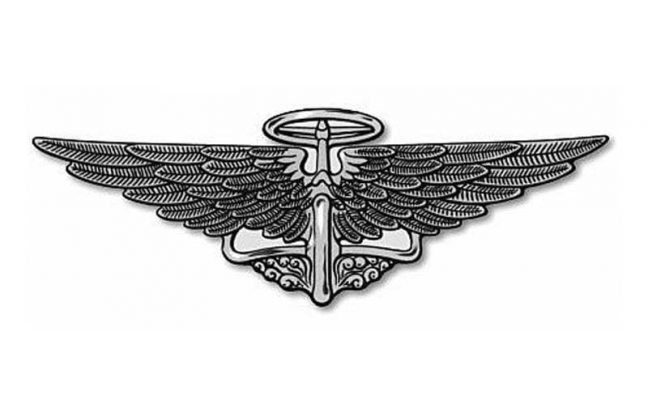
The Austin Motor Company used several different badges during more than eight decades of British car production, but its earliest and most historically significant symbol was the winged wheel created around the company’s foundation in 1905. Historical Austin club material attributes the design to Herbert Austin himself and records that it was intended to express speedy, controlled wheeled motion. The emblem appeared on company documents before becoming a familiar feature of Austin cars. [1]
Austin was founded by Herbert Austin after he left Wolseley in 1905 and established his new automobile company at Longbridge near Birmingham. The Longbridge works became one of Britain’s most important vehicle factories and produced cars under the Austin name for decades before Austin merged with Morris Motors in 1952 to create the British Motor Corporation. [2]
Meaning of the Austin Winged Wheel Logo
The early Austin emblem combines a wheel with a pair of extended wings. Unlike many retrospective interpretations of automotive logos, there is historical evidence explaining this design.
An account published by the Midlands Austin Seven Club states that Herbert Austin designed and drew the Wings and Wheel emblem when his company was registered in 1905. According to that account, Austin wanted the design to represent speedy, controlled wheeled motion. [1]
This explanation is much more useful than assigning generic meanings such as freedom or aviation to the wings. Austin did manufacture aircraft during the First World War, but the winged-wheel trademark predates that wartime production by roughly a decade.
Herbert Austin and the Founding of the Company
Herbert Austin was already an experienced automobile engineer before creating his own company. He had worked for Wolseley and developed several early vehicles there before disagreements over future automobile design contributed to his departure.
The British Motor Museum records that Austin left Wolseley and founded his own motor company in 1905. He acquired the former printing works at Longbridge, south of Birmingham, and established the Austin Motor Company there. [3] [2]
1905: The Original Winged Wheel
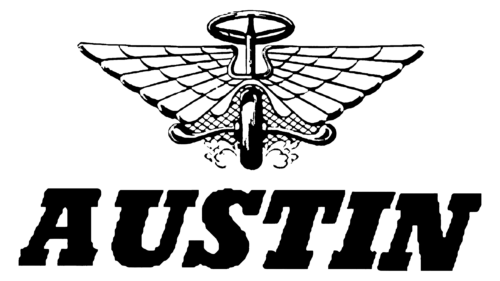
The winged wheel dates to the creation of the Austin Motor Company. Club historical material records that it was introduced as the company’s trademark in 1905, first appeared on official documents and correspondence, appeared in catalogues from 1906 and began appearing on vehicle radiator surrounds around 1907. [1]
The design combines a central wheel with horizontally extended wings. This basic visual idea remained associated with Austin in various forms for decades.
Importantly, the mark cannot originally have been inspired by Austin’s aircraft manufacturing during the First World War, because it was already in use before the war began.
The Austin Script
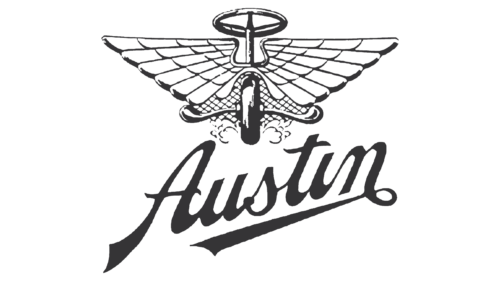
Another long-lived element of Austin’s identity was its handwritten-style script. Historical Austin material describes this wordmark as a stylized version of Herbert Austin’s own signature.
The script appeared on company literature from 1906 and, like the winged wheel, began appearing on vehicles shortly afterward. [1]
This gives the script a concrete connection with the founder rather than a speculative meaning based on italic typography supposedly representing motion or speed.
Austin and Longbridge
Longbridge became inseparable from the Austin name. Herbert Austin established his automobile operation there in 1905, and the site subsequently developed into a major integrated manufacturing complex with foundries, machine shops, body production and vehicle assembly.
The British Motor Museum notes that Longbridge eventually produced not only automobiles but also aircraft, munitions and military vehicles during wartime periods. [4]
Austin’s wartime aviation activity is therefore an important part of the company’s industrial history, but it should be separated from the origin of the winged-wheel logo.
The Austin Seven
The Austin Seven became one of the most important vehicles in the company’s history. Herbert Austin and Stanley Edge developed the car in 1921 and 1922, and it entered production in 1922.
Nearly 300,000 Austin Sevens were produced during its 17-year production run. The British Motor Museum describes it as Britain’s cheapest “real” car when introduced and credits it with making automobile ownership accessible to a much broader public. [5]
The Seven also extended Austin’s international influence. Its basic concept was licensed or adapted by manufacturers in other countries and became historically connected with companies including BMW and Nissan.
Later Austin Badges
Austin did not use one standardized badge across every car and every period. Various winged-wheel devices, script marks, block lettering, crests and other badges appeared across different models and markets.
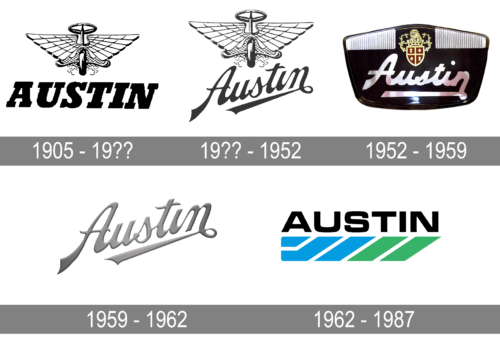
The Austin Motor Vehicle Club of Queensland documents examples including the Wings and Wheel, Flying A, Austin script, Austin coat of arms and later BMC-associated badges. This variety shows why a simple sequence of four supposedly universal corporate logos can give a misleading impression of Austin’s visual history. [6]
1952 and the Formation of BMC
In 1952, the Austin Motor Company merged with Morris Motors to create the British Motor Corporation, better known as BMC.
Austin remained a major marque within BMC rather than disappearing immediately after the merger. Vehicles continued to carry Austin branding, while BMC increasingly shared platforms and components between Austin, Morris and its other marques.
For that reason, badge changes after 1952 should not automatically be interpreted as a single corporate rebrand tied directly to the merger. Different models continued to use different Austin treatments.
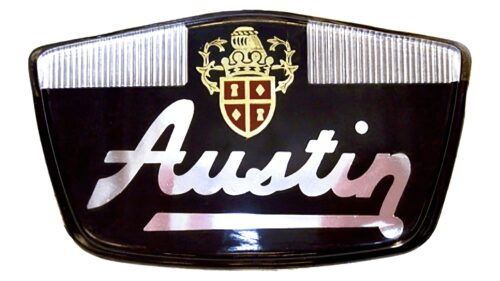
Austin Crest and Script Applications
One prominent postwar Austin identity combined the familiar script lettering with heraldic-style crest elements. Surviving badges show several variations depending on the vehicle and period.
These designs can be described visually, but there is no strong evidence that their shield forms were officially intended to symbolize protection, British heritage or authority. Such meanings should therefore not be presented as fact.
Wordmark Applications
Austin also used stand-alone wordmarks and script badges without the winged-wheel device. Their exact appearance differed across models, production periods and markets.
Rather than treating these applications as a clearly documented 1959 to 1962 corporate logo phase, it is more accurate to recognize that Austin used multiple identities concurrently during the BMC era.
Later Austin Identity
Later Austin branding became increasingly dependent on straightforward wordmarks as the marque moved through the BMC, British Leyland and Austin Rover periods.
The supplied later mark uses bold uppercase Austin lettering with colored geometric elements beneath it. However, no authoritative source located for this article confirms that this exact graphic was introduced universally in 1962 or remained Austin’s sole official logo until 1987.
The broader badge record shows that Austin identities varied significantly between individual models, markets and corporate eras. Exact dates attached to individual logo illustrations should therefore be treated cautiously unless supported by period documentation.
Typography
Austin used multiple lettering styles during its history rather than one consistent typeface. The early Austin script is particularly significant because historical material identifies it as a stylized version of Herbert Austin’s signature.
Later models used block lettering, scripts and badge-specific letterforms. No authoritative evidence located for this article identifies fonts such as Karnak Pro, Rockwell Nova or Stanford Serial as actual Austin corporate typefaces, so visual similarities should not be presented as confirmed font identification.
Color and Materials
Austin vehicle badges appeared in metallic, painted, enamel and printed forms. Silver-colored metal, black, red, blue, gold and other colors can all be found in surviving Austin badges from different periods.
These variations were influenced by manufacturing technique, individual model styling and corporate context. There is no reliable evidence that Austin maintained a single symbolic color system in which silver meant elegance, gold meant luxury or monochrome meant expertise.
From BMC to British Leyland
BMC underwent a series of corporate changes after its creation. It eventually became part of British Leyland, and the Austin marque remained important within the group’s mass-market range.
During the 1980s, Austin was associated with cars including the Metro, Maestro and Montego. The organization itself also used the Austin Rover Group identity during this period.
When Did the Austin Brand End?
Austin did not experience a conventional factory shutdown in 1987. Longbridge remained operational, and several models developed under the Austin organization continued production.
Instead, the Austin marque was phased out. Austin Motor Company historical material records that by the end of 1987 the Maestro and Montego had lost their Austin badges. The cars themselves remained in production, but without Austin branding. [7]
This makes 1987 a useful date for the end of the historic Austin marque in regular British production, rather than a literal closure of Austin manufacturing operations.
The Austin Name Today
The original Austin Motor Company no longer exists as the independent manufacturer founded by Herbert Austin. However, the Austin name and trademarks have subsequently been the subject of new ownership and revival efforts.
A modern company using the Austin Motor Company name states that dormant Austin trademarks were re-registered in 2019 and that it has developed new vehicles under the historic name. This modern business should be distinguished from Herbert Austin’s original company and from the BMC and British Leyland-era marque. [7]
FAQ
What does the Austin logo mean?
Historical Austin material states that Herbert Austin designed the original winged wheel to represent speedy, controlled wheeled motion. The emblem dates to the company’s foundation in 1905.
Who designed the Austin logo?
Historical Austin club material attributes the original Wings and Wheel trademark to Herbert Austin himself. It was created around the company’s formation in 1905.
Was the Austin logo inspired by aircraft?
The original winged-wheel emblem predates Austin’s First World War aircraft production. It was already being used on company documents and catalogues from 1905 to 1906 and on cars from around 1907.
When was the Austin Motor Company founded?
Herbert Austin founded the Austin Motor Company in 1905 after leaving Wolseley and established the company’s factory at Longbridge near Birmingham.
When did the Austin brand disappear?
The Austin marque was phased out during the late 1980s. By the end of 1987, models such as the Maestro and Montego had lost their Austin badges even though the vehicles themselves continued in production.
Disclaimer
This article is part of the educational resources provided by Logo Index, an independent archive covering logos, visual identities and graphic design history. Austin and associated trademarks and brand assets remain the property of their respective rights holders where applicable.