Berliet was a French manufacturer of automobiles, buses, trucks and military vehicles based at Vénissieux, outside Lyon. The company was founded in 1899 by Marius Berliet, whose first petrol engine dates to 1894 and whose first car followed in 1895, and it built passenger cars alongside commercial vehicles until car production effectively ended in 1939. After the Second World War it concentrated on trucks and buses. The marque disappeared in 1980, but the emblem that defined it, the front of a steam locomotive, had by then been in use in one form or another for more than seventy years.
 Berliet Logo PNG
Meaning and history
Berliet remained a family-controlled business for most of its existence. In 1967 the company entered the Michelin and Citroën orbit, with Citroën’s heavy-vehicle activities transferred to Berliet. In 1974 it was sold to Renault, and in 1978 Berliet and Saviem were merged to create Renault Véhicules Industriels, or RVI. The Berliet name was phased out by 1980 [1]. The Renault Trucks trade name came much later, after Renault V.I. joined the Volvo Group in 2001 and adopted that name in 2002, so Berliet was never acquired by Renault Trucks as such [2].
Early identification and the 1903 monogram
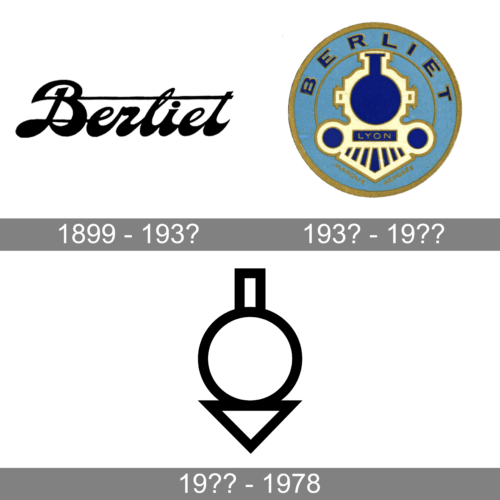
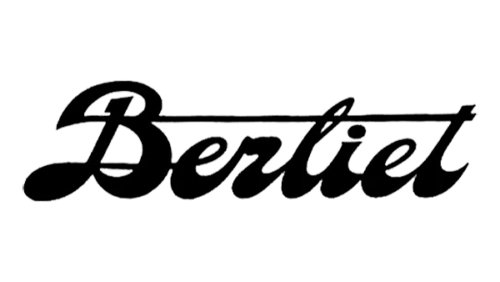
Before there was a formal emblem, Berliet vehicles were identified by a brass “Berliet” signature mounted on the radiator, closer in spirit to a maker’s plate than to a designed mark. The first printed logo documented in the company’s own archive is a 1903 catalogue device: the interlaced initials M and B, standing for Marius Berliet [3]. Script and signature-style wordmarks that circulate as the “1899 Berliet logo” belong most plausibly to that early radiator-signature period, since no dated 1899 emblem is documented.
The locomotive arrives: 1906
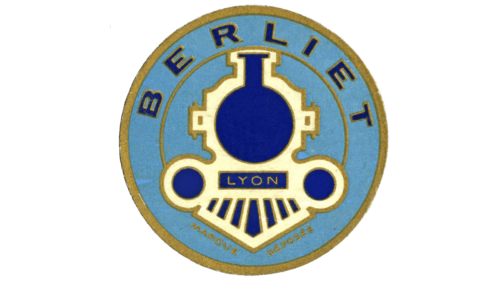
The locomotive motif was not decorative. In 1905 Marius Berliet signed a licence agreement with the American Locomotive Company, ALCO, and the contract helped fund a major expansion of his works. As a nod to that deal, Berliet adopted the front view of an American-style steam locomotive, complete with cowcatcher and short chimney, as the marque emblem. It appears on catalogues from 1906 and stayed with the brand for more than seventy years [3]. Regional press accounts of the emblem describe the same origin, framing it as Berliet’s pride at having sold an industrial product to an American giant [4].
1928: an elongated Art Deco treatment
The company archive records a publicity department under Jean Gabarre from 1928 and a noticeably elongated, Art Deco-inflected logo from the same period. The word Lyon was dropped from the mark in favour of Automobiles, and the Berliet signature was redrawn in block capitals [3].
The 1930s: a narrower locomotive
Through the 1930s the locomotive was drawn narrower, more stylised and more discreet, while the BERLIET lettering grew heavier and denser. Roundel versions of the locomotive mark from the interwar years exist, including a blue and gold circular badge with the name curved above the engine. The precise date of that particular variant is not well documented, so it is safer to place it within the interwar locomotive family than to attach a firm year to it.
1952 and 1953: Francis Deswarte’s simplification
In 1952 Jean Gabarre commissioned the Lyonnais graphic designer Francis Deswarte to modernise the emblem. Deswarte simplified the locomotive and, notably, removed the Berliet name from the mark on the grounds that the locomotive image alone was enough to identify the brand. In 1953 he went further and proposed a set of more abstract geometric variants built from three shapes. According to the Fondation Berliet, those proposals were not adopted [3].
1959: Publicis and the geometric locomotive
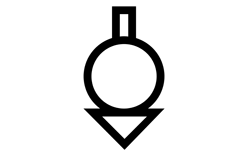
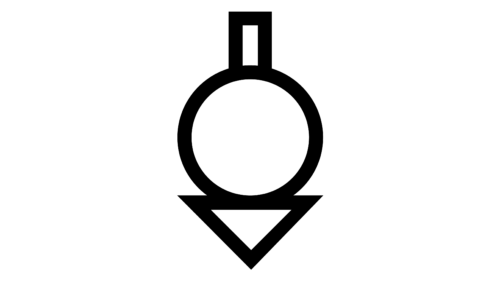
The redesign that stuck came in 1959. Paul Berliet entrusted the work to Publicis, and the drawing was produced by Pham Ngoc Tuan. The locomotive was reduced to three elements: a small vertical rectangle for the chimney, a circle for the boiler or body, and a downward-pointing triangle for the cowcatcher. Blue, yellow and black were chosen as the brand colours, with blue and yellow used across dealer signage and network identity [3]. Renault Trucks’ own account of the logo history describes the same three components as the circle, the square and the triangle [5]; the foundation’s more detailed description specifies a rectangle rather than a square for the chimney.
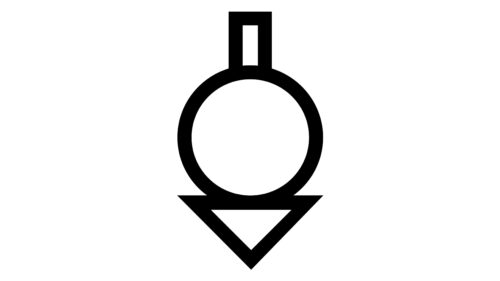
The geometric locomotive represented Berliet until the 1978 merger with Saviem into RVI, and the marque itself was abandoned by 1980 [1]. The three-shape mark, rather than the ornate locomotive drawing, is the version most people now associate with the name, and it is the direct ancestor of the visual language later carried on by Renault Trucks.
FAQ
Why does the Berliet logo show a locomotive?
Berliet adopted the locomotive after signing a 1905 licence agreement with the American Locomotive Company (ALCO). Marius Berliet chose the front of a steam locomotive as a reference to that contract, and it remained the basis of the marque for over seventy years.
When did Berliet start using the locomotive emblem?
The locomotive emblem appears on Berliet catalogues from 1906, shortly after the ALCO agreement, and replaced the earlier brass radiator signature and the 1903 interlaced M and B monogram as the company’s main identifying mark.
What do the three shapes in the 1959 Berliet logo represent?
The 1959 design by Publicis, drawn by Pham Ngoc Tuan, abstracts the locomotive into a small vertical rectangle for the chimney, a circle for the boiler or body and a downward-pointing triangle for the cowcatcher.
When did Berliet stop using its logo?
The geometric locomotive emblem was used until the 1978 merger of Berliet and Saviem into Renault Véhicules Industriels. The Berliet marque itself was phased out by 1980.
Was Berliet acquired by Renault Trucks?
Berliet was sold to Renault in 1974 and merged with Saviem in 1978 to form Renault Véhicules Industriels. The Renault Trucks name only appeared after Renault V.I. joined the Volvo Group in 2001 and adopted that trade name in 2002.
Disclaimer
This article is part of the educational resources provided by Logo Index, an independent archive covering logos, visual identities and graphic design history. Berliet and associated trademarks and brand assets remain the property of their respective rights holders where applicable.