 Datsun Logo PNG
Datsun was Nissan’s export brand rather than an independent carmaker. The business behind it started as Kwaishinsha Motor Car Works in Tokyo in 1911, and its first car appeared in 1914 under the name DAT. That word is an acronym built from the surnames of three backers, Kenjiro Den, Rokuro Aoyama and Meitaro Takeuchi, as Nissan’s own history records.
In 1931 the company introduced a small car called Datson, meaning “Son of DAT”. It was renamed Datsun a year later, when “son” was felt to suggest loss while “sun” pointed to the rising sun, according to Nissan’s brand history. Nissan Motor Co., Ltd. was formally named in June 1934, and the Datsun name went on to carry the company’s exports around the world for roughly fifty years.
The first documented Datsun emblem
Nissan dates its first brand logo to 1933: a blue rectangle carrying the name in white letters, laid across a red circle that stands for a rising sun and echoes the Japanese flag. Nissan’s Evolution of the Sun feature describes the emblem as inherited from the Datsun design and states that it stayed in service until 1970, with four later revisions following it.
A separate corporate mark was chosen in May 1935, listed among the 1930s entries in Nissan’s Heritage Collection. The basic format of that period, a red disc behind a blue name bar, became the most durable element of the identity.
Badges varied more than the logo
Pre-1981 Datsun vehicles generally carried Datsun wordmarks rather than one fixed badge, and as a Nissan-sourced feature notes, vehicle badges varied widely by nameplate and era. That variation explains the number of different marks that appeared over the middle decades, many of them applied to a single model line rather than adopted brand-wide.
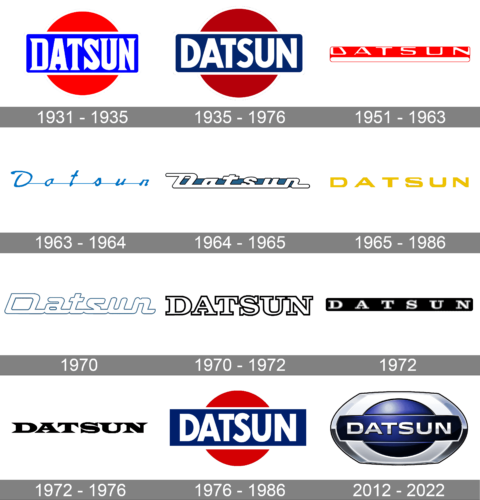
The stage-by-stage timeline that turns up in most logo round-ups, with separate designs for 1951, 1963, 1964, 1965, 1970 and 1972, cannot be traced to Nissan or to any named designer. The same wording recurs across tertiary logo directories, and the date ranges those sources give for the same artwork do not agree with one another. The marks below are better read as documented badge variants from the period, with dates approximate.
Mid-century variants include a red and white horizontal badge carrying a bold sans-serif name, and a blue connected-line script wordmark. Both survive in logo archives without a confirmed rollout date or an official role in the brand’s identity system.
By the mid-1960s the name also appears as white letters on a narrow blue band and as a gold-yellow uppercase logotype. Neither is dated in Nissan’s own material, and both read as typographic treatments applied to cars rather than as replacements for the core emblem.
Later versions move toward outlined lettering and gradient grey rectangular plates, a shift that reflects the general direction of automotive badging in the 1970s rather than a documented rebrand.
A silver-on-black block and a black serif wordmark round out the archive. Throughout, the red-circle-and-blue-bar emblem remained the graphic anchor. Nissan states that this core motif ran to 1970 and that revisions to the identity came after it, rather than a wholesale replacement by a grey oval or a monochrome wordmark.
The end of the name, 1981 to 1986
The decision to retire Datsun in favour of Nissan was announced in late 1981 and carried out between 1982 and 1984, with the changeover complete by roughly 1986. For a brand whose badge had been its main public signature, this was a straightforward substitution of one wordmark for another rather than a design exercise. Hemmings reports that a home-market pickup variant briefly reused the Datsun name around 2002, though Nissan does not confirm that detail.
The revived identity from 2013
A low-cost brand aimed at emerging markets was announced in 2012 and relaunched globally in July 2013 with the Datsun GO in India, with cars reaching customers in 2014. The revived badge returns to the established motif of a blue name bar over a red circle, shown here in current form. No designer or agency credit, and no official debut date for this artwork, is documented.
The second life was brief. Datsun withdrew from Russia and Indonesia in 2020 and the last vehicle was built at Chennai, India, in 2022, as reported by Drive.
What the Datsun logo means
Of the symbolism attached to the mark, only one element is officially supported: the red circle stands for a rising sun, a reference to the Japanese flag. That reading comes from Nissan, which cites graphic-symbolism specialist David Bihanic in the same feature on the emblem’s history. The name is documented too, as DAT plus “sun”, and the early rabbit association comes from “datto”, the Japanese word for hare, which was a nickname rather than the acronym’s meaning.
Other interpretations carry less weight. The idea that the blue rectangle was chosen with the American market in mind is editorial speculation, and the backronym reading of DAT as “durable, attractive, trustworthy” has no authoritative backing. Where a mark’s intent is not documented, the honest description is simply of what is visible.
FAQ
When was the first Datsun logo created?
Nissan dates the first brand logo to 1933, when the blue name bar over a red rising-sun circle was introduced. The corporate mark was settled separately in May 1935, and the emblem is documented as lasting until 1970, with four revisions after that.
What does the red circle in the Datsun logo mean?
The red circle represents a rising sun and refers to the Japanese flag. It is the only symbolic element of the mark that Nissan documents officially; other readings, such as colour psychology for the blue bar, are not supported by the company or by any named designer.
Why did Datsun change its name to Nissan?
Nissan consolidated its worldwide identity under a single name. The retirement of Datsun was announced in late 1981, implemented from 1982 to 1984, and complete by about 1986, after which Datsun vehicles carried Nissan badges instead.
Is Datsun still in production?
No. Datsun was revived in 2013 as a low-cost brand with the Datsun GO, but the revival ended when the brand withdrew from Russia and Indonesia in 2020 and the last car was built in Chennai, India, in 2022.
Disclaimer
This article is part of the educational resources provided by Logo Index, an independent archive covering logos, visual identities and graphic design history. Datsun and associated trademarks and brand assets remain the property of their respective rights holders where applicable.