John Cooper Works, almost always shortened to JCW, is the performance badge of MINI, itself a brand of the BMW Group. It is not a standalone British car marque: the name marks the sportiest tier of the MINI range, and the identity is owned, developed and applied by the parent company. Reading the logo properly means separating two things that share one name, the 1960s racing heritage of John Cooper and the tuning business his family launched decades later.
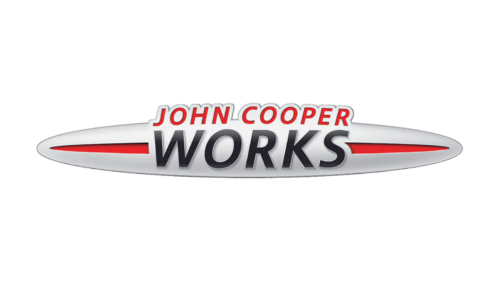 John Cooper Works Logo PNG
The “Works” half of the name is longstanding motorsport shorthand for a factory-backed racing operation. John Cooper (1923–2000) earned that association through the Mini Cooper of 1961 and the Cooper S works cars that won the Monte Carlo Rally in 1964, 1965 and 1967, after a 1966 event in which the cars swept the top three places was disqualified. Those victories came from BMC’s works programme and predate the John Cooper Works business by decades. The modern badge points back to them rather than inheriting them.
From a tuning shop to an official badge
The company that carries the Cooper name was founded by John’s son, Michael “Mike” Cooper, from a base in West Sussex. Sources disagree on the year. The Sussex Express dates the launch of the John Cooper Works brand to 2002, and Wikipedia’s entry on the firm follows the same line, while some motoring outlets place it in 2000. Because the earliest performance kits appeared in the early 2000s, that is the most defensible way to describe the starting point of the modern identity.
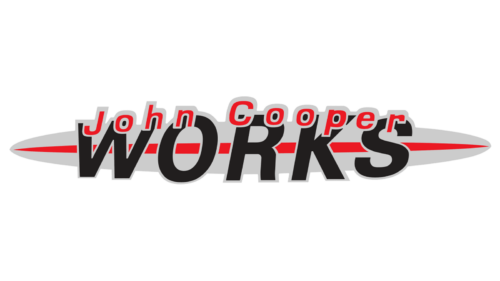
The original mark belongs to that era. Enthusiast histories describe it as an elongated, surfboard-like badge introduced around 2002 and used on tuning kits and accessories rather than on a factory car. It was a fitment badge in the ordinary sense, applied to modified MINIs and parts, and it did not carry the weight that a manufacturer’s corporate emblem would.
BMW’s involvement changed what the badge was for. The company struck a deal with the Cooper family around the 2006 holiday period to take over the JCW name, effective January 2007, a move Autoweek reported as BMW bringing its Cooper performance wing fully in-house, and it bought out the JCW company in 2008. The first documented redesign followed quickly. In a BMW Group announcement dated 21 January 2008, the company stated that JCW was becoming “an integral part of the MINI brand” and that “a visible sign of this repositioning is the newly devised brand logo which will be seen on all future John Cooper Works products.” That statement is the clearest evidence that the 2008 mark was a deliberate brand identity rather than a routine refresh. Enthusiast accounts of the same period describe the revision as evolutionary, with the lettering cleaned up for legibility.

The first factory-built JCW models, the MINI John Cooper Works Hatch and Clubman, went on sale in the UK on 22 July 2008 at £20,995, according to BMW’s own UK press kit. That launch matters for the identity because it marks the point where the badge stopped being an accessory mark and became the standard front-of-car identifier for a production model line.
The 2023 logo and what is documented
The identity changed again in 2023. On 1 November 2023, BMW Group announced the premiere of a new John Cooper Works logo, unveiled at the Rundstrecken-Challenge Nürburgring season finale on a Bulldog Racing car. The announcement stated that the new mark would replace the previous JCW logo across all cars of the new MINI family presented that September. Stefanie Wurst, then Head of the MINI brand, described the logo as “an expression of the boundless enthusiasm and pride we feel for John Cooper Works.”
That quotation is about as far as the documented meaning goes. BMW presents the 2023 mark as representing the passion and sporting character of the sub-brand, and the 2008 identity was positioned as a guarantee of racing know-how. There is no reliable public account of why particular colours, an oval frame or the placement of the wordmark were chosen. Colour palette and typeface for the JCW emblems are not documented in the sources available, so the visual tradition of the badge is best described in general terms: a compact performance emblem that has to read clearly at small sizes, a constraint that has shaped many automotive and heritage emblems over the same period.
What the John Cooper Works logo does today is identify tier rather than ownership. It signals that a given MINI has been developed by the group’s performance operation, and its chronology runs through an early-2000s tuning badge, the 2008 repositioning as an official MINI identity, and the all-new mark introduced in 2023.
Disclaimer
This article is part of the educational resources provided by Logo Index, an independent archive covering logos, visual identities and graphic design history. John Cooper Works and associated trademarks and brand assets remain the property of their respective rights holders where applicable.