Delage is a French luxury and racing marque whose emblem has stayed remarkably consistent with its name: a blue oval carrying the word DELAGE in white capitals. That badge outlasted the original company, which built cars from 1905 until 1953, and it returned with the marque’s 2019 revival. The logo is not a complicated piece of heraldry. Its job was to identify a car, and for most of the 20th century it did so with little more than a colour, an oval and a name.
The Delage logo: blue oval, white letters
The historic Delage mark is an oval or lozenge in blue, bordered by a white outline, with the brand name set inside in white capital letters. The wordmark fills the oval from edge to edge, leaving a narrow margin that reads as a frame. It is a seal-like badge of a type common among European carmakers of the early 1900s, where the emblem served as both a signature and a radiator or body badge.
 Delage Logo PNG
Visually, the mark has been described with details such as a dark blue field, a white border, serif capitals and, in later versions, a gradient or a wider blue surround. Those observations come from looking at particular images rather than from any official design record.
The lettering in the historic badge is set in capitals that appear to be serif; in the revived marque’s version the same basic layout is retained. The emblem has always done its work at a small size: on a radiator shell, a hubcap or a bonnet, where an oval with a name inside is easier to read than a pictorial symbol.
A badge for a racing and luxury marque
The company that the badge identified was founded in 1905 by Louis Delâge, a former Peugeot engineer, at Levallois, north-west of Paris. It began with a single-cylinder voiturette and moved into six- and eight-cylinder luxury cars. Racing gave the marque much of its early profile: a class win in the 1908 Coupe des Voiturettes, victory at the 1914 Indianapolis 500 with René Thomas, speed records in the 1920s, and the 1927 World Grand Prix Championship with the 15 S 8/155B driven by Robert Benoist (delage.fr).
The badge shown here belongs to the historic era, roughly the company’s first half-century. It is often captioned as a 1905 logo, but no authoritative source establishes that this exact version was introduced in 1905 or that it remained unchanged until production stopped. The safer description is a historic Delage emblem used during the marque’s original lifetime.
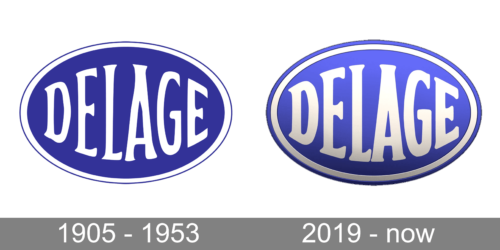
The evolution strip above is best treated as an illustration of how the oval idea persisted across different periods. It is not an authenticated set of stage-by-stage redesigns.
Financial trouble led to voluntary liquidation in 1935. Production of Delage cars continued under licence from Delahaye until 1953, so the same emblem appeared on cars built under two different corporate owners. Whether the badge itself was altered in that period is not well documented.
After 1953 the marque stopped building cars, but it did not disappear as a name. The enthusiast association Les Amis de Delage was created in 1956 and owns the Delage brand and trademark (Ouest-France).
The 2019 revival and the current mark
In 2019 the association licensed the brand to entrepreneur Laurent Tapie, and Delage Automobiles was refounded. The agreement was announced at the Epoqu’Auto show in Lyon in November 2019. The first new model, the D12 hypercar, was shown as a concept in Los Angeles in December 2019 and is limited to about 30 units; it uses a V12 engine and the D naming pattern that echoes the historic D6 and D8 models (Robb Report). Delage returned to the 24 Hours of Le Mans in the LMP2 class in 2023 with IDEC Sport and appeared at the 2024 Mondial de l’Auto.
The revived marque uses a blue-based oval identity, which keeps the visual link with the historic badge. The core elements, an oval, a blue ground and the DELAGE name in white capitals, remain the constant. The broader story of the marque is covered in our Delage profile.
FAQ
What does the Delage logo look like?
It is a blue oval with a white outline, containing the name DELAGE in white capital letters. The wordmark fills most of the oval, and the design has stayed close to that formula across the historic and revived eras of the marque.
When was the Delage logo introduced?
The exact introduction date is not well documented. The blue oval wordmark is associated with the original company, which built cars from 1905 to 1953, but no authoritative source confirms a specific year for the first use of this exact emblem.
Was the Delage logo redesigned in 2019?
The current badge continues the blue oval identity rather than replacing it with a documented new design.
Who owns the Delage brand today?
The brand and trademark are owned by Les Amis de Delage, an association founded in 1956. The operating company Delage Automobiles was refounded in 2019 and is led by Laurent Tapie under an agreement with the association.
Is Delage still making cars?
Delage stopped series production in 1953. The revived company is a very low-volume venture: its D12 hypercar is limited to around 30 units, so Delage is not a continuous mass manufacturer today.
Disclaimer
This article is part of the educational resources provided by Logo Index, an independent archive covering logos, visual identities and graphic design history. Delage and associated trademarks and brand assets remain the property of their respective rights holders where applicable.