The DeLorean Motor Company is remembered for a single car, a single material and a single badge: three letters, D, M and C, set in bright metal on the nose of the DMC-12. The emblem is easy to describe and unusually hard to date. Two unrelated companies have used the name, the surviving artwork circulates in several finishes, and the designer credit is genuinely contested.
Two companies, one name
The original DeLorean Motor Company was founded by John Z. DeLorean in Detroit on 24 October 1975, as recorded in the history of the original company. It produced one model, the DMC-12, styled by Giorgetto Giugiaro’s Italdesign and assembled at Dunmurry near Belfast from 1981. Around 8,500 to 9,000 cars were built before receivership ended production in 1982, a figure the BBC reported through DMC Texas vice president James Espey. The car’s wider fame arrived later, with Back to the Future in 1985, by which time the company had already collapsed.
The company trading today is a separate business. It was founded in 1995 by the Liverpool-born mechanic Stephen Wynne in Humble, Texas, and the Texas firm’s entry on Wikipedia records that it is not, and never has been, associated with the original manufacturer. What it did acquire was the remaining parts inventory and the stylized DMC trademark. A 2015 settlement with DeLorean’s widow, Sally Baldwin, settled ownership of the name and marks, and an appeals court affirmed that outcome in 2019. That settlement, rather than any redesign, is the event that put the current logo rights where they are. You can see the mark in its better-known treatment on the DMC brand page.
The DMC monogram
 DeLorean Motor Company Logo PNG
On the production car, the three letters appeared as brushed stainless steel on the front grille. DK’s Car: The Definitive Visual History describes the symmetrical DMC logo as an abbreviation of DeLorean Motor Company, and The News Wheel’s study of the badge describes the same construction: the D and C are treated as mirror images flanking a central M. The symmetry is horizontal, achieved by dropping the strokes that would otherwise interrupt the reflection, which is why the letterforms read as a single block rather than as three separate characters.
That account covers what is visible. Claims that the symmetry stands for global reach, or that it echoes the gull-wing doors, appear in logo round-ups rather than in any source close to the company, and an early wooden prototype said to have carried the letters DSV for DeLorean Safety Vehicle is repeated in enthusiast accounts without documentation.
Variants in circulation
Several versions of the mark survive, and comparing them is useful even where their dates are not.
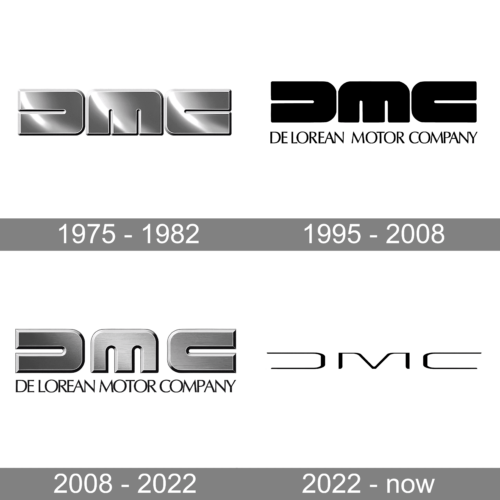
This composite gathers multiple finishes of the monogram into one image. It is a montage rather than a single dated mark, so it works as an overview of the badge family and not as evidence about when any one version appeared.
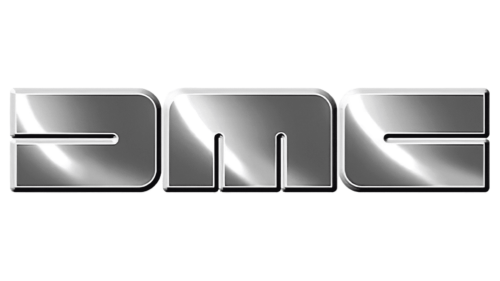
This polished metallic monogram, with the full company name set in a small line below, is the form most often labelled as the 1975 emblem. The badge itself is well attested on the 1981 to 1982 DMC-12; the 1975 label is not, and the artwork is more safely described as an early-style treatment than as a dated launch.
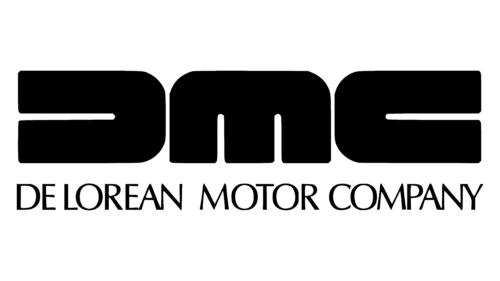
Here the metal is gone. The initials are rendered flat black with the full name underneath, and the result reads more like a corporate signature than a grille badge. The version is frequently tied to 1995, the year the Texas company was founded, but nothing in the record shows the artwork being introduced then.
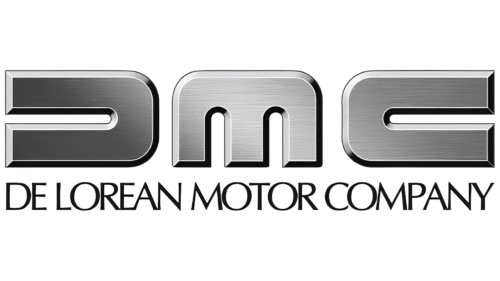
The wider-slit variant returns to metal, with a darker silver tone and a heavier three-dimensional edge, while keeping the full name in black beneath the initials. It is commonly dated 2008 for reasons set out below.
What the 1975, 1995 and 2008 dates mean
Logo round-ups usually present the DMC mark as a tidy sequence of periods with changes in 1975, 1995, 2008 and 2022. The 2022 date corresponds to a real event, the launch of the Alpha5. The middle two do not correspond to documented redesigns.
1995 is the year the Texas company was founded, and a trademark database listing cited by enthusiasts places the registration of the DMC brand in the same year. 2008 appears in that same listing in connection with the later mark. On that reading, both dates are registration filings rather than moments when the artwork changed, and the filing from 2008 has not been confirmed against the primary trademark record. A company-wide logo launch in 1975 is likewise undocumented; what the surviving photographs and factory material actually show is the emblem on the 1981 to 1982 car. The dated versions shown above are best read as a convenient arrangement of visibly different artwork, not a verified chronology.
Designer and typeface
The most widely repeated attribution comes from the British designer Phil Gibbon, who told Logo Design Love, “I got my 15 minutes of fame when I designed the logo for John DeLorean’s car company,” and whose son Gregg R. Gibbon has corroborated the claim in comments on the same page. Other accounts name Hector Gomez, connect the badge to New Products Director Chuck Bennington, or attribute it to Giorgetto Giugiaro through his work on the car. Enthusiast threads on dmctalk.org record the same split. No verified attribution is documented, so authorship is best treated as open.
Typeface claims are similarly thin. Descriptions of the emblem as Optima Pro Cyrillic Roman, Lightyear Regular or a Zapf Humanist derivative appear only in logo-directory write-ups. Typodermic’s Rustproof Body, released in 2012, is described on its own page as inspired by the DeLorean logo, but it is a modern interpretation rather than the original face. An enthusiast archive notes that dealer signage used Friz Quadrata, which concerns the showroom lettering and not the monogram.
The Alpha5 and the DeLorean wordmark
In 2022 DeLorean Motors Reimagined, led by chief executive Joost de Vries, unveiled the Alpha5, an electric grand tourer whose styling was once again handled by Italdesign. Carscoops reported that the car wears a DeLorean wordmark in place of the DMC acronym badge. The change concerns badging rather than the three-letter mark itself, but it does mean the newest car to carry the DeLorean name does not wear the classic monogram on its nose.
FAQ
What do the letters in the DMC logo stand for?
DMC is an abbreviation of DeLorean Motor Company. The monogram sets a central M between a mirrored D and C, and the abbreviation is documented in standard motoring reference works covering the DMC-12.
Who owns the DeLorean logo today?
The stylized DMC trademark belongs to the Texas company founded by Stephen Wynne in 1995, which also holds the remaining parts inventory. A 2015 settlement with DeLorean’s widow, Sally Baldwin, clarified those rights, and the outcome was affirmed on appeal in 2019.
Who designed the DMC emblem?
No verified attribution is documented. Phil Gibbon has claimed authorship publicly, other accounts name Hector Gomez or Chuck Bennington, and some tie the design to Giorgetto Giugiaro’s work on the car. The credit remains disputed.
Was the logo redesigned in 1995 or 2008?
No documented redesign took place in either year. Both dates appear to trace to trademark registrations rather than to changes in the artwork, and the 2008 filing has not been confirmed against the primary trademark record.
Does the Alpha5 use the DMC badge?
No. When the Alpha5 electric concept was unveiled in 2022, it carried a DeLorean wordmark rather than the three-letter DMC monogram, so the classic acronym badge and the modern car’s badging are not the same mark.
Disclaimer
This article is part of the educational resources provided by Logo Index, an independent archive covering logos, visual identities and graphic design history. DeLorean Motor Company and associated trademarks and brand assets remain the property of their respective rights holders where applicable.