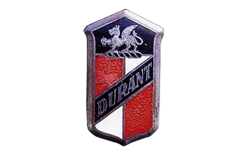
Durant Motors never had a single modern corporate logo. Its identity lived on the radiator: cloisonné enamel badges and script lettering fixed to the grille shell of each car, changing shape, colour and inscription as the company’s model lines shifted between 1921 and 1932. The mark most often labelled the Durant Motors logo is a heraldic winged beast above a shield, an emblem shared with the company’s Star cars and eventually displaced by a simple capital letter D.
 Durant Motors Logo PNG
A company built like a smaller General Motors
Durant Motors Inc. was founded in 1921 by William C. Durant, the co-founder and former president of General Motors, after he lost control of GM for the final time in late 1920. He built a full-line empire on the GM template: Durant for the mid-market, Star to compete with the Ford Model T, Flint, the acquired luxury marque Locomobile, and Rugby for export and truck work, alongside Mason trucks and nameplate ties to Dort, Frontenac and De Vaux. Corporate offices sat in New York City, with plants and operations in Elizabeth, New Jersey, Long Island City, Lansing and Flint, Muncie, Syracuse, Oakland and Toronto’s Leaside district, as the Hagley Museum and Library’s corporate records set out. Because so many cars came off different assembly lines, the badges rather than a paper logo system did the branding work.
What the Durant emblem actually looked like
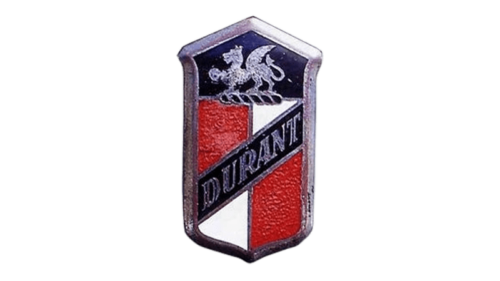
The recurring motif was a heraldic winged beast mounted on a shield, sometimes set against a five-pointed star. The Smithsonian’s National Museum of American History describes its Star Four radiator emblem as a blue-enamel badge built on a dragon-on-shield-on-star design, dated 1922 to 1928, and the design language carried across to the six-cylinder cars: a c.1925 Star Six emblem held by The Henry Ford is a round badge of roughly two inches inscribed STAR / SIX / DURANT MOTORS. The beast is usually called a dragon in museum records and a griffin by collectors, and both descriptions circulate for the same artwork.
These badges were not printed decals. They were cloisonné enamel on metal, generally brass or a zinc alloy, poured into colour fields of blue and aqua, white, red and silver. That technique gave the emblems their glossy, hard-edged finish and explains why so many have survived in reasonable condition.
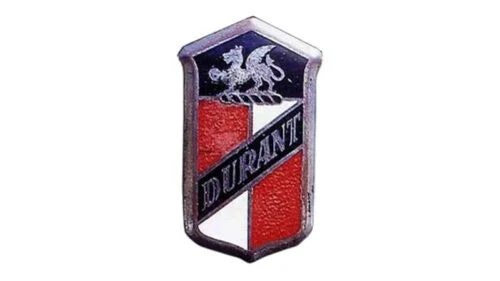
The graphic above is an undated modern rendering of the Durant emblem rather than a photograph of a specific radiator badge, so it should be read as an illustration of the mark’s overall form, not as a record of a particular year’s enamel colours or inscription.
From winged beast to letter D
The emblem sequence is reconstructed from surviving artifacts and specialist emblem references rather than company design documents. The American Auto Emblems chronology traces the line from the 1921 Durant Four prototypes, whose badge reportedly matched the size and shape of the Sheridan emblem from Durant’s last GM-era car, into the Model A-22 of 1921 and 1922, where the winged beast appears above a shield with the wings breaking through the emblem border. A transitional version followed in 1922, and the settled A-22 form, a multi-colour enamel badge, ran through 1926 and onto the six-cylinder B-22.
Star and Rugby cars used round emblems in the same period, with the Durant dragon appearing inside the Star badge from 1926. Some 1926 cars carried a plain Durant radiator script on the grille instead of a pictorial badge. By the late 1920s the mark had shifted decisively toward typography: a capital D with the beast reduced and pushed to the bottom of the badge. A 1928 redesign brought an oval badge in blue and white, followed by a gold-plated blue and white version in 1929 and a red, white and black treatment in 1930. The 1930 example held by The Henry Ford is a shield-shaped zinc-alloy enamel piece about 2.5 by 1.875 inches reading DURANT, made by the D. L. Auld Co. of Columbus, Ohio, which is one of the few documented manufacturer credits in the whole sequence.
A rare Durant-Canada badge in the De Vaux shape is generally placed around 1931 to 1932. A keystone-shaped badge that substitutes for the beast is sometimes linked to 6-22 show cars, but that attribution is not well documented.
What the emblem was meant to say
No reliable source records the reasoning behind the winged beast and shield, and no designer or agency credit is documented. Museum records simply describe the animal and the shield without assigning meaning, and colour psychology should not be read into the blue, white and red enamel. The motif sits comfortably within a period when American makers leaned on heraldic imagery, a tradition visible in shield-based marks such as Buick’s tri-shield. What can be said is that Durant repeated the same icon across brands, which made the parent company’s mark carry more recognition than any individual model nameplate.
Misreadings worth correcting
Some dealer listings describe the badge as an interlocking D and W referencing a partner named Wilkinson. No authoritative source supports that reading, and it does not match the surviving enamel pieces. It is also worth separating the company’s address from its factories: Durant’s offices were in New York City, while Elizabeth, New Jersey was one of several major plants, not the head office.
The end of the badge
Durant’s troubles predated the 1929 crash. Production halted for roughly a year from 1927, and the company was already slipping when the Depression hit. The last United States Durant-branded cars were built in August 1931. The firm was found insolvent and ended automobile production in early 1932, while the Canadian arm, Dominion Motors, continued until 1933, when its assets were liquidated. The Irish Times timeline of the marque and the Durant Motors corporate history agree on those boundaries, and the production record is set out in the model history.
FAQ
What did the Durant Motors logo look like?
Most surviving badges show a heraldic winged beast on a shield, sometimes set on a five-pointed star, rendered in cloisonné enamel. Later cars replaced the pictorial badge with a large capital D above the Durant script.
Was the Durant animal a dragon or a griffin?
Museum records describe it neutrally as a dragon or winged dragon on a shield, while collector references often call it a griffin. The source material does not settle which creature was intended.
Why did Durant cars carry different emblems?
Durant Motors ran several brands, including Durant, Star, Flint, Locomobile and Rugby, so badges varied by make and model year. The dragon-and-shield motif acted as the parent company’s mark across those lines.
Disclaimer
This article is part of the educational resources provided by Logo Index, an independent archive covering logos, visual identities and graphic design history. Durant Motors and associated trademarks and brand assets remain the property of their respective rights holders where applicable.