Hansa was a German automobile marque whose identity was carried on its radiators rather than in a modern logo manual. The Hansa-Automobil-Gesellschaft was founded on 1 December 1905 in Varel, in the Grand Duchy of Oldenburg, by the publisher Robert Allmers and the engineer August Sporkhorst, with cars following from 1906 and early production built to French patterns. The name comes from the medieval Hanseatic League, the northern trading confederation that counted Bremen among its members, and that historical reference is the clearest documented thread in the brand’s imagery: the oldest recorded Hansa badge is an enamelled radiator emblem from 1912 showing a twelfth-century Hanseatic cog, the trading vessel of the league.
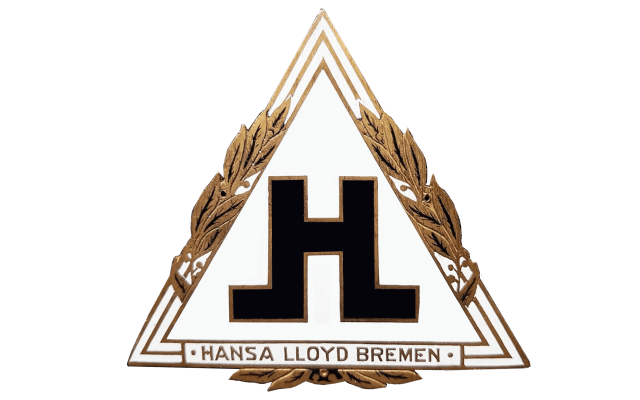 Hansa Logo PNG
The surviving artwork associated with the marque is largely undated, so it is more useful to read Hansa’s identity through the emblems that can be placed in time than through the shapes that circulate online without provenance.
Emblems rather than one logo
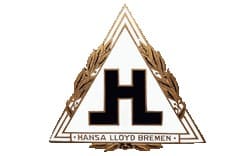
Hansa existed for decades before corporate design manuals, so its public face was a series of radiator emblems, made per model or era rather than held to one fixed mark. Radiator emblem archives list a first Varel badge carrying chassis number 362 and the type designation A14, the 1912 ship emblem, a rarer piece for the 1930 to 1931 Konsul measuring roughly 5.5 by 7.0 cm, the emblem made for the 1100 and 1700, and a six-cylinder badge of about 7.7 by 5.7 cm used in 1937 to 1939. At least one model also carried a hood mascot that incorporated the emblem itself, so the badge moved between the radiator shell and the bonnet.
The 1100 and 1700 mattered most commercially, with roughly 27,000 sold by 1938, and their emblem design was protected about two years before the 1934 launch. That registration shows how deliberately the company treated its badge even though no designer credit for it survives.
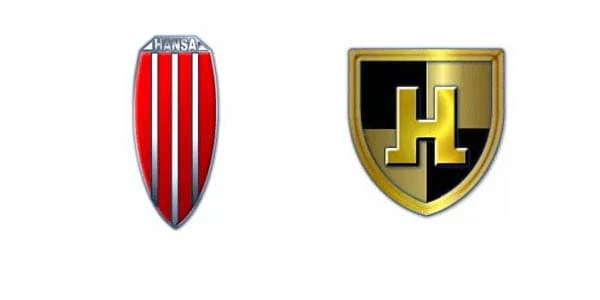
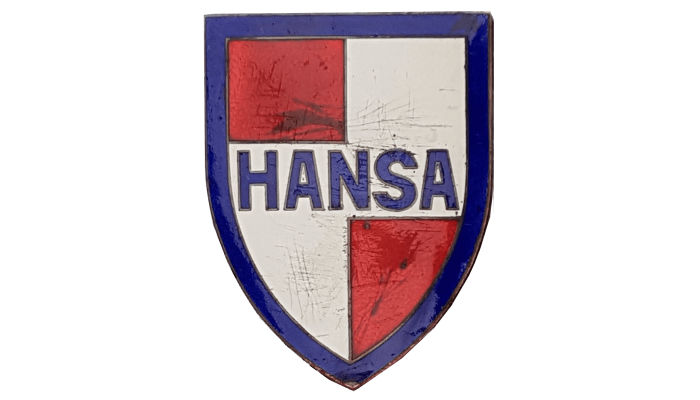
The artwork widely reproduced as a Hansa badge includes a shield form, and that outline sits squarely in the European radiator tradition described above.
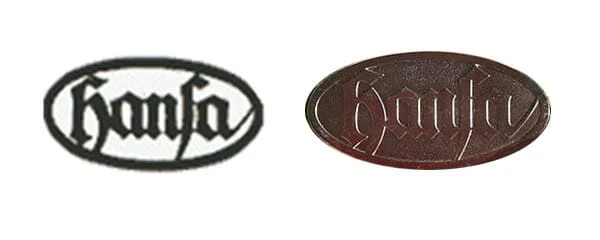
A further emblem file survives without provenance. What these pieces share is the logic of the period: a pictorial or lettered device mounted on the radiator, readable at a distance, and replaced whenever the model or the corporate parent changed.
Hansa-Lloyd, Borgward and the rhombus
In 1914 Hansa merged with Bremen’s NAMAG, maker of the Lloyd car, to form Hansa-Lloyd Werke AG. Both marks were used for a time, and Hansa-Lloyd settled mainly on trucks and buses down to roughly 1937. Borgward took a controlling stake in 1929 and full ownership in 1931, but the passenger cars continued under the Hansa name. The corporate shift in the badge came later: the six-cylinder Hansa Borgward 2000 appeared in February 1937, and in 1939 the nameplate was shortened to Borgward 2000, so the Hansa badge began its retreat from the cars at that point.
The group symbol that took over is the red and white checkered rhombus, introduced by Borgward in 1939 and used afterwards on commercial vehicles and as a chrome rhombus on passenger cars. That checkered field and diamond shape belong to Borgward, not to Hansa, and the earlier Hansa emblems stand upstream of them as a related tradition rather than as the same mark. Anyone tracing the checkered device should follow it through the Borgward logo and its diamond emblem, where the group identity is the subject.
Borgward’s post-war cars kept the older name in use. The Hansa 1500 arrived in 1949, the Hansa 1800 in 1952 and the Hansa 2400 in 1952 and 1953. The model first shown as the Hansa 1500 was renamed Isabella in 1957, and the Hansa badge was revived once more in 1958 on the former Goliath flat-four, sold as the Hansa 1100. That car stayed in production until 1961, when the Borgward insolvency ended the marque, as ADAC’s marque record confirms.
Claims about the Hansa badge that do not hold up
Several widely repeated descriptions of Hansa’s identity are not supported by documentation and are better set aside. The idea that the company used four different logos has no reliable enumeration behind it; because emblems were produced per model, any fixed count depends on which pieces are included. A gold and black checkered shield with a central H is likewise undocumented, since the checkered field that can be sourced is red and white and belongs to the 1939 Borgward rhombus.
The ornate flowing script associated with this corporate family in the mid 1950s is a model wordmark rather than a Hansa badge. It was drawn for the Isabella by the graphic artist Johannes Jaxy at Bremen’s Atelier Akenberg, as the Borgward club archive records, and it should not be read as evidence of a Hansa corporate logo.
For dating a piece of Hansa artwork, the emblems remain the reliable objects. Company chronology is documented in the usual marque histories, but it is the radiator badge, not a master logo, that carries the marque’s identity from the Hanseatic cog of 1912 to the Borgward nameplate of 1939.
FAQ
What did the earliest Hansa logo look like?
The oldest documented Hansa badge is an enamelled radiator emblem from 1912 depicting a twelfth-century Hanseatic cog, the trading ship of the medieval league that gave the company its name.
Why was the marque called Hansa?
The name refers to the Hanseatic League, the northern trading confederation that included Bremen, where the company later merged with NAMAG. The 1912 ship emblem makes that reference visible on the car itself.
When did Hansa become Borgward?
Borgward took a controlling stake in 1929 and full ownership in 1931, but the cars kept the Hansa name. The badge shifted in 1937 with the Hansa Borgward 2000 and was shortened to Borgward 2000 in 1939.
Disclaimer
This article is part of the educational resources provided by Logo Index, an independent archive covering logos, visual identities and graphic design history. Hansa and associated trademarks and brand assets remain the property of their respective rights holders where applicable.