Mazzanti Automobili was a small Italian maker of hand-built supercars based in Pontedera, in the Tuscan province of Pisa. Its emblem is a shield, or scudetto, built from two dominant colours, gold and blue, around a stylised compass, with a strip of the Italian tricolour at the top and the words “Mazzanti Automobili” set across it. The badge is the clearest surviving trace of a marque that produced only a handful of cars a year and tied its visual identity directly to its flagship model.
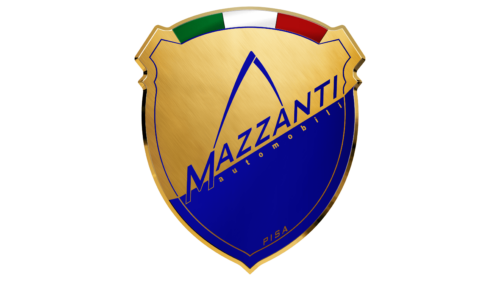 Mazzanti Automobili Logo PNG
Where the marque came from
The company behind the badge grew out of Faralli & Mazzanti, a Tuscan workshop founded by designer Luca Mazzanti and restoration specialist Walter Faralli. Italian Wikipedia and several enthusiast references date the founding to around 2002, although published accounts vary by a year or two and no single date is settled. In 2010 the partners separated amicably: Faralli kept the restoration business, while Mazzanti carried the car project forward as Mazzanti Automobili. The new marque needed an identity of its own, and the earliest badge associated with it is dated to 2011.
The first badge
The pre-refresh crest, dated by the company and the Italian motoring press to 2011, was a busy composition. It carried a sketched front end of the Evantra above gold and blue fields, together with a compass motif, a strip of the Italian tricolour at the top, the “Mazzanti Automobili” wordmark and the city name “Pisa”. The sketch tied the badge to the model the firm wanted to be known for: the mid-engined Evantra, named after the Etruscan goddess of immortality, was first presented in 2011 and reached production form as the Evantra V8 at Top Marques Monaco in April 2013. Exterior design is credited to Zsolt Tarnok working with Luca Mazzanti.
The December 2015 redesign
In December 2015 the badge was refreshed and lightened. The shield shape itself was kept. According to Quinews Valdera, the Evantra front sketch was removed, the compass was stylised further, the Italian tricolour at the top was enlarged and given greater prominence, and the wordmark was enlarged and moved to the centre, where it now sits as a bridge between the two colour fields. The “Pisa” text was moved from bottom-centre to a higher position to one side. Motorionline and AllCarIndex relayed the same set of changes. No later revision of the identity is documented in reliable sources, which makes the 2015 work the marque’s only recorded redesign.
What the colours and symbols stand for
The meanings attached to the badge come from the company’s own statement accompanying the 2015 refresh. Gold is described as standing for the prestige and preciousness of the hand-built cars. Blue is given as Luca Mazzanti’s favourite colour, associated with his period as a racing driver, and the pairing of blue and gold is presented in the same press material as a nod to Pisa. The compass is described as the firm’s design and craftsmanship know-how, an emblem of design fused with artisanal construction. The tricolour marks Italian origin, and the Evantra front sketch that appeared before 2015 linked the crest to the flagship model. No designer or agency credit for either version of the badge is documented in reliable sources, so the authorship of the artwork remains unattributed.
The compass beyond the badge
The compass motif did not stay confined to the crest. A report on the Evantra Pura, unveiled on 23 October 2021 at the XIII Florence Biennale Art+Design, notes the same symbol repeated on the car’s grille and air intakes, giving the device a place on the vehicle itself as well as on the badge.
How the badge survives the closure
Mazzanti Automobili is no longer building cars. Production halted in 2022 and the company entered judicial liquidation in 2023, as recorded by Italian Wikipedia and Quattroruote. Its assets, among them the registered trademarks “Mazzanti”, “F&M Mazzanti Automobili” and “Evantra”, were put up for auction, and Quattroruote reported that the sale closed in June 2025 with the buyer awarded the full compendium for €363,550 before charges. Those records establish who owns the registrations; they do not by themselves document the design history of the artwork or its first use.
For readers of Italian car badges, the Mazzanti shield remains a compact case study in how a low-volume maker used a single emblem to advertise its nationality, its flagship and its hand-built ethos, and then simplified that emblem once it had a production car to point to.
Disclaimer
This article is part of the educational resources provided by Logo Index, an independent archive covering logos, visual identities and graphic design history. Mazzanti Automobili and associated trademarks and brand assets remain the property of their respective rights holders where applicable.