IC Bus is the school and commercial bus brand of Navistar, and its visual identity is more layered than most. The letters in the name stand for Integrated Coach, and the emblem that carries them sits at the end of a line that begins with a small Arkansas body builder in 1933. Three different marks have represented that business over nine decades: a Ward Body Works bus illustration, an AmTran wordmark, and the shield-shaped IC monogram used today. The operating company appears in Navistar documents as IC Bus, LLC.
 IC Bus Logo PNG
The current IC Bus mark
The present identity is built around a bold IC monogram, with the two letters drawn as a single compact unit, set within a shield outline. On vehicles the same badge appears as a hood ornament and decal: a parts vendor lists the OEM piece simply as “IC SHIELD,” which confirms that the shield form is what actually sits on the buses rather than a purely digital device. Alongside the monogram, corporate material uses a plain sans-serif wordmark.
Colour is where third-party sources part company. One brand-asset directory lists yellow, white and a dark gold tone; another lists a red primary. Neither listing comes from the company, and no official IC Bus palette is documented, so the exact values are best read as directory estimates. School-bus yellow is a product convention in this industry, not a documented brand colour for the mark itself.
Where the IC name comes from
“Integrated Coach” is the documented expansion of the abbreviation, and it describes a structural idea rather than a stylistic one: body, chassis and, until 2015, engine all produced within one corporate organisation. Earlier glosses sometimes read the letters as Integrated Chassis or Integrated Conventional. The TRATON brand timeline and the company’s IC Bus record both carry the Integrated Coach reading.
Three marks, one lineage
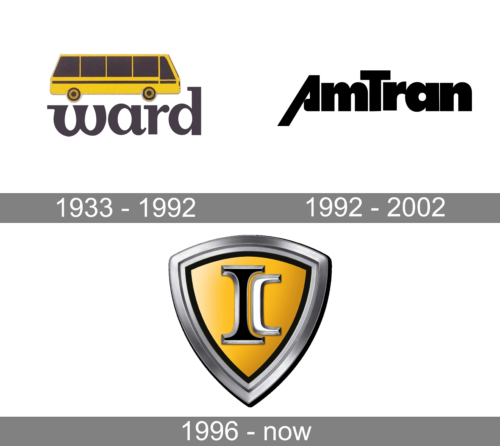
The collage below gathers the stages of this identity into a single frame. It is a third-party composite rather than a company-published history, so it works as an overview of how the marks relate to one another; the individual panels are not dated by their placement in the graphic.
Ward Body Works, 1933 onward
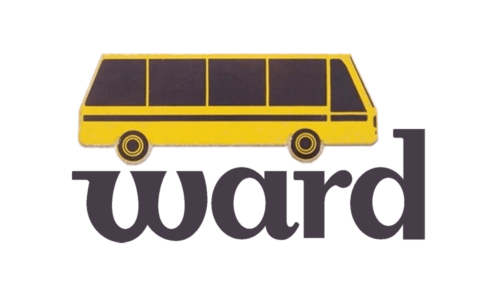
The oldest of the three marks belongs to Ward Body Works. David H. “Dave” Ward, a blacksmith, founded the business in Conway, Arkansas, in 1933 with roughly $125 and moved into bus-body manufacturing, producing all-steel bodies from 1936. The surviving Ward-era artwork is a simple side-profile school bus in yellow with black windows and a lowercase “ward” wordmark beneath the body. The 1933 label attached to that artwork in circulation is approximate: the founding year is documented, while the drawing’s own date is not.
Charles D. Ward took over from his father in 1968, and by 1973 the company held about a quarter of the school bus market, the largest share in the world. That position did not survive the decade. Ward filed for Chapter 11 in July 1980 with $21.5 million in liabilities and roughly 1,100 layoffs, and the Conway plant reopened that August under an investor group, MBH, Inc. The badge changed with the ownership.
AmTran, early 1980s to 2002
The AmTran name entered use around 1981, when the reorganised Conway business began trading as American Transportation Corporation; the Harmon brothers took control in 1983. The mark is purely typographic: AmTran set in a monochrome bold face, with the initial A fused to the following m into one continuous form and no pictorial element at all. It is the plainest of the three, and the surviving artwork is undated, generally placed in the early 1990s when the branding replaced Ward on the buses.

Navistar bought a third of AmTran in 1991 and exercised its option for the remainder in April 1995, making the bus builder a wholly owned subsidiary. The Ward name was phased out at the end of 1992, with models such as the Senator rebadged under AmTran. The AmTran RE, introduced in 1996, is sometimes treated as the start of the IC period; it is a bus model debut, not a logo date.
International IC and the IC Bus name
In March 2000 the company unveiled a new integrated conventional bus as the International IC at a Tampa event and announced that the AmTran brand would give way to International branding, as School Bus Fleet reported at the time. The bus subsidiary was then renamed IC Corporation, but the year is genuinely unsettled: sources place the change in 2001, 2002 or 2003, and period trade discussion of the new IC badge replacing the International diamond on the buses dates from roughly 2002 to 2003. The IC identity, in other words, is an early-2000s development, not a mid-1990s one.
The final renaming came in April 2009, when the subsidiary became IC Bus; some sources date that change to 2008, though 2009 is the better-supported year. This is the point at which the IC Bus name attached permanently to the monogram already appearing on the vehicles. One later revision is recorded only in a single uncited source, which describes a “wing” version of the emblem with Navistar script added for 2014 production. The change itself is plausible and consistent with the mark’s evolution, but the 2013 date is not independently corroborated.
What the mark says today
IC Bus operates inside Navistar, which has been a subsidiary of TRATON, and therefore of the Volkswagen Group, since 2021, and which reverted its corporate name to International in 2024. A 2024 factsheet issued by the parent states that about 42 percent of school buses on the road are IC Bus. The third generation of the CE series launched on 14 July 2023, carrying the same shield emblem that has marked the brand since the early 2000s.
Read as a set, the three marks describe a single company line rather than three unrelated businesses: a pictorial Ward badge tied to the era when the firm was a regional body builder, an AmTran wordmark from the years of independent ownership, and the shield monogram that arrived with Navistar’s integrated-chassis strategy and stayed through the renaming to IC Bus.
FAQ
What does IC stand for in IC Bus?
Integrated Coach. The letters reflect a bus built with body, chassis and, until 2015, engine all coming from one corporate structure. Earlier readings of the abbreviation include Integrated Chassis and Integrated Conventional.
When did the IC Bus name appear?
April 2009 is the better-supported date. The predecessor name, IC Corporation, is variously placed in 2001, 2002 or 2003, and a minority of sources date the IC Bus renaming to 2008.
Is IC Bus the same company as Ward Body Works?
Yes. The line runs from Ward Body Works, founded in Conway, Arkansas, in 1933, through AmTran from the early 1980s, then IC Corporation and finally IC Bus, now a Navistar subsidiary.
Disclaimer
This article is part of the educational resources provided by Logo Index, an independent archive covering logos, visual identities and graphic design history. IC Bus and associated trademarks and brand assets remain the property of their respective rights holders where applicable.