 Bandini Automobili Logo PNG
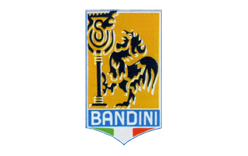
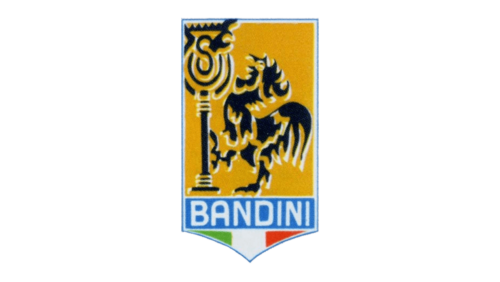
Bandini Automobili’s emblem is a heraldic shield on a yellow ground, and it is one of the more distinctive small-marque badges to come out of post-war Italy. Inside the shield stands a rearing cockerel, the galletto rampante, together with an iron caveja, the traditional Romagna cart peg. The green, white and red of the Italian flag runs along the lower edge, and a blue band carries the name BANDINI in white capitals. The same emblem appeared on the marque’s cars from 1946 until production ended in 1992, and it survives today in museum and historical-register use. [1]
What the Bandini emblem shows
The badge is built around a shield, the shape shared by many Italian constructors of the period. Its field is yellow, and it carries two figure elements: a dark rearing rooster, drawn with a visible comb, open beak and raised leg, and the caveja, a slim vertical device with loose rings and an ornamental plate at the top. Across the lower part of the emblem sits a blue band with BANDINI set in white capitals, while the Italian tricolour appears along the shield’s lower edge, beside or beneath the name band. [5]
On a car this works as a small nose badge, and at that scale the rooster reads first: the comb, the beak and the lifted leg are the details that survive reduction best. The caveja is the element most often misread. It is neither a column nor a letter, and once the shape is compared with traditional Romagna ironwork the rings and the decorated head make it recognisable at a glance. The animal, for its part, is a cockerel rather than a horse, a distinction worth making because the badge is small and the rooster is stylised.
Rooster and caveja: the symbols of Forlì
Both figures belong to the visual identity of Forlì and the wider Romagna region. Italian sources describing the marque’s badge identify the galletto rampante and the caveja as symbols of the city of Forlì, which is why a Forlì workshop founded in 1946 could adopt them without explanation for a local audience. [1]
The caveja itself is a wrought-iron peg used on carts and ploughs, formed of a rod topped by an ornamental plate and hung with sounding rings that jingled as the cart moved. Treccani records it as a wrought-iron ornament with ringing rings, adopted as a symbol of Romagna. [4] In Romagna iconography the rooster frequently appears with, or standing on top of, the caveja, and the pairing on the Bandini shield follows that established local motif rather than inventing a new device. [3]
One detailed account of Ilario Bandini’s life reports that he chose the rooster and caveja on a yellow field as a deliberate tie to his homeland, a reading that fits the badge’s tight focus on local rather than national or abstract imagery. [6] What the emblem does not carry is any documented explanation of the yellow field itself. Yellow is described in the sources as the colour of the shield, but no meaning is attached to it, and the tricolour is the element that carries the national-heritage message. [1]
One emblem, not a series of redesigns
The Bandini 1100 of 1946 is described as the first car to carry the Bandini stemma, which places the emblem at the very beginning of the marque rather than arriving after the brand was established. [2] The sources that describe the badge describe one design: the shield, the yellow ground, the rooster and caveja, the tricolour. No dated redesign, alternative version or named designer is documented for it, so the practical way to read the mark is as a single long-running emblem, introduced with the first car in 1946 and unchanged in its documented essentials through 1992.
That continuity suits the way the company worked. Bandini Automobili was an artisan constructor rather than an industrial manufacturer, and a hand-built output of roughly seventy-five cars did not generate the repeated brand exercises that larger firms went through in the same decades. The badge stayed on the cars, and the cars stayed recognisably Bandini. [7]
The company behind the badge
Ilario Bandini founded the firm in Forlì in 1946, starting from a modified Fiat 1100 known as “La prima”, the 1100/46. Production remained small and competition-oriented, concentrated in the 1950s and early 1960s, with tubular chassis and twin-cam engines built in-house. The racing record includes SCCA class championships in 1955 with Dolph Vilardi and in 1957 with Melvin Sachs, SCCA Southwest regional titles between 1961 and 1963, and Ilario Bandini’s own Mille Miglia entries from 1947 to 1965. [1] [7]
The company closed with Ilario Bandini’s death on 12 April 1992, which makes Bandini Automobili a defunct constructor rather than a continuing manufacturer. That fact shapes how the emblem should be read today: it is a historical mark belonging to a completed body of work, not the current identity of an active car maker. [7]
Where the emblem appears now
The legacy is kept alive by the Museo Bandini Auto and the Registro storico Bandini, which has certified 46 surviving cars, and the marque is represented online at bandiniautomobili.it. [5] In those settings the badge functions as a heritage identifier: on restored cars, in museum displays and in register documentation. Because the emblem was never replaced during the company’s active years, a badge seen on a genuine Bandini is a reliable pointer to the marque’s whole 1946 to 1992 span rather than to a particular phase.
FAQ
What does the Bandini Automobili logo depict?
It is a heraldic shield on a yellow ground containing a rearing rooster, the galletto rampante, and the caveja romagnola, a wrought-iron cart peg with rings. A blue band carries the name BANDINI in white capitals, and the Italian tricolour runs along the lower edge of the shield.
What do the rooster and the iron peg on the badge mean?
Both are traditional symbols of Forlì and Romagna. The rooster is the galletto rampante, and the peg is the caveja, a wrought-iron cart and plough fitting with sounding rings that Treccani records as a symbol of Romagna. On the Bandini emblem the two appear together, as they often do in local iconography.
When was the Bandini logo introduced?
It appeared with the marque’s first car. The Bandini 1100 of 1946 is described as the first vehicle to carry the Bandini stemma, and the emblem stayed in use on the company’s cars until production ended in 1992.
Did the Bandini logo have different versions over the years?
The sources that describe the badge describe a single emblem: shield, yellow field, rooster and caveja, tricolour and the BANDINI name band. No dated redesign or alternative version is documented, so it is best treated as one long-running mark rather than a sequence of identities.
Is Bandini Automobili still in business?
No. The company, founded in Forlì in 1946 by Ilario Bandini, ended with his death on 12 April 1992. Its heritage is preserved by the Museo Bandini Auto and the Registro storico Bandini, which has certified 46 surviving cars.
Disclaimer
This article is part of the educational resources provided by Logo Index, an independent archive covering logos, visual identities and graphic design history. Bandini Automobili and associated trademarks and brand assets remain the property of their respective rights holders where applicable.