Jeep Gladiator is two vehicles sharing one nameplate. The first was a full-size, body-on-frame pickup that arrived on the SJ platform in 1962, developed alongside the Jeep Wagoneer. The second is the midsize crew-cab truck that debuted at the 2018 Los Angeles Auto Show as a 2020 model. Both carry standard Jeep corporate identity: the seven-slot grille, the JEEP wordmark and the model name set in the brand’s own type.
 Jeep Gladiator Logo PNG
The name was chosen for heritage rather than for imagery. Jeep has said the word honours the historic truck line and the 2005 concept that brought it back, and the 2005 show truck was framed by the company as an expression of Jeep brand heritage. Nothing in the documented record shows a gladiator helmet standing in for a letter, or a formal two-line JEEP-over-GLADIATOR lockup. What exists is a model name attached to Jeep’s existing visual system.
Meaning and history
1962 to 1988: the full-size truck
The Gladiator nameplate was introduced on the full-size Jeep pickup in 1962, according to the SJ model record and Stellantis heritage material. The truck is frequently described as a 1963 model year debut, so both dates appear in circulation. Early trucks used the Tornado overhead-cam six; an AMC inline-six and AMC V8 followed in 1965. The fender and tailgate identification was ordinary chrome lettering, not a pictorial badge.
Ownership shaped the badge’s history rather than its design. AMC acquired Kaiser Jeep in 1970 for roughly US$75 million, and the Gladiator name was retired around 1971 in favour of the J-Series, a rename that some sources date to the 1972 model year. Payload-based J-10 and J-20 designations arrived in 1974. Chrysler bought AMC in 1987, and full-size Jeep pickup production ended at some point between 1987 and 1988 depending on the source. The smaller Comanche lasted until 1992.
2005: the concept that revived the name
Jeep returned to the Gladiator name at the North American International Auto Show in Detroit in January 2005 with a concept pickup. Trevor Creed, then Senior Vice President of Chrysler Group Design, presented it as an authentic statement of Jeep brand heritage. The concept carried the same corporate grille and wordmark logic as the production Jeeps around it; its contribution to the identity was the decision to reuse the name, not a new emblem.
2018 to today
The production Gladiator (JT) premiered on 28 November 2018 at the Los Angeles Auto Show and went on sale in 2019 as a 2020 model. It is built in Toledo, Ohio, on a Wrangler JL-based platform, which is why its front-end styling is effectively identical to the Wrangler’s. Jeep limited the Rubicon Launch Edition to around 4,190 units, a figure recorded in the JT model entry.
Typography and the JEEP wordmark
The lettering on the truck is where most of the identity lives. In May 2019 Stellantis introduced Jeepography, a brand-wide graphic identity covering the Jeep wordmark and its supporting typography. It was announced as a regional brand system, not as a Gladiator-specific logo, and it applies across the Jeep range.
The Gladiator’s tailgate carries the JEEP wordmark. Separate GLADIATOR tailgate lettering exists largely as aftermarket and officially licensed Mopar-branded accessories, which is why owners see so much variety in how the model name is spelled out on the truck. Any claim that the badge uses a specific commercial typeface such as Accelerator Black Extended or Comic Opera JNL is not supported by Jeep materials or by the typeface vendors, and the model-name lettering is best described through Jeep’s own corporate typography rather than through lookalike fonts.
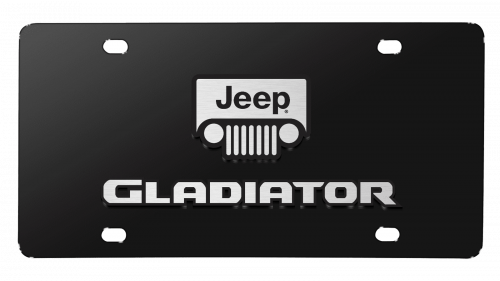
Artwork circulating under a Gladiator emblem heading is not documented as a production Jeep badge. Enthusiast and retail listings sometimes use emblem to describe fender or tailgate pieces, but Jeep’s own identity for the truck has remained the corporate wordmark and grille rather than a dedicated insignia.
The grille and regional variants
The seven-slot grille is the constant across both Gladiator generations in spirit, even though the shapes are decades apart. On the current truck it is a wide, modern interpretation of the Jeep face, shared with the Wrangler. Jeep has also shown that Gladiator identity can be adapted to local markets: the Texas Trail edition, announced in 2021 with comment from Jim Morrison, Vice President of the Jeep brand in North America, is a regional trim rather than a change to the badge itself.
How to read the identity
For practical purposes, the Jeep Gladiator logo is the Jeep logo applied to a pickup: the JEEP wordmark in corporate type, the seven-slot grille, and the model name in matching letterforms. The 1962 truck and the 2020 truck share a name and a brand system, not a single emblem. Anyone looking for a Roman helmet on a current Gladiator will not find one in Jeep’s documented visual identity.
FAQ
Does the Jeep Gladiator have a gladiator helmet logo?
No documented Jeep badge uses a gladiator helmet, and none substitutes a helmet for a letter in the wordmark. The truck carries standard Jeep corporate badging and the model name in Jeep’s own typography.
Is the Gladiator the same truck as the 1960s Jeep pickup?
They share a name but not a design. The original Gladiator was a full-size SJ-platform pickup built from 1962 until the late 1980s; the current Gladiator is a midsize truck built on the Wrangler JL platform and sold from 2019 as a 2020 model.
Where did the Gladiator name come from?
Jeep has said the name honours the historic full-size truck line and the 2005 Gladiator concept that reintroduced it. It reflects heritage rather than a pictorial reference to a Roman gladiator.
Disclaimer
This article is part of the educational resources provided by Logo Index, an independent archive covering logos, visual identities and graphic design history. Jeep Gladiator and associated trademarks and brand assets remain the property of their respective rights holders where applicable.