Landwind (陆风, Lüfeng) was the passenger-car marque of Jiangling Motor Holding, a joint venture formed in 2004 between Changan Automobile and Jiangling Motors Corporation Group (JMCG). The parent is frequently confused with Jiangling Motors Corporation, Ltd. (JMC), the listed company and Ford partner, though the two are distinct legal entities. Based in Nanchang, Jiangxi, Landwind produced SUVs and MPVs, and its badge travelled with the cars into Europe for a period in the 2000s. For the marque’s structure and origins, see Wikipedia’s Landwind entry.
 Landwind Logo PNG
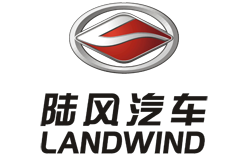
The Landwind emblem is generally explained through the idea of wind. Chinese brand and encyclopedia copy describes the letter L as carrying a ripple, so that the stroke reads as fluttering movement and echoes the name 陆风, or land wind. Red is given as the colour of ambition and energy, while a metallic frame and an outer circle are said to signal technical aspiration and a sense of completeness or customer satisfaction. That reading appears in the PCauto encyclopedia entry for the marque and in a Chinese brand reference on qcds.
Those meanings come from brand-facing and tertiary sources rather than any published design standard, so they are best read as the symbol’s accepted brand description. No designer or agency credit for the Landwind badge is documented, and the emblem carries no dated identity metadata in surviving sources.
Available evidence points to one emblem used across the marque’s life rather than a sequence of successive marks. Variants that appear in circulation are more easily explained as differences in application, such as a vehicle badge compared with a marketing lockup, than as separate identity refreshes. The exact date of any redesign is not well documented.
The name predates the joint venture. Jiangling Lufeng Automobile Co., Ltd. was founded in April 1999, and the first product, the X9 two-door SUV, launched in December 2002. The brand was later relaunched under Jiangling Motor Holding following the 2004 formation of the parent company. That chronology matters for the identity because it places the marque and its badge under Jiangling’s corporate umbrella from the start, rather than as a standalone company mark.
The most widely known chapter involving Landwind’s design came much later than is often repeated. The Range Rover Evoque was revealed in 2010 and went on sale in 2011, so it cannot have influenced a 2005 vehicle. The resemblance dispute concerns the Landwind X7, which debuted at the Guangzhou Auto Show in November 2014 and was sold from 2015 to 2019. JLR won its case on unfair competition rather than copyright at the Beijing Chaoyang District Court on 13 March 2019, with damages of RMB 1.5 million, as Bloomberg reported. The X7 is a separate vehicle from the earlier X6, which was based on the first-generation Isuzu Rodeo and Opel Frontera rather than on any Land Rover.
Landwind’s first push into Europe began in May 2005 with roughly 200 exported units, and the brand returned in 2010 with the CV9 MPV in the Netherlands. The marque’s badge is now a closed chapter: the brand is listed as defunct in 2022, with production of Landwind-badged cars effectively halted by 2020 and only negligible European registrations recorded in the final years. The company status is documented in the same reference work, which gives bankruptcy as the marque’s fate.
Disclaimer
This article is part of the educational resources provided by Logo Index, an independent archive covering logos, visual identities and graphic design history. Landwind and associated trademarks and brand assets remain the property of their respective rights holders where applicable.