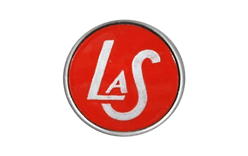
LaSalle was a companion marque of Cadillac, built and sold by General Motors’ Cadillac division in Detroit and marketed for the 1927 through 1940 model years. It sat above Buick and below Cadillac in price and was retailed only through Cadillac dealers. The make took its name from the French explorer René-Robert Cavelier, Sieur de La Salle, echoing Cadillac’s own namesake, Antoine de la Mothe Cadillac (Old Cars Weekly).
 LaSalle Logo PNG
The companion-make idea followed Alfred P. Sloan’s push at General Motors for “a car for every purse and purpose.” Sloan, then GM president, championed the plan to fill the gap between Buick and Cadillac (Hemmings). At its 1927 launch the LaSalle started at $2,495, roughly $600 above the most expensive Buick and about $500 below the cheapest Cadillac. That pricing is the context for the badge: the car had to look like a Cadillac product without wearing the Cadillac crest.
Harley Earl, then a Los Angeles custom-body designer working through Cadillac distributor Don Lee, styled the first LaSalle at the invitation of Cadillac chief Lawrence P. Fisher. Its reception led GM to establish the Art and Colour Section and place Earl in charge of it, the origin of modern American automotive styling; accounts date that appointment to 1927 or 1928 depending on the source (Revs Institute).
The first LaSalle mark: “LaS”
The earliest documented LaSalle device was not a crest at all. The 1927 car carried the marque’s circled trademark “LaS” cast into the horizontal tie bar between the front lights, a placement described as a nod to Hispano-Suiza practice. A separate, larger raised “La S” monogram appeared on the carburetor cover of the 1927 model, as recorded in a 1966 retrospective (Auto History Preservation Society). Both are the explorer’s initials rather than a pictorial emblem.
The heraldic radiator badge
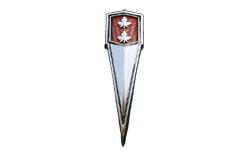
The more elaborate LaSalle badge draws on the armorial bearings of the La Salle family. An 18th-century French nobility dossier gives the blazon as a black (sable) field bearing a running silver (argent) greyhound beneath a gold (or) eight-rayed star, with the shield described as timbré d’un casque de profil, a helmet shown in profile (archived lettres de noblesse). The Canadian Heraldic Authority’s official arms for Ville de LaSalle, Quebec use the same two charges, an eight-rayed gold star and a running silver greyhound (Governor General of Canada heraldic registry).

The animal is specifically a greyhound, a lévrier courant. Some later reproductions show a horse, or draw the star with seven points rather than eight; both depart from the recorded arms. The grant year is not settled: enthusiast accounts traceable to the Cadillac Database give 1710, while the archive documents restate the same arms in 1717 letters of nobility issued for La Salle’s nephew.
Badge variations across the model run
LaSalle badges changed several times across the production years. A specialist emblem catalog lists a chrome “LaS” casting on a grille bar from 1927 to 1932; enamel radiator badges from 1927 to 1930, with the 1930 version becoming a two-piece design and a helmet riveted on separately; hub badges from 1927 into the early 1930s; a luggage-rack badge in 1932; a more V-shaped 1933 grille badge with a more prominent helmet; and a two-piece badge for 1934 (American Auto Emblems). That chronology rests on a single specialist catalog, which also cautions that most red and blue enamel on surviving badges was added by restorers, so the colors seen on today’s examples are not reliable evidence of original finish.
For 1934 the LaSalle was nearly cancelled. Harley Earl’s redesign gave it a tall, narrow grille with chevrons and portholes, and a 1934 LaSalle served as the Indianapolis 500 pace car (Revs Institute). Despite a strong late-1930s showing, the make was not renewed after the 1940 model year (Old Cars Weekly).
Lettering, color and attribution
No reliable source identifies a typeface for any LaSalle wordmark or monogram, and no designer or agency credit for the badge itself is documented. Descriptions of the “LaS” glyphs as letters of different heights and weights, with the “S” the largest, come from individual surviving images rather than from a brand specification, and are best read as descriptions of a single example.
Wings occasionally attached to LaSalle emblems in modern retellings belong to a different identity. Cadillac’s own crest of 1932 to 1946 carried a winged element, and that device is separate from anything recorded on a LaSalle badge. The documented LaSalle charges remain the greyhound, the eight-rayed star and, from about 1930, the helmet.
FAQ
What does the LaSalle emblem show?
The heraldic LaSalle badge carries the arms of the La Salle family: a running silver greyhound on a black field, an eight-rayed gold star above it, and a helmet shown in profile. Earliest marks were simply the letters “LaS” in a circle or a raised “La S” monogram.
Is the LaSalle badge the same as the Cadillac crest?
No. LaSalle was a companion marque sold through Cadillac dealers, but its badge used the La Salle explorer’s family arms. The winged crest associated with Cadillac between 1932 and 1946 is a separate identity.
Who designed the LaSalle logo?
No designer or agency credit for the LaSalle emblem or monogram is documented. Harley Earl is credited with styling the first LaSalle car in 1927, which led to his role at the head of GM’s Art and Colour Section.
Disclaimer
This article is part of the educational resources provided by Logo Index, an independent archive covering logos, visual identities and graphic design history. LaSalle and associated trademarks and brand assets remain the property of their respective rights holders where applicable.