 Oshkosh Logo PNG
Meaning and history
OshKosh B’gosh began in Oshkosh, Wisconsin, in 1895 as a maker of workwear, including hickory-striped denim bib overalls. The Wisconsin Historical Society traces the phrase “Oshkosh B’Gosh” to a vaudeville routine heard by company manager William Pollock in 1911 and records the company name change in 1937. The two-part name therefore links the place name with the phrase that became part of the company identity. Carter’s brand history also describes the overalls and the 1895 origins.
The wordmark is built around “OSHKOSH,” with “B’GOSH” below or alongside it in a contrasting style. In the pictured versions, the O and K receive particular emphasis, while a rule or underline ties the main word together. Carter’s completed its acquisition of OshKosh B’Gosh in 2005 and described it as a separate brand in its completion announcement.
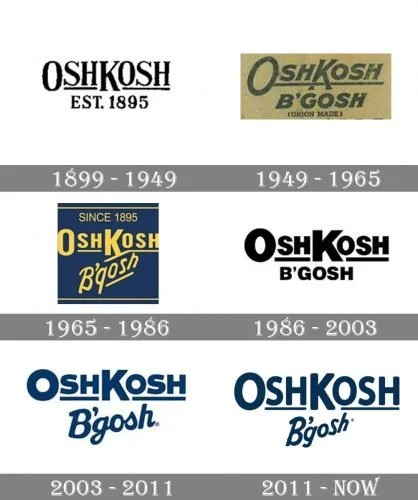
1895 – 1949
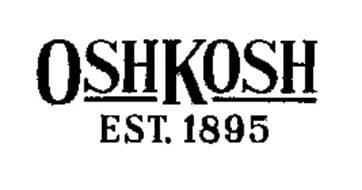
This image pairs a serif “OSHKOSH” wordmark with a rule beneath the letters and “EST. 1895” below. The enlarged O and underline give the name a sign-like form. The date in the artwork is part of the visible design; it does not establish when this particular version first appeared.
1949 – 1965
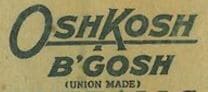
The next pictured version places “B’GOSH” beneath “OSHKOSH,” adding a second line to the identity. Both lines are slanted, with a fine rule under the upper word. The Wisconsin Historical Society records use of the phrase by 1911 and the company rename in 1937, so this image shows the two-part name in a later visual arrangement rather than its documented origin.
1965 – 1986
Here, the wordmark appears in yellow on a dark-blue field, with a border and “SINCE 1895” above the main name. “B’gosh” is rendered in a loose diagonal script, contrasting with the larger, upright letters of “OSHKOSH.”
1986 – 2003
This black-and-white version uses heavy lettering and a compact two-line layout. “B’GOSH” is set in bold capitals beneath “OSHKOSH,” replacing the previous stage’s handwritten treatment with a more uniform typographic style.
2003 – 2011
Blue lettering returns on a white ground. The upper word has an underline, and the lower “B’gosh” uses a slanted script with its own short rule. The two contrasting lines remain distinct while forming a single compact mark.
2011 – Today
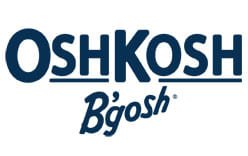
This pictured version uses dark-blue lettering on white, with a large O and K, underlined “OSHKOSH,” and diagonal script for “B’gosh.” Compared with the preceding image, the main letters appear taller and more open. This describes the visual stage shown here without assigning it a confirmed present-day use.
Wordmark variations
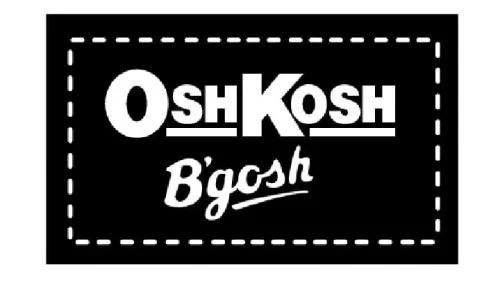
This framed version reverses the palette to white lettering on black and adds a dashed inner border. It retains the enlarged initial letters, underline, and script “B’gosh,” but the border makes the design read more like a label than the unframed wordmarks. A third-party description of OshKosh labels also notes a yellow mark on a blue garment tag.
View the Oshkosh logo archive entry.
Disclaimer
This article is part of the educational resources provided by Logo Index, an independent archive covering logos, visual identities and graphic design history. Oshkosh and associated trademarks and brand assets remain the property of their respective rights holders where applicable.