 ARO Logo PNG
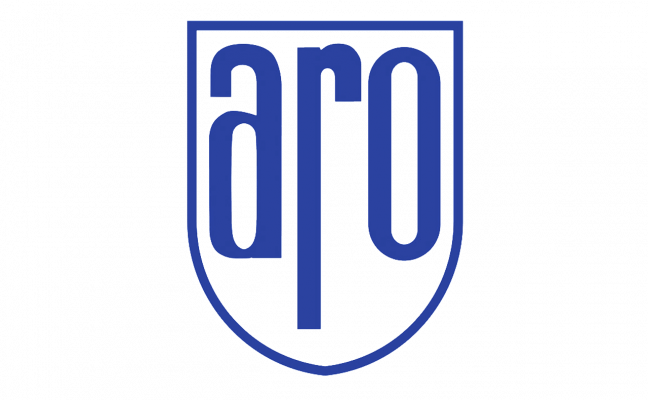
The ARO logo belongs to one of Romania’s best-known historic vehicle manufacturers. Its compact shield-shaped badge contains the lowercase aro name, usually shown in blue and white or as a metallic vehicle emblem.
The name came from Automobil Românesc, meaning “Romanian Automobile.” Importantly, the ARO name did not begin with the factory’s first 4×4 in 1957. The early vehicles were sold under IMS and M461 designations; specialist ARO historical material places the adoption of the ARO name around 1969 with the ARO M461 C. [1]
ARO Logo Meaning and History
The ARO emblem is built around a simple visual structure:
- a compact shield or crest-shaped outline;
- the lowercase aro name inside it;
- a distinctive extended stroke in the central lettering;
- blue-and-white or metallic finishes depending on the application.
The strongest documented meaning lies in the name itself. ARO is an abbreviation of Automobil Românesc, linking the badge directly to the Romanian origin of the vehicles. [2]
No authoritative source located for this article states that the shield officially represented strength or protection, that lowercase lettering meant approachability, or that blue represented reliability. Those are later design interpretations rather than documented ARO symbolism.
What Does ARO Stand For?
ARO derives from the Romanian phrase Automobil Românesc.
ARO M461 Club Romania, a section of Retromobil Club Romania dedicated to documenting the marque’s history, explains that the factory’s existing M461 designation had become unsuitable as a commercial brand as exports expanded. The name ARO was therefore adopted as an abbreviation of “automobil românesc.” [1]
The new branding appeared with the ARO M461 C, launched around 1969.
ARO Did Not Begin as ARO in 1957
The Câmpulung factory began producing off-road vehicles in 1957, but the first model was called the IMS-57.
IMS stood for Întreprinderea Metalurgică de Stat, and the number 57 referred to the launch year. Later versions included the M59 and M461. :contentReference[oaicite:3]{index=3}
The M461 became an important export model during the 1960s. Historical documentation from ARO M461 Club notes that technical material from 1965 even listed the make as UMM, referring to Uzina Mecanică Muscel, before ARO became the established commercial name. [3]
This means it is misleading to label a 1957 badge as the original “ARO logo” unless period evidence specifically shows ARO branding on it.
When Did the ARO Logo Appear?
The best-supported period is the late 1960s.
ARO historical sources state that vehicles began to be branded with the ARO name in 1969, when the M461 was updated into the ARO M461 C. [4]
Technical manuals also show the transition. ARO M461 Club preserves manuals and parts catalogues from the period, including ARO M461 C documentation dating from the end of the 1960s and early 1970s. [5]
That provides a much firmer historical anchor than simply assigning the logo to 1957.
The Classic ARO Shield Badge
The classic ARO badge uses a vertically compact crest with rounded lower contours and the lowercase wordmark occupying most of the interior.
The lettering is unusual enough to function almost like an emblem by itself. One of the strokes extends downward toward the lower part of the shield, visually tying the name to the outer shape.
No reliable source located for this article identifies the designer of the mark or a commercial typeface from which it was derived.
ARO Logo Typography
The lowercase aro lettering is one of the most recognizable features of the badge.
Its shapes are relatively narrow and rounded, with customized proportions that distinguish it from ordinary typeset text.
The safest description is therefore a custom lowercase wordmark rather than assigning it to a particular font family.
The use of lowercase letters is visually distinctive, but there is no evidence that ARO chose them specifically to communicate friendliness or approachability.
ARO Logo Colors
The badge is commonly reproduced in blue and white, while badges mounted directly to vehicles can appear in silver, black or other metallic treatments.
These variations reflect different manufacturing and reproduction contexts rather than necessarily representing separate symbolic identities.
No authoritative source located for this article confirms that:
- blue officially represented trust or reliability;
- white represented purity;
- black represented masculinity;
- silver represented engineering precision.
Those claims should therefore be treated as generic color psychology, not ARO history.
Did the ARO Logo Change in 2003?
Some logo-history sources divide the ARO identity into a 1957–2003 design and a revised 2003–2006 version.
There is not enough authoritative documentation located for this article to support such a precise two-stage redesign timeline.
Different badge executions certainly existed, including flat printed versions and metallic vehicle emblems, but these may reflect manufacturing, model and application differences rather than a formal corporate rebrand.
For Logo Index, it is safer to present them as variations of the established ARO shield identity unless a dated factory brand manual or trademark record proves otherwise.
The ARO 24 and the Badge’s Best-Known Era
The ARO identity became particularly visible with the 24 Series.
Development of the new vehicle family began in the second half of the 1960s, and production of the ARO 24 range began in the early 1970s. The vehicles became the marque’s most internationally recognizable products. :contentReference[oaicite:4]{index=4}
ARO vehicles were exported widely. Historical accounts state that production reached hundreds of thousands of vehicles, with exports reaching more than 100 countries. :contentReference[oaicite:5]{index=5}
That international distribution helped turn the small shield badge into a recognizable symbol of Romanian off-road manufacturing.
ARO and Romanian Industrial Identity
The ARO name itself made the brand’s national origin unusually explicit.
Rather than using a founder’s surname or an invented international name, Automobil Românesc effectively described the product and its country of origin at the same time.
This is the strongest national-identity connection in the branding. It is better supported than trying to derive Romanian symbolism from every shape or color in the badge.
What Happened to ARO?
The company’s decline accelerated after the fall of Romania’s communist regime.
ARO was converted into a joint-stock company in 1990. After several failed privatization attempts, the Romanian state sold its majority stake in 2003 to the U.S.-registered company Cross Lander. [6]
The company entered reorganization proceedings in 2005 and was declared bankrupt in 2006. [6]
Was the ARO Factory Bought by Renault?
No.
The claim sometimes repeated in logo articles that Renault bought the ARO factory after bankruptcy is incorrect.
ARO’s assets were sold separately through liquidation. In 2007, one major package of land, buildings, equipment and manufacturing licences was purchased by Landmark Management, associated with businessman Nicolae Rațiu. :contentReference[oaicite:6]{index=6}
Another ARO components facility was sold separately to a company from Câmpulung. :contentReference[oaicite:7]{index=7}
Renault did own Dacia, another Romanian manufacturer, but it did not acquire the bankrupt ARO plant in the manner described by the old article.
ARO Logo Legacy
The ARO badge remains recognizable because of a few simple features:
- the direct Automobil Românesc name;
- the compact crest outline;
- the custom lowercase aro lettering;
- decades of use on Romanian 4×4 vehicles;
- extensive exports during the marque’s strongest years.
The real history is more interesting than generic symbolism: ARO grew out of the IMS and M461 programs, adopted a proper export-oriented brand name around 1969, and carried that identity across one of Romania’s most successful automotive export stories.