 Bristol Logo PNG
Meaning of the Bristol Cars Logo
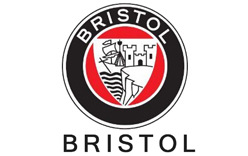
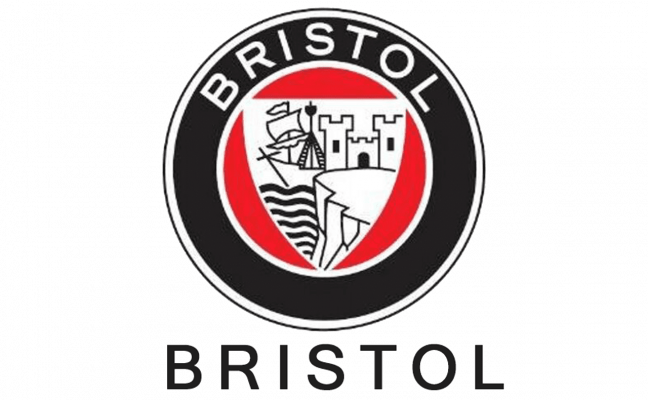
The central element of the Bristol Cars badge comes from the historic heraldry of the City of Bristol.The emblem shows a sailing ship approaching or emerging from a fortified gateway or castle. Bristol City Council describes the city’s crest as depicting a merchant ship alongside the castle, imagery that reflects Bristol’s long history as a major port and center of maritime trade. [3]The imagery is much older than the automobile company. Bristol Archives documents a medieval city seal from the reign of Edward I showing Bristol Castle and a merchant ship approaching its Watergate along the River Avon. [4]The car company’s use of this symbol therefore created a direct visual connection with the city whose name it carried, rather than functioning as an invented luxury-car emblem.Bristol Cars Logo Design
The best-known Bristol Cars badge places the historic ship-and-castle device inside a circular emblem surrounded by the BRISTOL name.Earlier and later physical badges differ in color, framing and detail. Some versions reproduce the city imagery in several colors, while later badges simplify the heraldic scene into a more restrained red, black, white and metallic treatment.The important constant is the central Bristol civic imagery. There is no need to interpret the ship as speed, the castle as strength or the surrounding circle as unity without documentary evidence.1945: Bristol Enters the Car Business
The automobile operation began immediately after the Second World War. The Bristol Aeroplane Company had a large skilled workforce and needed new products as wartime aircraft production declined.The Bristol Owners’ Club states that the company decided to enter the quality-car market and established a new Car Division. By autumn 1946, motoring publications were already testing the new Type 400 saloon. [2]For this reason, Bristol Cars is commonly dated to 1945 as an organization, while its first production automobile reached the market around 1946 to 1947.The Bristol 400 and BMW Engineering
Bristol’s first car was closely connected with prewar BMW engineering.The Bristol 400 used a chassis related to the BMW 326, body ideas associated with the BMW 327 and an engine derived from the BMW 328’s 2.0-liter six-cylinder unit. BMW engineer Fritz Fiedler also became involved with Bristol’s engine development after the war. :contentReference[oaicite:3]{index=3}The relationship came partly through AFN, the British Frazer Nash company that had sold BMW automobiles in Britain before the war. H.J. Aldington of AFN played an important role in establishing Bristol’s access to the German engineering designs.The Bristol 400 therefore was not simply a British car fitted with an imported BMW engine. Bristol manufactured and developed its own versions of the BMW-derived mechanical components.Bristol-Built Six-Cylinder Engines
The original article incorrectly suggests that Bristol initially used its own engines and later switched to BMW.In reality, Bristol’s early engines were Bristol-built derivatives of the BMW 328 six-cylinder design. They powered the Bristol 400 and successive models through the 1950s.These engines also developed a reputation outside Bristol. Variants were supplied to manufacturers and racing teams including Frazer Nash, AC, Lotus and Cooper. :contentReference[oaicite:4]{index=4}Bristol 401, 403 and Aerodynamic Design
The Bristol 401 followed the 400 and introduced significantly more aerodynamic bodywork influenced by Italian coachbuilder Touring and its Superleggera construction principles.The later 403 retained the basic body shape while receiving mechanical improvements. Aerospace Bristol preserves a 1953 Bristol 403 built at Filton and emphasizes how the manufacturer’s aviation engineers applied aircraft-industry knowledge and production methods to the cars. [1]Bristol’s Aircraft Connection
The relationship between Bristol cars and aviation was real, but it should not be reduced to generic statements about aerospace-inspired quality.The cars were developed by the automobile division of the Bristol Aeroplane Company at Filton, using engineering staff and manufacturing expertise that came directly from aircraft production.BAE Systems’ official history notes that Bristol Cars was one of the Bristol Aeroplane Company’s postwar diversification projects and that the automobile business was separated from the aircraft organization in 1960. [5]1960: Bristol Cars Becomes Independent
Corporate changes in the British aircraft industry led to a major transition for Bristol’s automobile operation.When the Bristol Aeroplane Company’s aircraft activities became part of the newly created British Aircraft Corporation, the car operation was separated. Sir George White and Anthony Crook formed Bristol Cars Limited in 1960 and continued production independently. [2]Anthony Crook later became one of the personalities most closely identified with Bristol Cars and eventually became sole proprietor.1961: Bristol Switches to Chrysler V8 Power
The major engine change came in 1961 with the Bristol 407.The 407 replaced Bristol’s BMW-derived straight-six with a larger Chrysler V8 sourced from Canada. The change provided substantially greater torque and performance without requiring Bristol to finance development of an entirely new large engine. :contentReference[oaicite:5]{index=5}Subsequent traditional Bristol models continued using Chrysler-based V8 engines for decades.Bristol 407 to 411
The 407 established the basic mechanical direction followed by Bristol during the 1960s and 1970s.It was succeeded by the 408, 409, 410 and 411, each continuing the formula of a hand-built British grand tourer with American V8 power.Production remained deliberately small. By this period Bristol’s strategy increasingly emphasized individual construction and exclusivity rather than competing with larger-volume luxury manufacturers. :contentReference[oaicite:6]{index=6}Later Bristol Cars
Bristol continued evolving the traditional front-engine grand-tourer layout through models including the 603, Britannia, Brigand and Blenheim.The company became famous for being unusually discreet. Production numbers were low, advertising was limited, and for many years Bristol operated a single London showroom.This exclusivity was partly a consequence of tiny production capacity rather than simply a modern luxury-marketing strategy.The Bristol Fighter
The most radical modern Bristol was the Fighter, introduced during the 2000s.Unlike the company’s traditional saloons, the Fighter used a dramatic gullwing coupé body and a Chrysler-derived Dodge Viper V10 engine. It represented a substantial departure from Bristol’s earlier understated grand tourers while retaining the company’s preference for very small production runs. :contentReference[oaicite:7]{index=7}What Happened to Bristol Cars?
The original Bristol Cars business entered administration in 2011, bringing its continuous period of low-volume automobile production to an end.Assets and intellectual property subsequently passed to new ownership, and there were attempts to revive the company. One of the most visible was the Bristol Bullet project announced during the 2010s.Those revival efforts should be distinguished from the original Bristol Cars operation rather than treated as uninterrupted production.Bristol Cars in 2026
The Bristol name has recently returned again.In September 2026, Bristol Cars announced a limited revival of the Bristol Fighter using five remaining original chassis. The cars are intended to be completed in collaboration with a British manufacturing partner and built to specifications based on the original V10-powered model. :contentReference[oaicite:8]{index=8}This means Bristol should no longer be described simply as a permanently defunct marque, although it remains very different from a conventional active volume manufacturer.The City of Bristol Crest
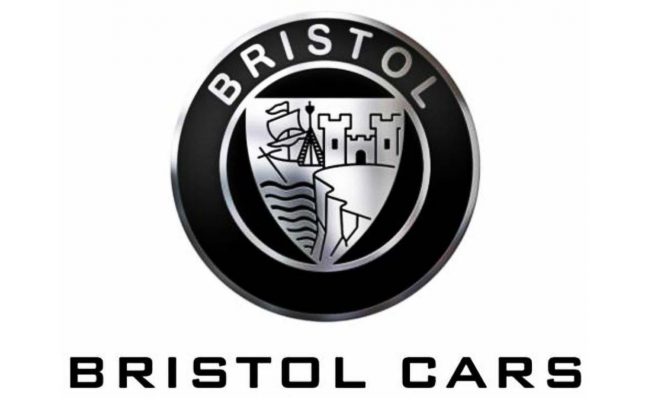 The ship and castle at the center of the Bristol Cars badge are derived from the historic arms of Bristol.The imagery reflects the city’s geography and commercial history. Bristol developed as an important port on the River Avon, and the combination of a fortified gateway with a merchant ship had already appeared in medieval civic seals centuries before Bristol Cars existed. [4]Bristol City Council explicitly interprets the merchant ship and castle as highlighting the importance of the port, trade and the wealth associated with maritime commerce. [3]
Bristol Script Badge
Bristol cars also used a separate cursive Bristol script as exterior badging.This lettering commonly appeared as a metallic vehicle emblem and could be used separately from the circular civic-crest badge. It functioned as a simpler marque identifier when the detailed heraldic emblem was unnecessary.No authoritative source located for this article identifies the designer of the script or a commercial typeface from which it was derived.Typography and Color
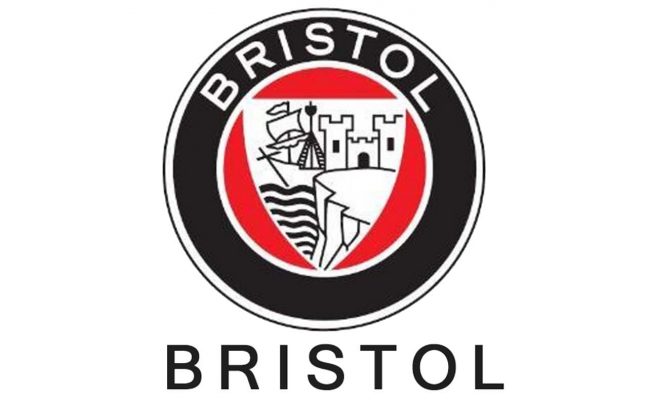 The circular Bristol Cars badge generally combines uppercase BRISTOL lettering with a detailed central heraldic device. The lettering itself is visually secondary to the ship-and-castle emblem.Different reproductions and physical badges use red, black, white, silver and other colors inherited partly from their interpretation of the civic arms.No reliable Bristol Cars source located for this article establishes a color-psychology system in which red represents passion, black represents confidence or white represents purity. Those meanings should not be presented as documented brand symbolism.
Why the Bristol Logo Matters
The Bristol Cars identity is unusual because it links three separate histories: the maritime heritage of the City of Bristol, the aircraft engineering background of the Bristol Aeroplane Company and the extremely small-scale automobile manufacturer that emerged after the Second World War.The badge therefore carries a genuine geographic meaning. The ship and castle are not generic luxury symbols but recognizable elements of Bristol’s civic heraldry, while the continued use of the city name reinforces the manufacturer’s connection with its original Filton home.FAQ
What does the Bristol Cars logo mean?
The Bristol Cars logo is based on the historic coat of arms of the City of Bristol. Its central imagery shows a merchant ship and castle, reflecting Bristol’s long history as a port and trading city.
When was Bristol Cars founded?
The Bristol Aeroplane Company created its automobile division around 1945 after the Second World War. The first Bristol 400 cars appeared during 1946 and entered production around 1947.
Did Bristol Cars use BMW engines?
Early Bristol cars used Bristol-built engines derived from the prewar BMW 328 six-cylinder design. They were not simply later BMW engine installations. Bristol used these BMW-derived engines until the 407 introduced Chrysler V8 power in 1961.
When did Bristol start using Chrysler engines?
Bristol introduced Chrysler V8 power with the Bristol 407 in 1961. Later models continued using Chrysler-based V8 engines, while the Fighter used a Dodge Viper-derived V10.
Is Bristol Cars still in business?
The original Bristol Cars company entered administration in 2011. The marque has subsequently undergone several revival attempts, and in 2026 a limited return of the Bristol Fighter using surviving original chassis was announced.
Disclaimer
This article is part of the educational resources provided by Logo Index, an independent archive covering logos, visual identities and graphic design history. Bristol Cars and associated trademarks and brand assets remain the property of their respective rights holders where applicable.