KG Mobility Corp. is the Pyeongtaek-based South Korean SUV maker listed on the KRX under 003620 and the company that took over from SsangYong Motor. Its visual identity carries an unusual split: the name used in legal documents and the name on the badge are not the same. The company’s own brand identity guide states that “KG Mobility” is reserved for legal references and official documents, while all other internal and external communication uses “KGM”. The marque most people now see on a vehicle is therefore a three-letter wordmark rather than the full corporate name, and the KGM letters appear on the vehicles themselves.
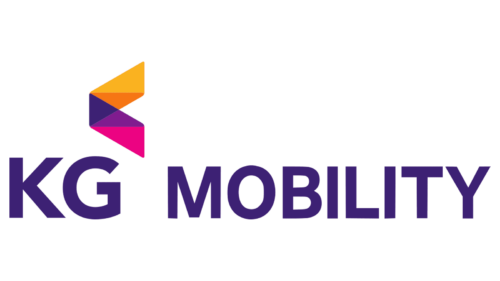 KG Mobility Logo PNG
Meaning and history
The business behind the badge began in January 1954 as Ha Dong-Hwan Motor Workshop. It was renamed Dong-A Motor in February 1977, and SsangYong Group took ownership in November 1986, with SsangYong Motor following as the legal name in March 1988. Mahindra & Mahindra agreed to buy roughly 70 per cent of the company in 2011 in a deal reported at around ₩523bn, and the SsangYong name stayed on the cars for another decade (Yonhap).
Two SsangYong marks shaped what came next. The three-circle SsangYong emblem, which pairs a stylised “S” with a dragon form, was first used in 1993 and was retired from new cars in 2023, giving it a run of roughly thirty years. A wing emblem arrived in 1997 on the Chairman luxury sedan, created to signal a more premium and international positioning; the specialist outlet that documents it describes the motif as a bird embracing the globe.
Financial trouble forced the change of name. SsangYong applied for court rehabilitation in December 2020 and entered receivership in April 2021. KG Group was selected as preferred bidder in June 2022, and a rehabilitation plan was approved that August, with the acquisition finalised in late 2022. Shareholders approved the rename to KG Mobility on 22 March 2023, ending 35 years of the SsangYong corporate name (Yonhap).
2023 to today: from KG Mobility to KGM
At the Seoul Mobility Show on 30 March 2023 the company displayed the export wing emblem in place of the SsangYong three-circle badge, and said the final design had not yet been fixed (Motorgraph). The KGM wordmark entered use in overseas markets in April 2023, and on 30 November 2023 KGM was launched as the company’s representative brand in Korea. That launch defined the system still in use: a KGM wordmark paired with the wing emblem, rolled out across roughly 200 sales outlets and around 500 parts and service outlets, with the new lettering applied to all vehicles produced from 1 December 2023 (Yonhap, Edaily).
The UK market rebrand is documented by the agency that carried it out. Visarc records that it kept the wing brandmark it calls Dragon Wings at the centre of a new wordmark lockup, introduced a two-font pairing and a restrained black-and-white palette with regal purple borrowed from KG Group’s corporate colours. The UK campaign also carried the slogan “Go Different. KGM” (CarDealer Magazine). This is a market-level project rather than a credit for the global KGM wordmark.
The wing did not accompany the wordmark indefinitely. It was used progressively less in the Korean market after the brand launch, and the KGM wordmark became the primary identifier on its own. That transition is why earlier KGM material can look noticeably different from the badge the brand uses now.
Colour and typography
Colour is the most precisely documented part of the system. The official guide lists five KG corporate colours – KG Royal Purple (Pantone 268C), KG Violet (2602C), KG Magenta (213C), KG Orange (158C) and KG Yellow (130C) – and two brand colours for KGM, a deep Astral Aura (Pantone 19-3830) and a Light Gray (Cool Gray 4C) (KG Mobility brand identity). That palette is a useful reference point when older descriptions call the badge purple or fuchsia: the purple tones map to Royal Purple and Violet, while fuchsia sits closest to KG Magenta.
Typography is handled more quietly. The wordmark is a geometric sans-serif with even, closed letterforms, and no designer or agency is documented in reliable sources as the author of the global KGM lettering. A tertiary encyclopedic source associates KG Group’s own corporate typeface with Avenir (Wikipedia), which is a group-level detail rather than a confirmed choice for the KGM logo, and the typeface behind the wordmark itself is not publicly credited.
Symbolism attached to the marks is thin. KG Group’s multicolour corporate mark is described as representing a prism, and the same source notes the group’s reading of its initials as “Korea Green”. For the automotive wing emblem, the one documented intention is the 1997 brief to project a premium, global image. Interpretations that read the KGM lettering as a directional shape or arrowhead are not supported by any published material; the official identity is described through the wordmark, the wing and the colour system rather than a hidden symbol.
FAQ
Is the brand called KG Mobility or KGM?
Both, for different purposes. KG Mobility is the legal and corporate name used in official documents, while KGM is the name used in all other communication, including vehicles, advertising and dealerships, according to the company’s own brand guide. Cars built since the KGM brand launched carry KGM lettering.
What happened to the SsangYong three-circle logo?
The three-circle emblem, which combines a stylised “S” with a dragon form, was first used in 1993 and stopped appearing on new cars in 2023, when the company renamed itself KG Mobility and then introduced the KGM brand.
Does the KGM logo still use the wing emblem?
The wing emblem was part of the KGM identity introduced in late 2023 and was retained through the first phase of the rebrand, including in the UK market. It was used progressively less afterwards, leaving the KGM wordmark as the primary mark.
Disclaimer
This article is part of the educational resources provided by Logo Index, an independent archive covering logos, visual identities and graphic design history. KG Mobility and associated trademarks and brand assets remain the property of their respective rights holders where applicable.