 Aston Martin Logo PNG
The Aston Martin wings are among the longest-running symbols in British automotive design. Aston Martin introduced its first wing-shaped badge in 1927, but the emblem most closely related to the modern logo appeared in 1932, when feathered wings and a central Aston Martin nameplate established a structure the company has retained ever since. [1]
The company itself dates to 1913, when Lionel Martin and Robert Bamford established the business that produced the first Aston Martin cars. The name combines Martin’s surname with Aston Hill, the Buckinghamshire hill-climb venue closely associated with Lionel Martin’s early competition activity. [2] [3]
Aston Martin Logo Meaning and History
Aston Martin’s documented explanation of its wings is more specific than the generic claims often attached to automotive wing symbols. The company says that its first wing-shaped badge replaced an earlier round logo in 1927. In 1930, those wings became more tapered and pointed, forming a V-shaped composition. [1]
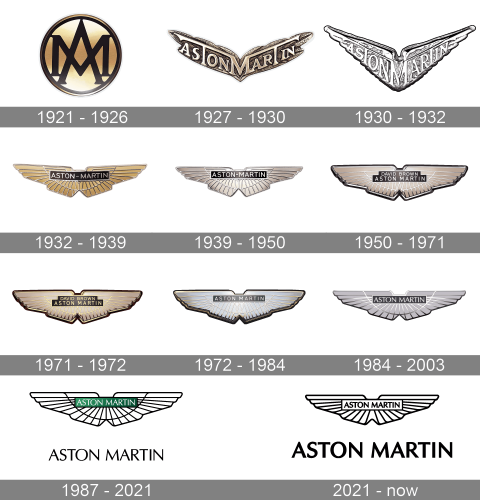
The decisive change came in 1932. Aston Martin says the wings acquired the feathered appearance recognizable today, while the company name was placed inside a central rectangular panel. Racing driver and The Autocar editor Sammy Davis designed this version. [1]
The Scarab Inspiration Behind the Wings
Aston Martin directly connects Davis’s design with the popularity of Egyptology during the 1930s. The company explains that ancient Egyptians associated the scarab beetle with the sun god and with new beginnings. Davis drew on that imagery while redesigning the badge during a period of restructuring in Aston Martin’s ownership. [1]
The redesigned emblem first appeared on the Aston Martin LM1 racing car that Davis had purchased and modified for road use. It subsequently appeared in Aston Martin marketing and eventually across production cars. [1]
This documented scarab connection is more useful than assigning unsupported meanings such as freedom, aspiration or speed to the wings. Those ideas may be reasonable interpretations of a winged automotive badge, but Aston Martin’s own history identifies the scarab and the theme of new beginnings as the specific inspiration for the landmark 1932 design.
Early Aston Martin Badges
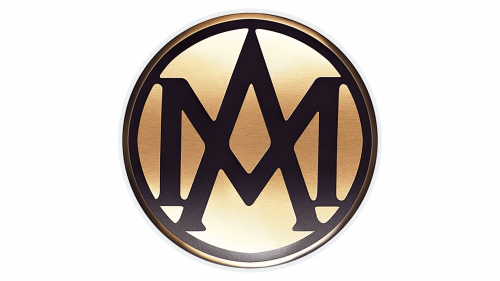
Before the wings, Aston Martin used a circular badge built around the letters A and M. The surviving early identity is fundamentally different from the winged form that later became inseparable from the marque.
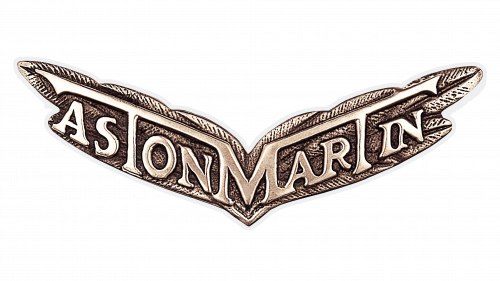
Aston Martin officially dates the introduction of its wing-shaped badge to 1927. This first interpretation was substantially different from the feathered wings used today but established the horizontal silhouette that would define the company’s identity. [1]
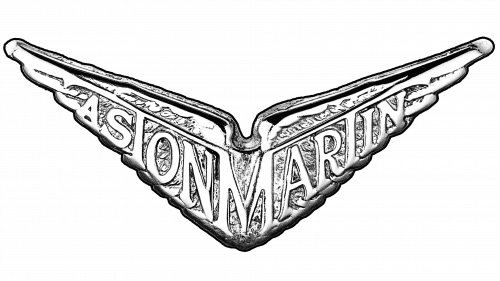
In 1930 the wings became tapered and more sharply pointed. Two years later the company adopted the feathered treatment and central name panel that established the foundation of the modern Aston Martin badge. [1]
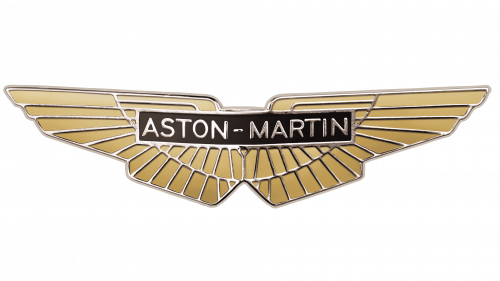
Evolution of the Winged Badge
Once the feathered wings had been established, Aston Martin’s visual identity evolved primarily through refinements to proportions, line weight, lettering, materials and the central nameplate rather than through replacement of the core symbol.
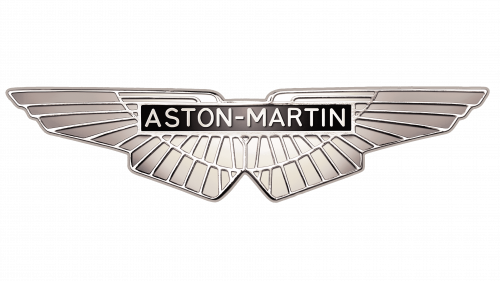
The ability of the basic wing structure to survive successive periods of ownership became one of the most notable characteristics of the identity. Aston Martin itself describes the 2022 badge as only the eighth significant adjustment to the marque during its first 109 years. [4]
David Brown and Aston Martin
Industrialist David Brown acquired Aston Martin in February 1947 and bought Lagonda later that year. His ownership became one of the defining periods in the company’s history, and his initials produced the DB model designation still associated with Aston Martin cars. [5]
Brown stepped away when Aston Martin Lagonda was taken over by Company Developments in 1972. The wings nevertheless remained the central identifying device through the subsequent ownership changes. [6]
2003 Refinement
A major refinement arrived in 2003. Aston Martin’s later announcement of its 2022 identity explicitly described the new badge as the first major update to the wings since 2003, demonstrating how stable the design had become during the intervening period. [4]
The 2022 Aston Martin Logo
Aston Martin unveiled its current identity in July 2022 as part of a broader brand repositioning built around the expression “Intensity. Driven.” The redesigned wings were produced by Aston Martin’s own design function in collaboration with British art director and graphic designer Peter Saville. [4]
The revision simplified the construction of the wings while preserving their familiar overall shape. Aston Martin also retained the physical craftsmanship associated with the badge: the company stated that the new hand-enamelled wings would be made by artisans in Birmingham’s Jewellery Quarter and introduced on its next generation of sports cars. [4]
The significance of the 2022 redesign therefore lies less in creating a new symbol than in reducing and modernizing a mark whose essential structure has existed since 1932.
Aston Martin Wordmark and Typography
The central nameplate uses uppercase lettering placed within the wings. Its proportions and treatment have changed across different badge generations, but the name has remained integrated into the emblem rather than becoming a separate automotive symbol.
No authoritative source located for this article identifies the current Aston Martin lettering as a standard commercial typeface. Font matches sometimes suggested online should therefore not be presented as the actual font used by the company.