 Bogdan Motors Logo PNG
Bogdan Motors is the name most Ukrainians associate with the buses and trolleybuses that ran through Cherkasy, Lutsk and Kyiv. The business behind them started out in 1993 as a vehicle distributor and was reorganised in February 2005 into what is now Bogdan Corporation, a group that builds buses, trolleybuses, trucks and specialised vehicles and acts as an importer for brands including Hyundai, Haval, Great Wall, JAC and Subaru. Its corporate mark is unusual for the industry: instead of a wing, a gear or a speedometer motif, the primary Bogdan emblem is a stylized hetman’s mace.
What follows covers the corporate emblem, the separate badge the company introduced for passenger cars in 2010, and the ЛуАЗ wordmarks that regularly appear in Bogdan logo round-ups even though they belong to a plant Bogdan only acquired in 2000.
The Bogdan emblem: a stylized hetman’s mace
The Kyiv design agency Büro.MT lists the Bogdan logo and corporate identity in its portfolio and states that the starting point was the association of the name “Bogdan” with Hetman Bohdan Khmelnytsky. The resulting emblem is a stylized hetman’s bulava, the ceremonial mace that functions as a symbol of authority. In the agency’s own description, it stands for devotion to Ukraine, for a contribution to the development of the state, and for the corporation’s authority on Ukrainian roads (Büro.MT).
The agency page is undated, so the exact year the mace first appeared cannot be fixed from that source. Contemporary reporting from 2010 already referred to it as the “main trademark of the corporation,” which confirms it was in established use by then (Autocentre). In the version shown here, a metallic emblem sits above the Cyrillic wordmark “Богдан,” which reads green. No official typeface name or published Pantone, CMYK or RGB specification for the corporate mark has surfaced in the sources reviewed, so it is more accurate to describe the colours as they appear than to assert a formal specification.
The mace reads as a piece of Ukrainian state symbolism placed at the centre of a commercial identity, which makes it a recognisable sight on city buses even at a distance. Its shape is sometimes described in casual logo collections as an automotive component or a mechanical part, but the documented origin is the hetman’s bulava.
A second, separate badge: the 2010 sailboat “B”
On 28 May 2010 Bogdan presented a different trademark, created specifically for passenger cars intended for export and for the Bogdan 2310. It is not the mace. The badge is a letter “B” shaped like a sailboat with fully set sails, enclosed in an ellipse and executed in silver and green (LIGA.net).
Reporting at the time set out the intended reading of each element: the sailboat represented a favourable wind, success and hope; the ellipse represented stability; the silver suggested perfection; and the green stood for growth and renewal. That documented explanation applies to the passenger-car badge, not to the corporate or bus emblem, and the two should not be treated as interchangeable. The sailboat “B” belonged to the car programme; the mace remained the identity of the wider corporation and its bus production.
LuAZ: a predecessor brand, not a Bogdan logo stage
LuAZ is the Lutsk Automobile Plant, and the abbreviation has been attached to the works since 1967. Bogdan Motors took over the bankrupt LuAZ plant in 2000, and bus and trolleybus production in Lutsk began in spring 2006 (Kyiv Post). Every LuAZ mark therefore predates Bogdan’s ownership and belongs to a different manufacturer’s identity, which is why treating a sequence of ЛуАЗ logos as the early history of the Bogdan Motors logo is misleading.
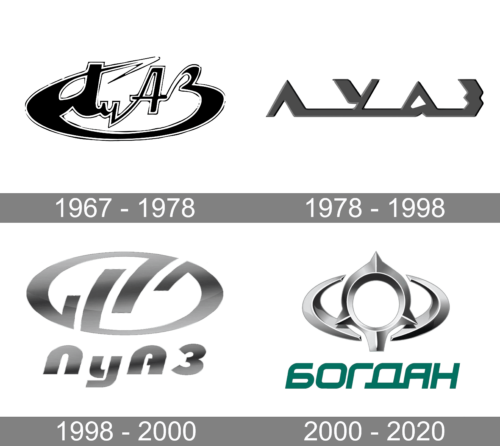
Composite overviews that line up ЛуАЗ wordmarks beside the Bogdan mace can give the impression of one continuous lineage. In practice the two identities come from different companies: the mace is Bogdan’s corporate mark, while the ЛуАЗ lettering belongs to the Lutsk plant’s own Soviet and post-Soviet branding.
An early LuAZ mark sets the Cyrillic letters ЛуАЗ in sharp, angular forms within an oval frame, rendered in plain black and white. The date range sometimes printed alongside it on logo compilations is not confirmed by any official plant source, so it is safest to read the numbering as approximate editorial context rather than a documented redesign date.
A later LuAZ version renders the same lettering with a metallic gradient, giving the wordmark solidity and depth while keeping the angular geometry. The accompanying date label is again unverified.
A third LuAZ variant places two symmetrical metallic shapes, visually suggesting two connected forms, above the ЛуАЗ lettering on an elliptical backdrop. As with the other two, the dated label comes from logo collections rather than from plant documentation.
Company background behind the identity
Bogdan Motors was created in 1993, after the break-up of the Soviet Union, initially as a distributor of Russian vehicles and later of Kia models. It took over the Cherkasy Automobile Repair Factory in 1998; in 1999 that plant became Cherkasy Autobus and began building Bogdan’s own buses; in 2000 the bankrupt LuAZ works in Lutsk were acquired. In February 2005 the group was consolidated into Bogdan Corporation, which today describes itself as a manufacturer of buses, trolleybuses, trucks and specialised vehicles and a representative of several foreign car brands (Bogdan). The company also supplied vehicles to the Ukrainian military and developed cooperation with educational institutions.
The brand’s active manufacturing period, however, does not run to the present. Production had effectively stopped by around 2020, and Bogdan Motors was declared bankrupt and liquidated in 2021 (Wikipedia). The mace emblem was in use by 2010 and remained the corporation’s mark as the group wound down, which is the accurate way to frame the end of the logo timeline.
FAQ
What does the Bogdan Motors logo represent?
The main corporate emblem is a stylized hetman’s mace, or bulava. Its designer, the agency Büro.MT, states that the idea came from the association of the name Bogdan with Hetman Bohdan Khmelnytsky, and that the mace stands for devotion to Ukraine, contribution to the state’s development, and the corporation’s authority on Ukrainian roads.
Did Bogdan Motors ever use a different logo?
Yes. On 28 May 2010 the company introduced a separate trademark for passenger cars for export and for the Bogdan 2310: a letter “B” shaped like a sailboat with full sails inside an ellipse, in silver and green. That badge was intended for the car programme and is distinct from the corporate mace.
Are the LuAZ logos part of Bogdan Motors logo history?
No. LuAZ is the Lutsk Automobile Plant, whose abbreviation has been used since 1967. Bogdan Motors only acquired the plant in 2000, so the ЛуАЗ wordmarks belong to a predecessor manufacturer rather than to Bogdan’s own identity.
Who designed the Bogdan logo?
The Kyiv agency Büro.MT credits itself with the Bogdan logo and corporate identity and explains the mace symbolism on its portfolio page. That page is undated, so the exact year of the design is not established from the available source.
When did Bogdan Motors stop producing vehicles?
Manufacturing had effectively stopped by around 2020, and Bogdan Motors was declared bankrupt and liquidated in 2021. The group had already been consolidated as Bogdan Corporation in February 2005.
Disclaimer
This article is part of the educational resources provided by Logo Index, an independent archive covering logos, visual identities and graphic design history. Bogdan Motors and associated trademarks and brand assets remain the property of their respective rights holders where applicable.