The Dodge Charger has carried more than one emblem over its life. The nameplate spans B-body muscle coupes, a front-drive 1980s hatchback, a full-size rear-drive sedan and, most recently, an electric and combustion generation sold on both sides of the Atlantic. Its visual identity was never a single fixed lockup. It blends a corporate Dodge symbol, model-specific scripts and a long list of performance badges that changed with each generation.
For anyone tracing the Dodge Charger logo, the useful starting point is the split between marks owned by Dodge as a brand and badging owned by the Charger as a model.
The Fratzog, Dodge’s corporate symbol
Dodge’s mid-century corporate mark is the Fratzog, a deltoid built from three delta-shaped elements arranged in an equilateral triangle. Stellantis describes the geometry as futuristic and aerospace-inspired, and dates its use on Dodge muscle cars to between 1962 and 1976.
The 1966 Charger, which entered production on 1 January 1966, is the car most closely associated with the mark. Enthusiast documentation places a large circular Fratzog at the centre of the grille, with further applications on the trunk lid, steering-wheel centre and hubcaps. The symbol was reportedly dropped from the car’s front and rear for 1968 to 1970 and survived on smaller details such as the steering wheel, while chrome Charger script and R/T emblems spread across the body. A 1970 SE quarter-panel emblem built around the deltoid still appears in period parts catalogues.
 Dodge Charger Logo PNG
It works as an illustration of the nameplate’s wordmark rather than as a dated artifact.
A corporate shift: slashes, script and a standalone wordmark
After the 2010 separation of Ram from Dodge, the brand’s visual language changed at the corporate level. Dodge CEO Ralph Gilles adopted the twin red slashes, previously tied to SRT and R/T graphics, for dealer signage, advertising and merchandise, while the vehicle wordmark became a standalone Dodge script without the slashes. The first vehicles to carry the approach were the 2011 Charger and a seven-seat crossover, as reported at the time. The ram’s-horn mark was phased out.
The 2011 Charger itself carried a split-crosshair grille and a 164-LED racetrack taillamp graphic, both detailed in Dodge’s official generation history. The 2012 Charger SRT8 paired a high-gloss black grille with the Dodge crosshair next to the SRT badge, plus 6.4-litre HEMI badges on each fender. Stellantis rates that engine at 470 hp and 470 lb-ft.
The Fratzog returns
Dodge began teasing the Fratzog again in a 2021 eMuscle film, and the mark now anchors the next-generation Charger. In its design release, Stellantis confirms the deltoid is integrated into the full-width front light, the ring of fire rear lamps and the wheel centre caps. Model differentiation comes from text rather than a new symbol: a debossed Charger logo on the combustion SIXPACK, Daytona on the electric version, and a SIXPACK-logoed hood bezel.
This is a model-level application of a corporate symbol, not a wholesale rebrand of Dodge worldwide.
Model badges carry much of the identity
Across generations, the Charger has been read through its trim badges as much as through any single mark: Charger script, R/T for Road and Track, SRT, SRT8, Super Bee with its helmeted-bee mascot, Scat Pack, Hellcat, Redeye, 392 HEMI and Daytona. The grille-mounted Charger script of the late 1960s and the 1970 SE emblem are period examples, while the fender badges of the 2010s are modern ones.
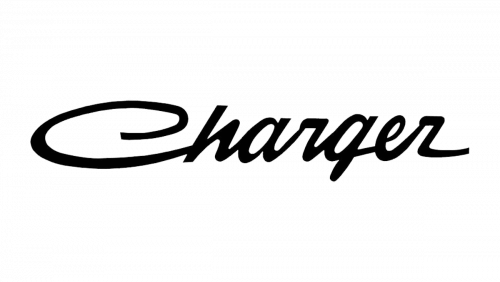
The emblem above is a distinct asset from the wordmark graphic earlier on this page, and its date is not established by the surviving source material. If it shows a deltoid, it belongs loosely in the Fratzog era. If it shows a script or a combined lockup, it documents a model badge rather than the corporate mark. Either way, its role here is illustrative: the Charger identity has always combined more than one kind of badge.
Typography and colour
No authoritative source identifies the typeface behind the Dodge or Charger wordmarks, so any specific font attribution is speculative.
Colour is similarly model-led. Black recurs in Charger badging and trim, while the twin red slashes mark Dodge’s post-2010 corporate identity. Reading a fixed emotional meaning into the badge’s black is a matter of interpretation rather than documented brand strategy.
The name
Charger itself is generally treated as a coined marketing name with no documented inspiration, in the tradition of Dodge’s 1960s naming. Two concept cars preceded production, a 1964 Polara-based study and the 1965 Charger II show car, before the production Charger arrived for 1966.
Later generations arrived in 1968, 1971 and 1975, followed by a front-drive fifth generation in 1981, with the turbocharged Shelby Charger from mid-1982 and the 1987 GLHS conversions closing the run. A 1999 concept preceded the rear-drive sedan that was shown at the 2005 North American International Auto Show and launched as a 2006 model.
FAQ
Does the Dodge Charger have its own logo?
Not in the sense of one fixed master mark. The Charger identity combines Dodge’s corporate symbol, the Fratzog, with model-specific badging such as the Charger script, R/T, SRT and later performance emblems. What appears on the car depends heavily on the generation and trim.
What is the Fratzog?
The Fratzog is Dodge’s deltoid corporate mark, built from three delta-shaped elements arranged in an equilateral triangle. Stellantis describes it as futuristic and aerospace-inspired and dates its use on Dodge muscle cars to between 1962 and 1976.
When did Dodge bring back the Fratzog?
Dodge teased the symbol again in a 2021 film, and it now appears on the next-generation Charger, integrated into the front light, the rear lamp graphic and the wheel centre caps. The combustion and electric versions are distinguished by Charger and Daytona text rather than by separate symbols.
Disclaimer
This article is part of the educational resources provided by Logo Index, an independent archive covering logos, visual identities and graphic design history. Dodge Charger and associated trademarks and brand assets remain the property of their respective rights holders where applicable.