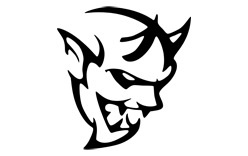
The Dodge Demon name has been attached to three different things over the years: a 1971 to 1972 compact called the Dart Demon, a 2007 roadster concept that never reached production, and the 2018 Challenger SRT Demon drag coupe that returned in 2023 as the Demon 170. The emblem most people picture today comes from the two Challenger models. It is a sub-brand badge rather than a redesign of Dodge’s corporate identity, and it sits alongside a separate wordmark rather than replacing it.
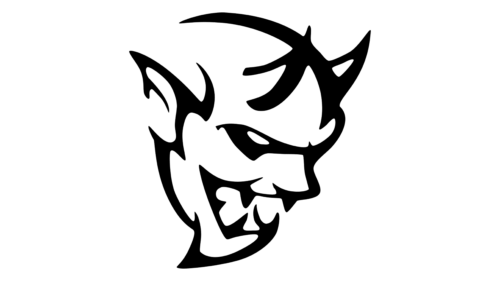 Dodge Demon Logo PNG
The modern Demon head appears here as standalone artwork. This is the contemporary badge design associated with the 2018 and 2023 Challenger models, not the cartoon devil used on the original Dart Demon.
The 1971 Dart Demon and Its Devil Mascot
The first Dodge Demon was a compact A-body built for the 1971 and 1972 model years, essentially a Plymouth Duster body fitted with a Dodge Dart front clip. According to Dodge’s own history of the 1971 Demon, the car carried devil graphics built around “a devil with a pitchfork,” and the accompanying lettering is widely reported to have shaped the letter “m” from an upside-down pitchfork or trident. DodgeGarage’s account of the logo, citing Cartype, records that the devil decal was left off the car for 1972 because buyers objected to it, and the model was renamed Dart Sport for 1973. In practice, the cartoon devil lived on the car for roughly one season.
The name itself is usually traced to an advertising line, “Come in for a Demon-stration,” a wordplay Dodge has acknowledged in its own materials and that Hot Rod repeats on the way to noting the car was nearly called the Beaver instead. MotorCities documents the same pitchfork mascot and the religious objections that eventually pushed Dodge to retire both the name and the graphic. That history is why the modern Demon badge reads as a revival rather than an unbroken lineage.
Rebirth of a Legend: The 2018 Badge
The 2018 Challenger SRT Demon was revealed at the New York Auto Show in April 2017, and its demon-head fender badge was listed as standard equipment when customer cars began shipping on 10 November 2017. Dodge documented the emblem’s development in a series of first-person design features published on DodgeGarage, with Mark Trostle, then head of design for Dodge and SRT, walking through the process.
The starting point was the 1971 mascot. Trostle described it as “kind of like Casper the Friendly Ghost with a pitchfork,” which read as too friendly and happy for a drag-focused car. Sketches for a skull were explored, then set aside. The team instead evolved the existing SRT Hellcat badge, on the reasoning that the SRT Demon was built off the SRT Hellcat. The final formula combined the 1970s demon head with the Hellcat’s linework and profile, producing a more skeletal and sinister face than the original. Adam Hubers, who sketched the Hellcat logo, has noted that the Hellcat’s eyes represent the Charger and Challenger headlamps, a detail carried into the family’s visual language. Road & Track has published alternative sketches released by Trostle that show how many directions were considered before the production badge was chosen.
The badge was fitted to a single model year. Production totaled 3,300 cars, split between 3,000 for the United States and 300 for Canada, a figure FCA confirmed again when the last car left the line. Buyers could order a $1 personalized Demon Crate, whose contents included a high-octane PCM calibration, a replacement switch module, a conical air filter, a passenger-mirror block-off plate, narrow front-runner drag wheels and a set of Demon-branded tools, which extended the badge beyond the car itself. At the time, the automaker was FCA US LLC (Fiat Chrysler Automobiles); Dodge is now a Stellantis brand.
The Wordmark, the 170 Callout and Other Badge Forms
The demon head is not the only piece of Demon lettering. A separate “DEMON” wordmark accompanies the head emblem, and Mopar-licensed badges sold under a distinct “Demon font” confirm that the lettering is a deliberate standalone style. The designer account describes the lettering being pursued “in a style similar to calligraphy,” aiming for less of a heavy metal edge than the subject might suggest. No authoritative source names a specific digital typeface, so the wordmark is best treated as custom lettering.
On 20 March 2023, Dodge unveiled the Challenger SRT Demon 170, the 1,025-horsepower farewell model. Its badge is a reworking rather than a new design: a “170” callout sits at the demon’s neck like a tattoo, and the eye is rendered in yellow to reference the car’s E85 fuel capability. It is the clearest example of the emblem being adapted for a specific model rather than held fixed.
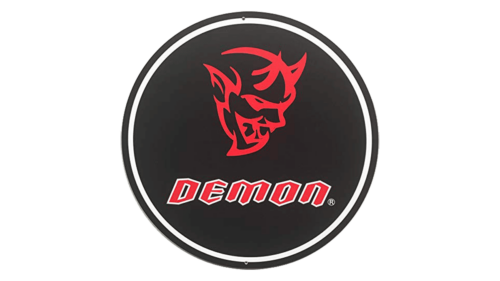
A separately named emblem artwork, distinct from the head-badge image above rather than a copy of it. Because this file is undated, it is best read as an additional surviving example of the Demon emblem rather than proof of a particular model year.
What ties these versions together is the profile itself: a horned, sharp-featured demon head facing right, built from heavy linework. What separates them is everything around it, from the monochrome standalone head to the 2023 badge’s yellow eye and numeric callout. Anyone tracing the mark should treat the 1971 cartoon devil and the modern badge as two related but separate graphics.
FAQ
Is the modern Dodge Demon logo the same as the 1971 Dart Demon’s devil?
No. The 1971 car used a cartoonish human-faced devil with a pitchfork, and the decal was dropped for 1972. The badge on the 2018 and 2023 Challenger models was drawn fresh from that starting point, but with the profile and linework of the SRT Hellcat badge, so the two read as related rather than identical.
Why does the Demon badge look like the Hellcat logo?
Because the design team deliberately evolved from it. Dodge designers have said the SRT Demon was built off the SRT Hellcat, so the Hellcat badge became the base, then the 1970s demon head was layered into it for a more skeletal, aggressive result.
What does the yellow eye on the Demon 170 badge mean?
The 2023 Challenger SRT Demon 170 badge adds a yellow demon’s eye that references the car’s E85 fuel capability, along with a “170” callout at the neck. It is the same head emblem with model-specific details added.
Disclaimer
This article is part of the educational resources provided by Logo Index, an independent archive covering logos, visual identities and graphic design history. Dodge Demon and associated trademarks and brand assets remain the property of their respective rights holders where applicable.