K-R-I-T Motor Car Company was a small American automaker based in Detroit, Michigan, that built cars for roughly a decade beginning in 1909. Its visual identity is unusually compact for a car brand: essentially one emblem, a swastika, used in the good-luck sense that was common in the West long before the Nazi party adopted the symbol.
 K-R-I-T Motor Car Logo PNG
What makes K-R-I-T worth a closer look is not a rich logo system but the way a single mark carried the entire brand. Both the name and the emblem belong to a very specific moment in American car making, when dozens of small Detroit firms competed on engineering and durability rather than on elaborate corporate design.
Meaning and history
The marque’s name most likely comes from Kenneth Crittenden, who helped design and finance the cars. Crittenden had worked at Ford and at Regal before joining the venture, and he stayed on as vice-president and head of engineering after control of the company changed hands. His obituary in The New York Times credits him with designing and producing the Krit.
The company was organized in Detroit in mid-1909, with W. S. Piggins and Claude S. Briggs among its principals; early cars were built in the former C. H. Blomstrom plant and sold as 1910 models. In 1911 control passed to Walter S. Russel of the Russel Wheel & Foundry Company, and production moved into the works previously used by R. M. Owen & Company, a firm later known as Owen Magnetic. Christie’s auction history of a c.1913 K.R.I.T. tourer records that sequence. Period advertising from 1911 to 1912 also names Lawrence Moore as company president and lists a Model “K” touring car at $900.
Records of the company are thin, and they disagree at the edges. A six-cylinder model arrived in 1913, and the firm failed in early 1915, with its assets auctioned that spring and a handful of cars assembled from leftover parts. Some sources place the end date at 1916, so the safest reading is 1909 to about 1915 or 1916. Bonhams notes the early-1915 failure, while Wikipedia’s company article gives the broader outline.
The K-R-I-T emblem
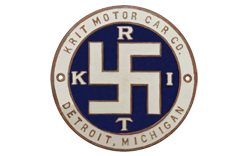
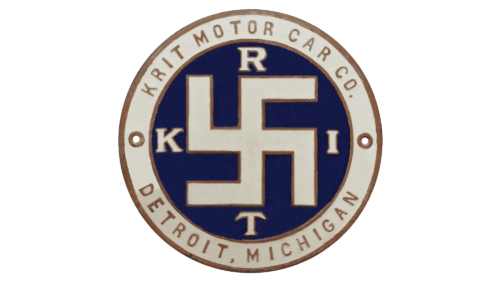
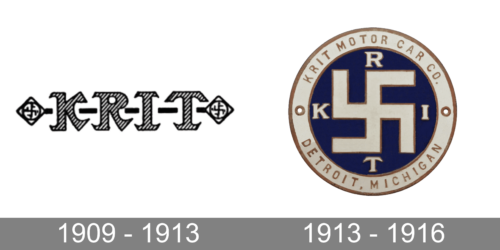
The best documented description of the badge comes from Bonhams, which catalogued a 1912 Model A roadster: a swastika set on a field of white, each arm flanked by letters of the marque’s name, the whole enclosed in a red circle. That is the fullest period emblem description available, and it is the anchor of the identity.
The swastika was a widespread good-luck device in early twentieth-century design, appearing on everything from postcards to commercial marks, and K-R-I-T used it in that established sense. Auction archives and encyclopedia entries on the company agree on the motif; Bonhams and Christie’s both describe cars of the period carrying it.
Alongside the emblem, the wordmark changed once in a way that is visible in surviving material. Through 1912 the name was styled “K-R-I-T”, the letters separated by hyphens; from 1913 it was simplified to “Krit”. Bonhams records that shift, and it is the only clearly documented change to how the brand presented its own name. There is no reliable evidence of two distinct, differently coloured logos or of a specific redesign year attached to either. Artwork of the badge is best read as one continuous emblem rather than a dated before-and-after.
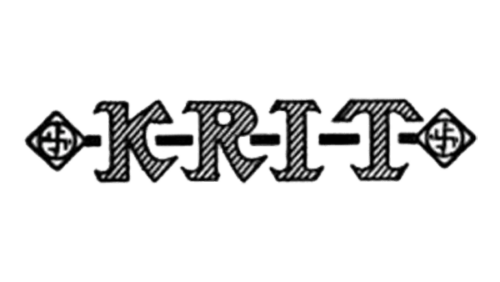
Details such as the typeface, the lettering treatment and the exact proportions of the swastika and its enclosing circle are not documented in surviving sources. Period advertising shows the hyphenated wordmark in a plain commercial style, and that is about as far as the record goes. No designer or agency credit for the emblem is documented.
What the mark tells us
K-R-I-T’s identity is a reminder of how ordinary a swastika mark once was. Its use here predates any association with the Nazi party by decades, and nothing in the company’s history points to a political meaning. The rest of the identity, a hyphenated name that became a single word and a badge built around one central symbol, is typical of the small, engineer-led Detroit firms of the era, most of which have left only a handful of cars, photographs and advertisements behind.
Disclaimer
This article is part of the educational resources provided by Logo Index, an independent archive covering logos, visual identities and graphic design history. K-R-I-T Motor Car and associated trademarks and brand assets remain the property of their respective rights holders where applicable.