Dodge has worn more distinct emblems than almost any other American car brand: a six-pointed star set over a globe, a leaping ram mascot, a boomerang, a three-pointed triangle called the Fratzog, a parent-company pentastar, a ram’s head, and finally a nameplate sliced by two red stripes. Because each mark maps to a different phase of ownership and market position, the story of the Dodge logo is also a compact history of the marque itself.
 Dodge Logo PNG
A modern Dodge mark is shown above. The surviving artwork carries no verifiable production date, so it is best read as a contemporary rendering rather than a dated milestone in the sequence that follows.
Origins: components first, cars later
John Francis Dodge and Horace Elgin Dodge founded the Dodge Brothers Company in Detroit on December 14, 1900, initially as a machine shop and parts supplier. The brothers built components for Oldsmobile and then, more consequentially, for Ford, supplying engines, transmissions and axles during the Model T’s rise. They were early Ford suppliers and shareholders rather than owners, and Henry Ford bought their shares back in 1919. Dodge built its first complete cars under its own name in 1914 and ranked fourth in U.S. sales by 1916. The marque’s early reputation rested on value and reliability rather than luxury, and it appealed strongly to professionals who needed dependable transport.
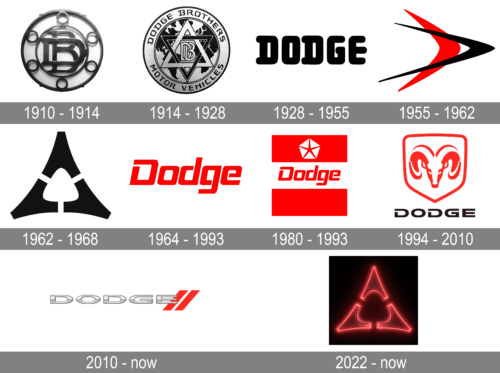
This timeline graphic gathers several of the marque’s marks in one place. It works as an overview of the range of Dodge identities rather than as documentation of any single date.
Chrysler Corporation acquired the company on July 30, 1928, for roughly $170 million, a transaction recorded in the Dodge centennial chronology published by Stellantis. By around 1930 the division was being referred to simply as Dodge.
The DB star and globe
The badge most often described as Dodge’s first is a circular radiator emblem: a black rim, silver uppercase lettering reading DODGE BROTHERS, DETROIT U.S.A., a globe at the centre, and the interlocked letters DB set inside a six-pointed star. The Smithsonian’s National Museum of American History, which holds an example, describes the star as two interlocking triangles, a device Chrysler has read as two Greek deltas, one for each brother, locked together to signal closeness. The star’s resemblance to the Star of David has been noted for decades; the documented corporate reading is the interlocking deltas.
The DB monogram badge above is undated in the surviving artwork. Dodge did not build cars until 1914, so an emblem of this type from 1910 is not established; the design belongs to the period when the brothers’ initials and the star emblem appeared on their vehicles.
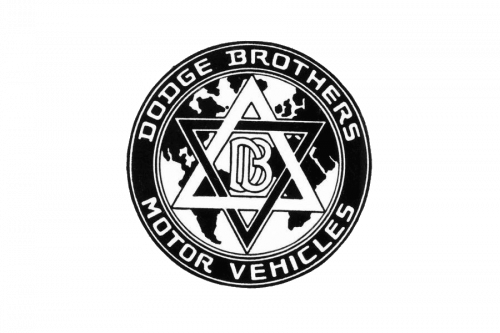
The globe-and-star emblem is the verified radiator badge from the 1914 car era. It remained in service into the early 1930s, and the same chronology records 1932 as the last year the Dodge Brothers logo was used on Dodge vehicles.
Ram mascot and the Forward Look
A leaping ram entered Dodge vehicles as a hood ornament in 1932, and by the 1940s and 1950s it appeared mainly on trucks. By 1951 only the head with curved horns remained, and the full figure was phased out in the mid-1950s. The ram of this period was ornamentation on the car rather than a radiator badge, which is why it sits alongside the wordmarks in Dodge’s visual history rather than replacing them.
Under Chrysler styling chief Virgil Exner, the company’s Forward Look era arrived with a different emblem altogether: a boomerang of two horizontally interlocking V or delta shapes.
Some surviving artwork of this boomerang is only approximately dated to the middle of the 1950s, which is consistent with the Forward Look period.
The Fratzog
In 1962 the triangular emblem now known as the Fratzog appeared, first on the Polara 500 and Custom 880. It is built from three arrowhead or delta shapes that form a three-pointed star, and its arrival is tied to Elwood Engel’s appointment as Chrysler’s chief stylist in November 1961. The name is an invented word with no meaning attached to it, and the Fratzog was never used in advertising, appearing instead on emblems, badges and manuals. Published accounts place its use variously up to 1976 and, in some cases, 1981.
Wordmarks and the pentastar
Alongside its emblems, Dodge also relied on plain wordmarks. A red Dodge logotype came into use in the 1960s, set in a modern sans-serif that gave the name a lighter, more forward-leaning feel than the earlier serif treatments.
In around 1981 or 1982 the Chrysler pentastar was adopted across the corporation’s brands, including Dodge and sibling marques such as DeSoto had earlier been part of the same stable.
What the artwork above shows is the Chrysler corporation badge rather than an emblem unique to Dodge, and it is only approximately dated in the surviving source.
The ram’s head
The ram returned in a new form around 1993 as a stylised ram’s head, and from 1996 it was used across Dodge’s line with the exception of the Viper. It became the mark most closely associated with the brand for the following two decades.
2010: wordmark with red stripes
On May 26, 2010, Chrysler announced a new Dodge logo: the DODGE name with two red racing stripes cut into the E, borrowing the red slashes of SRT. The company’s statement on the new logo specified the stripes for communications, advertising, internet and merchandising, explicitly not for Dodge products or dealership signage. The change followed the separation of Dodge and Ram into distinct brands, which is why the ram’s head moved across to Ram.
2022: the Fratzog returns
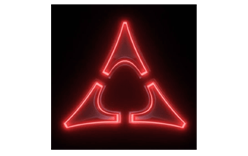
Dodge signalled in 2021 that it would revive the Fratzog for electrified models, as CNBC reported. The redesigned mark, rendered in three dimensions and lit in neon red on black, appeared on the Charger Daytona SRT Concept in August 2022, according to Stellantis’ concept announcement. Dodge presents the Fratzog as a marker for its EV models rather than as a sub-brand, which keeps the revived symbol inside the existing identity rather than creating a new one.
Symbol, emblem, type and colour
Dodge’s identity today runs on two tracks: the ram’s head and later the electrified Fratzog serve as pictorial marks, while the DODGE nameplate carries the brand in communications. The two panels below are illustrative renderings of the recurring symbol and the current emblem rather than dated official artwork.
The symbol is the compact, recognisable form of the brand, drawn for use at small sizes where a full wordmark would not hold.
The emblem places the name at the centre and uses the diagonal strokes to give the wordmark a sense of forward direction.
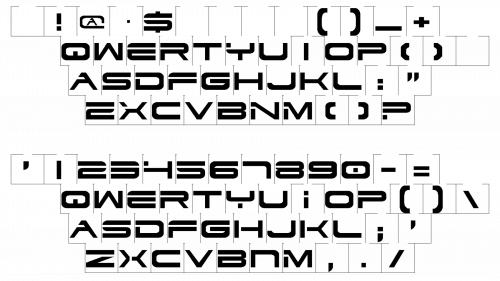
The modern wordmark is a bold, all-caps sans-serif with extended letterforms that stay balanced despite their width. Speculation about the exact typeface circulates online, including the suggestion of Ordin Rounded, but no reliable source confirms a specific font, so the letterforms are best described by their appearance rather than by a name.
The palette pairs a metallic silver with a strong red. The contrast does most of the work: the neutral silver keeps the nameplate legible and restrained, while the red stripes carry the sporty character the company has attached to the mark since 2010.
FAQ
What was Dodge’s first logo?
The best documented early Dodge badge is the circular radiator emblem from around 1914, with a globe at the centre, the interlocked letters DB inside a six-pointed star, and DODGE BROTHERS lettered around the rim. Earlier DB monogram badges circulate in logo collections, but a documented Dodge car emblem from 1910 is not established.
Why is the Dodge triangle logo called the Fratzog?
Fratzog is an invented word. It was coined informally by a designer, carries no meaning, and became the accepted name for the three-pointed emblem that Dodge used from 1962, first on the Polara 500 and Custom 880.
Does Dodge still use the ram’s head logo?
No. The ram’s head was used across most of the Dodge range from the mid-1990s, but when Chrysler split Dodge and Ram into separate brands in 2010, the ram’s head moved to Ram. Dodge adopted the DODGE nameplate with two red stripes for its communications.
Disclaimer
This article is part of the educational resources provided by Logo Index, an independent archive covering logos, visual identities and graphic design history. Dodge and associated trademarks and brand assets remain the property of their respective rights holders where applicable.