Herbert Hartge GmbH & Co. KG, known simply as Hartge, was an independent German tuner and small-series manufacturer based at Beckingen in Saarland. Founded in 1971 by the racing driver Herbert Hartge together with his brothers Andreas and Rolf, it built its reputation on BMW-based conversions and complete vehicles, and later extended its work to MINI, Range Rover and racing cars. Its visual identity shows up far more clearly on the vehicles themselves than in any single, heavily promoted emblem.
 Hartge Logo PNG
The Stripes, the Emblems and the Wheels
On the road, Hartge’s identity is carried by a consistent stripe motif and by badges that quietly replace the manufacturer’s own. Bonnet and boot roundels give way to Hartge emblems, and the same treatment reaches the grille, wheel centre caps, steering wheel and gear knob. Hartge’s own 2011 press material, reproduced by Motoring Exposure, lists matt-silver stripes, a set of bonnet and boot emblems, a discreet Hartge insignia and an aluminium steering-wheel emblem as part of a car’s finish.
Earlier cars used the same idea in different materials. A 1986 H35 offered through Bring a Trailer carries white vinyl Hartge stripes along the flanks, H35 badging and a Hartge valve cover. Wording varies by car and by decade, but the logic is constant: stripes, wordmark, replacement emblems.
Wheels belong to the same package. The ten-spoke Classic 2 design and an eleven-spoke alloy have both been treated as Hartge staples, often paired with Hartge-branded instruments and trim. Taken together, these elements are the identity most owners actually see, and they are better documented than any standalone logo file.
A Merzig Workshop That Became a Manufacturer
The company’s early chronology explains why its badges carry weight. Hartge started in Merzig in 1971, moved to a purpose-built plant in Beckingen in 1974, and was recognised as a manufacturer by the German authorities in 1985, after which completed cars carried a Hartge Motorsport VIN plate instead of BMW’s. English Wikipedia and its German counterpart agree on that sequence, and auction specialists have recorded the same milestone.
Artcurial dates the ministry recognition to 1985 and describes early-1980s H6S and H5S cars by their radiator grille badge and rear monogram, which places visible Hartge badging on customer cars well before the manufacturer plate existed. Bonhams Cars Online notes a later E39 with Hartge badges and a side graphic, and lists the firm alongside Alpina and AC Schnitzer as a third-party specialist rather than an in-house department.
That independence is worth stating plainly, because it shaped the identity. Hartge was not an official BMW partner, and its documented corporate engineering collaboration was with Renault, whose Safrane BiTurbo engine work it carried out with Irmscher, as Carjager records. MINI and Range Rover coverage came late, in the 2000s, as the BMW-based market narrowed. Trading faded from around 2014; the company was liquidated in July 2019 and later struck from the commercial register. Other independent specialists of the same era, such as Carlsson, followed a broadly similar route from tuning workshop to recognisable badge brand.
The Wordmark That Still Circulates
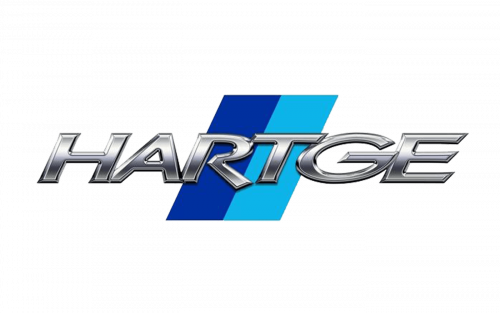
The artwork most often published as the Hartge logo pairs a wordmark with a vertically set parallelogram split into two blue halves and outlined in black. Its exact date is not well documented, the surviving files are anonymous reproductions rather than an official brand asset, and no designer, agency or typeface credit is recorded for it. What can be said is that a Hartge logo image was already in circulation by the mid-2000s: the archived 2006 Wikipedia article used a file named HARTGE_Logo.jpg in its infobox.
Much of the interpretive detail attached to this artwork online, including readings of a blue, grey and black palette as professionalism or confidence, and claims that the wordmark passed through several distinct versions, comes from unattributed logo directory pages rather than from Hartge itself. The company’s own descriptions of its cars talk about stripes, emblems and insignia, not colour symbolism. Until an official source or a dated asset turns up, the split blue parallelogram is best understood as the form in which the mark is reproduced, not as a documented corporate redesign.
FAQ
What does the Hartge logo look like?
The mark that circulates today is a wordmark combined with a vertical parallelogram split into two blue halves and outlined in black. On the cars themselves, the identity is expressed mainly through silver or white stripes and Hartge emblems that replace the manufacturer’s roundels on the bonnet, boot, grille and wheels.
Who designed the Hartge logo?
No designer, studio or agency credit is documented. Company communications, auction catalogues and press reproductions describe finished cars and their fittings, not the authorship of the wordmark or badge artwork.
Was Hartge an official BMW partner?
No. Hartge was an independent third-party tuner and, from 1985, a recognised manufacturer in its own right. Its documented corporate engineering collaboration was with Renault on the Safrane BiTurbo, carried out together with Irmscher.
Disclaimer
This article is part of the educational resources provided by Logo Index, an independent archive covering logos, visual identities and graphic design history. Hartge and associated trademarks and brand assets remain the property of their respective rights holders where applicable.