Carlsson is a German tuning and refinement specialist that built its reputation on Mercedes-Benz and smart models. Its logo is more layered than most in the tuner world: a pictorial emblem, a running horse, paired with a bold wordmark, rather than lettering alone. Both elements appear in the company’s trademark documentation, which makes the basic composition of the mark far easier to describe than its design history.
That history is not well documented. Logo directories circulate a tidy sequence of dated redesigns, and some of it may be plausible, but no authoritative source sets out dated logo stages for this company. What the record does support is a single horse-plus-wordmark concept, used both in print and on the cars themselves.
A name borrowed from a rally driver
Carlsson was founded in 1989 by brothers Rolf and Andreas Hartge in Merzig, in the German state of Saarland, and the business took its name from Ingvar Carlsson, the Swedish rally driver who worked with the firm as a technology partner and who had driven for Mercedes in the early 1980s. He died in 2009 at the age of 62. The name is the best-documented piece of symbolism attached to the brand: it points to motorsport credibility rather than to the family that ran the company, and Carlsson’s own corporate copy repeats the attribution.
From 1995 the business was based at Gut Wiesenhof, an estate near Merzig whose renovation earned a heritage-preservation award in 1996. Company material notes that the estate had historically been used for breeding thoroughbred horses, a detail that becomes relevant to the emblem below.
What the mark looks like
 Carlsson Logo PNG
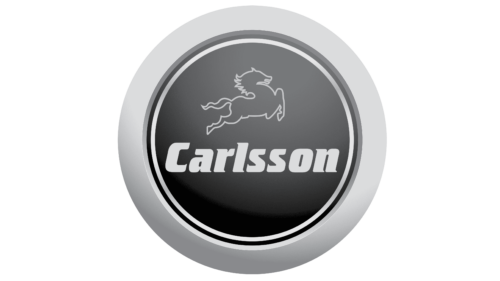
US trademark descriptions give the clearest account of the design. One filing describes a stylized “Carlsson” wordmark beneath a design element consisting of an outline of a galloping horse, while a later filing describes a figure of a running horse on top of the stylized wording “CARLSSON.” The horse sits above the name in both readings, and the lettering is bold and relatively wide. Black and silver or chrome are the finishes that appear most often on finished products.
The surviving artwork is undated, so it is more accurate to treat it as one continuing mark than as the product of a series of redesigns. Exact typeface, colour values and circle-versus-wordmark construction are not established in any authoritative source.
The horse leaves the page
Carlsson’s emblem is not confined to stationery. A Swiss dealer lists a “Carlsson Logo mit Pferd” hood emblem, a 57 mm metal badge offered in chrome or matte black and made for specific Mercedes facelift models. The mark therefore works as an applied body badge as well as a print logo, which is consistent with the way tuning houses use their identity to signal who prepared a car.
What the horse is said to represent
Here the evidence thins out. Tertiary sources, including Chinese encyclopedia entries, describe a black circular field with a silver horse and silver lettering, and connect the animal to the thoroughbred-breeding history of Gut Wiesenhof, reading it as a sign of nobility and sport. The stud-farm history itself is documented, but the explicit link from that history to the emblem is reported rather than confirmed by the company. The horse is best described as a distinctive badge animal whose intended symbolism has not been formally explained.
Ownership changes and the end of the road
Ownership questions matter for a logo because they determine who controls the mark. The Hartge brothers owned the company until 2007, when it was sold to Mathias R. Albert. In May 2012 Hong Kong’s Zhongsheng Holding took a majority stake of roughly 70 per cent. The firm entered insolvency in May 2015 and was acquired that December by the Korean supplier Sambo Motors, which renamed it Carlsson Fahrzeugtechnik GmbH and moved its headquarters to Saarlouis on 1 April 2016. A subsidiary brand, Carlsson Peninsula, targeted Hyundai and Kia models.
Operations closed in October 2023, with inventory and showroom cars sold off, as reported at the time. The trademark rights have reportedly remained with Sambo Motors, so the identity has outlasted the workshop. Earlier in its history the company had also asserted its mark rights in the United States, appearing as a potential opposer in a 2013 trademark opposition.
Because the mark changed hands rather than changing shape, the horse and wordmark should be read as one continuous identity across those ownership periods, not as evidence of a rebrand.
FAQ
What does the Carlsson logo show?
It combines a running or galloping horse with the stylized wordmark CARLSSON, with the horse positioned above the name. Trademark filings describe the horse as an outlined figure and the lettering as bold and stylized, most often rendered in black or silver.
Why is there a horse in the Carlsson logo?
Reported explanations link the horse to the thoroughbred-breeding history of Gut Wiesenhof, the estate near Merzig where Carlsson was based from 1995. That history is documented, but the company has not publicly confirmed the connection between the estate and the emblem.
Where does the Carlsson name come from?
The brand is named after Ingvar Carlsson, the Swedish rally driver and former Mercedes works driver who served as the company’s technology partner. It is not the surname of the founding family, who were called Hartge.
Did the Carlsson logo change over time?
No reliable source sets out dated logo redesigns for Carlsson. The available trademark descriptions and badge listings all point to the same horse-plus-wordmark concept, and the surviving artwork is undated, so any staged chronology should be treated as unverified.
Is Carlsson still in business?
Carlsson ceased operations in October 2023, when its inventory and showroom cars were sold. Trademark rights to the name and emblem have reportedly stayed with Sambo Motors, the Korean supplier that acquired the company in December 2015.
Disclaimer
This article is part of the educational resources provided by Logo Index, an independent archive covering logos, visual identities and graphic design history. Carlsson and associated trademarks and brand assets remain the property of their respective rights holders where applicable.