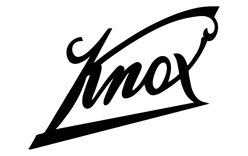
The Knox Automobile Company never used a single, canonical logo. Its identity was carried instead by three separate devices that appeared at different points in its life: small maker’s nameplates, brass radiator scripts, and a short run of enamel dash or radiator emblems.
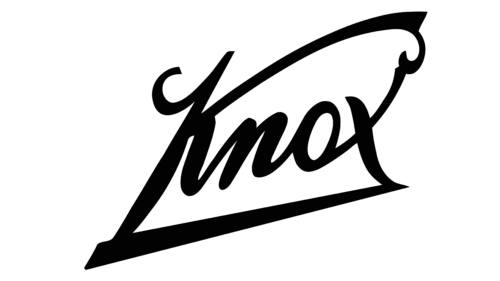 Knox Automobile Logo PNG
The company was founded in 1900 in Springfield, Massachusetts, by Harry A. Knox, with financing from Elihu H. Cutler, as Hemmings’ company profile records. Knox’s early cars were air-cooled, a trait that produced the nickname “Waterless Knox” and the better-known “Old Porcupine”, taken from the roughly 1,750 threaded 3/16-inch studs screwed into the cylinder casing, an engine detail described in a Bonhams catalogue entry for a 1902 Model C runabout. Four-wheel models arrived from 1902 and Knox left the business in 1904. That sequence matters for the identity: the cars that first carried a radiator script were already a decade away from the founder.
What the earliest Knox cars carried
For much of its first decade a Knox car had no emblem in the modern sense. A specialist emblem reference, the only source found that sets out a Knox nameplate and emblem chronology, places the earliest identification on small maker’s plates carrying serial and patent data, likely mounted at the rear of the body and later under the driver’s seat, with rectangular brass serial plates appearing around 1904.
Brass “Knox” scripts turned up on radiators in period photographs from 1908, including a 1909 fire truck, and the name also appeared on hubcaps. That collector chronology suggests the radiator script was not fitted to every car: trade-show photographs from around 1910 show vehicles without scripts or emblems, so the script may have been optional or applied in batches.
Advertising usually fixes a marque’s logo early, but Knox advertising appears to have used one only from about 1909, and most of its ads carried no logo at all. The first radiator or dashboard emblems come later still, around 1911, and at least one surviving Model M carries its emblem on the dashboard rather than the radiator.
Meaning and documented ornament
The best-documented Knox emblem is a 1912 radiator badge recorded by a collector reference for radiator badges: 3 7/8 by 2 1/4 inches, built around a blue enamel field surrounded by cast oak leaves and acorns, with four original screw holes and a maker’s mark on the reverse for Robinson Co. of Attleboro, Massachusetts. Wikimedia Commons holds a dated file titled “Knox-auto 1912 logo.jpg”, which places surviving Knox identity artwork at roughly the same year.
Those oak leaves and acorns belong to one surviving badge. No source describes them as a company-wide motif, and no motto, symbolism or colour standard is documented for Knox. No designer or agency credit is documented either, and the marque’s trademark first-use and registration records are not established in the available material.
How the identity ended
Passenger-car production ended in 1914, and the business was reorganised that same year as Knox Motors, a change recorded in the same emblem reference. Commercial vehicles continued afterwards, and the “Knox” name remained the main identifier on trucks, tractors and fire apparatus. Dating the final chapter cleanly is difficult: Grace’s Guide runs trucks and tractors to 1924, a company history published in Arcadia’s Images of America series puts the end of the business in 1927, and the Fire Museum of Maryland catalogues Jack Hess’s history of Knox fire apparatus as covering 1906 to 1928. A single closure year flattens a longer, uneven wind-down.
Read as a whole, the Knox identity is a brass-era progression rather than one mark with a documented meaning: serial nameplates first, then a script name on radiators and hubcaps, then a brief emblem phase in the early 1910s before the passenger car gave way to commercial production.
Disclaimer
This article is part of the educational resources provided by Logo Index, an independent archive covering logos, visual identities and graphic design history. Knox Automobile and associated trademarks and brand assets remain the property of their respective rights holders where applicable.