Mack Trucks, Inc. builds heavy-duty commercial trucks, but its visual identity rests on a single, unusually durable idea: the bulldog. Where most truck makers put a wordmark first, Mack has carried a dog as its corporate symbol since 1922, and the badge’s history is mostly the history of how that one animal has been drawn, posed and paired with the company name.
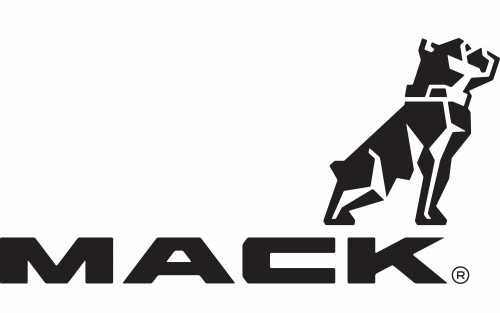 Mack Logo PNG
Meaning and history
The bulldog nickname is documented rather than invented. During the First World War, British soldiers are reported to have called the Mack AC a “Bulldog Mack” for its tenacity, and Mack’s own historical material repeats that wartime origin. In 1922 the company took Mack Trucks, Inc. as its corporate name and made the bulldog its corporate symbol in the same period, as recorded in Wikipedia’s Mack Trucks timeline.
The firm behind the badge began in 1900, when the Mack Brothers Company was established in Brooklyn; sources differ on whether incorporation fell in 1900 or 1901. It was renamed Mack Brothers Motor Car Company in 1905, merged with the Saurer Motor Truck Company in 1911 to form International Motor Truck Company, and only later settled into the Mack Trucks, Inc. name. The Reference for Business chronology traces that sequence in detail.
The bulldog became physical in 1932, when chief engineer Alfred Fellows Masury carved the first hood ornament, reportedly while recovering from an operation. The design was patented that year and the ornament began appearing on trucks from 1933. Mack’s own ornament history records design patent 87931 and trademark registration 1,387,477, with the registration record dating to about March 1986.
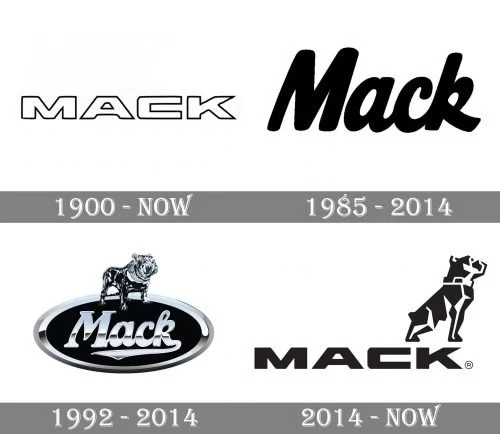
The lettering developed on a separate track from the dog. The slanted, script-like “Mack” wordmark that dominated much of the late twentieth century is variously attributed to the late 1960s and the 1970s, and the bulldog predates that lettering by decades. A distinct 1985 redesign of the wordmark or emblem is not documented in the available sources.
The hood ornament also doubles as an engineering code, which is rarer than it sounds for a decorative badge. Gold finish was introduced for the 1967 model year to mark a Maxidyne engine paired with a Maxitorque transmission. The gold paint disappeared around 1981, returned on the CL Elite in 1992 and 1993, and from the 2007 model year gold has signified an all-Mack powertrain: engine, transmission and axles from the same maker. Chrome remains the standard finish for everything else, according to Mack’s ornament color designations.
The current identity dates to 2014. Mack unveiled a refreshed brand program at CONEXPO-CON/AGG in Las Vegas, announced on 4 March 2014, built around a sleeker, more modern bulldog positioned above a stronger block-letter “Mack Trucks” wordmark, with the tagline “Born Ready.” TruckingInfo reported the logo and tagline details, and MediaPost credited Chicago agency VSA Partners with the work. The Morning Call’s description of the new mark notes that the loopy, chrome-like text and the front-facing line drawing were replaced by block lettering and a right-facing side view of the hood ornament bulldog. Mack’s own framing described the bulldog as poised confidently above the wordmark; readings about the direction the dog faces carrying a message about the future are not part of that material.
Ownership changed hands at the end of the century. Renault took a controlling stake in 1990, and AB Volvo later acquired the company in a deal valued at $1.71 billion, with sources placing completion in either 2000 or 2001. Headquarters moved to Greensboro, North Carolina, around 2008. The Mack Trucks timeline and the Reference for Business chronology both cover the transition.
Mack’s bulldog belongs to a small tradition of American truck emblems built on an animal mascot rather than a letterform, a group that also includes the Brockway husky. Where those marks typically stay fixed, Mack’s has been redrawn, repositioned and re-coloured repeatedly while keeping the same subject.
Disclaimer
This article is part of the educational resources provided by Logo Index, an independent archive covering logos, visual identities and graphic design history. Mack and associated trademarks and brand assets remain the property of their respective rights holders where applicable.