 Brockway Logo PNG
Brockway Logo Meaning
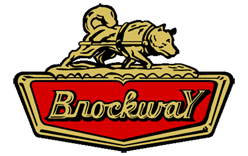
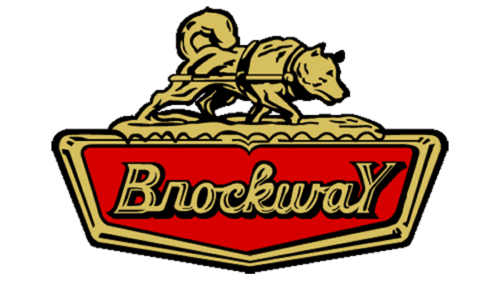
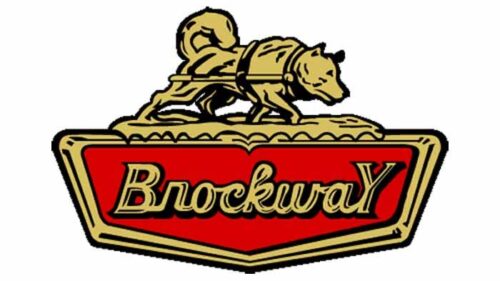 The Brockway identity combined the company name with a husky dog motif. Surviving Brockway badges use strong horizontal lettering together with the dog positioned above or within the emblem.The husky is the most historically significant visual element. Historical trucking sources report that the mascot appeared after Mack acquired Brockway and first appeared as a hood ornament on a 1958 Brockway Model N-260TL. Mack was already identified by its bulldog, while Brockway adopted its own dog, the husky. [2]No authoritative company source located for this article assigns abstract meanings such as endurance, loyalty or strength to the dog. The documented connection with Brockway’s post-1956 identity is more useful than adding generic animal symbolism.
From Carriages to Brockway Trucks
Brockway’s history began before motor vehicles. William N. Brockway founded Brockway Carriage Works in Homer, New York, and incorporated the carriage business in 1875.His son, George A. Brockway, entered the family company as a teenager and eventually assumed full control. At its peak, the carriage operation employed hundreds of workers and produced thousands of horse-drawn vehicles each year. [3]As automobiles and motor trucks began replacing horse-drawn transportation, George Brockway redirected the family business toward motor vehicles.1909 to 1912: The Move Into Motor Trucks
George Brockway began experimenting with motor trucks around 1909. Early vehicles used chassis supplied by the Chase Motor Company of Syracuse. [2]The major corporate transition came in 1912. The Cortland County Historical Society records that George A. Brockway and F. R. Thompson leased the former Ellis Omnibus and Cab Company factory in Cortland and organized the Brockway Motor Truck Company. [1]The first truck to leave the new Cortland operation was a Model A built for the Miller Corset Company, another local business. Brockway produced 95 trucks during 1912 and 1913. [1]Brockway During World War I
Brockway expanded rapidly during the First World War. The company became one of the manufacturers involved in producing standardized military trucks for the United States government.Historical records credit Brockway with producing hundreds of Class B Liberty trucks during the war. The military work helped establish the company as a serious heavy-vehicle manufacturer rather than simply a converted carriage builder. [4]A Specialist Heavy-Truck Manufacturer
For most of its existence, Brockway concentrated on commercial and heavy-duty vehicles rather than passenger cars.The company produced trucks for freight hauling, construction, municipal services, fire departments and other specialist applications. Brockway became particularly known for building vehicles to customer specifications rather than relying solely on a narrow standardized range.This custom-heavy-truck focus is a more accurate description of the company than generic claims that Brockway simply produced “some of the best trucks in America.”Mack Trucks Acquires Brockway
Mack Trucks purchased Brockway Motor Company in 1956. Mack’s own historical museum records the acquisition directly. [5]Brockway did not disappear after the purchase. Trucks continued to be manufactured in Cortland under the Brockway name for more than two decades.The relationship did, however, create increasing technical overlap between the two manufacturers. Components, engineering resources and eventually cab designs could be shared while Brockway remained positioned as a separate marque.The Brockway Husky
The husky became one of the most distinctive visual features of Brockway trucks during the Mack era.FleetOwner’s history of American truck manufacturers states that Mack’s acquisition prompted Brockway to adopt a mascot of its own. The husky first appeared as a hood ornament on the 1958 Brockway N-260TL. [2]The animal was generally depicted wearing a harness, reinforcing its visual identity as a working dog rather than simply a decorative canine figure.The symbol became strongly associated with Cortland itself. The city is still called Huskietown, USA in connection with Brockway, and the modern Brockway Truck Preservation Association continues to use the historic husky imagery. [6]Brockway Logo and Typography
The surviving Brockway mark uses prominent uppercase lettering arranged inside an angular horizontal badge. The husky is positioned above the company name, creating a compact vehicle emblem suitable for a radiator or hood application.Historical Brockway badges appeared in different metallic, painted and printed forms, so a single flat digital recreation should not be treated as the only physical execution of the identity.No authoritative source located for this article identifies a commercial typeface or graphic designer responsible for the Brockway wordmark.Brockway Logo Colors
Historic Brockway badges can be found with red, gold, black and metallic elements, while other applications use simpler monochrome finishes.The modern Brockway Truck Preservation Association’s trademark documentation describes its historic-style BROCKWAY mark using gold and red lettering with a gold husky and black detailing. [7]There is no strong historical evidence that Brockway assigned psychological meanings to these colors. Claims that red represents power or gold represents quality should therefore not be presented as official logo symbolism.Important Brockway Truck Models
Brockway produced numerous truck families over its 65-year Cortland history. Its range evolved from early chain-driven trucks into modern heavy-duty conventionals and cab-over vehicles.The company’s later 300 Series, introduced during the 1960s, helped revive sales after a difficult period. Brockway continued introducing updated heavy trucks into the 1970s even while operating under Mack ownership. [2]Why Did Brockway Close?
Brockway’s closure was caused by a combination of financial, regulatory and labor pressures rather than one simple decline in demand.A federal court decision examining Brockway’s final years records that the 1975 recession and the need for substantial new capital led Mack’s executive committee to begin looking for a buyer in May 1976. Potential purchasers were approached, but no transaction was completed. [8]The truck industry was also facing tighter federal safety requirements, including new braking regulations, while Brockway faced strong competition from larger manufacturers. [2]After a wildcat strike by United Auto Workers employees at the Cortland plant, Mack’s board voted on March 24, 1977 to liquidate its Brockway division. Distributors were formally notified five days later. [8]When Did Brockway Production End?
Brockway truck production ended in 1977, approximately 65 years after the truck company had been organized in Cortland.Mack continued trying to find a purchaser even after the liquidation decision, but those efforts did not preserve the manufacturer. The Cortland operation eventually closed and Brockway disappeared as a new-vehicle marque.Brockway’s Legacy in Cortland
Brockway remains particularly important to the industrial history of Cortland County.The Brockway Truck Preservation Association was created to preserve vehicles, photographs, records and other material related to the manufacturer. Its collection is housed at the Central New York Living History Center, while Cortland continues to host the National Brockway Truck Show. [9]The Cortland County Historical Society also maintains a large Brockway Motor Trucks photographic collection spanning the carriage era through the truck company’s final years. [1]The surviving husky emblem remains one of the strongest visual links with that history.FAQ
Who founded Brockway trucks?
William N. Brockway founded the family’s carriage business in 1875. His son George A. Brockway later moved into motor vehicles and organized the Brockway Motor Truck Company with F. R. Thompson in Cortland in 1912.
What animal is on the Brockway logo?
Brockway used a husky dog as its mascot. Historical trucking sources place the first husky hood ornament on a 1958 Brockway N-260TL, after Mack Trucks had acquired the company.
When did Mack buy Brockway?
Mack Trucks purchased Brockway Motor Company in 1956. Brockway continued producing trucks under its own name in Cortland until 1977.
Why did Brockway shut down?
Brockway faced the effects of the 1975 recession, the need for additional investment, tighter industry regulations and labor problems. After unsuccessful attempts to sell the division and a wildcat strike, Mack voted to liquidate Brockway in March 1977.
Where were Brockway trucks built?
Brockway Motor Truck Company was based in Cortland, New York. The company’s importance to the city and its husky mascot gave Cortland the nickname “Huskietown, USA.”
Disclaimer
This article is part of the educational resources provided by Logo Index, an independent archive covering logos, visual identities and graphic design history. Brockway, Mack and associated trademarks and brand assets remain the property of their respective rights holders where applicable.