Marussia Motors was a Russian sports car company based in Moscow, widely described as the country’s first serious supercar manufacturer. It was founded in 2007 and led by Nikolai Fomenko, the former racing driver and television presenter who acted as its president and most visible figure. The Marussia name ended up in two places at once: a short-lived line of road cars, and a Formula 1 team that carried the badge from 2011.
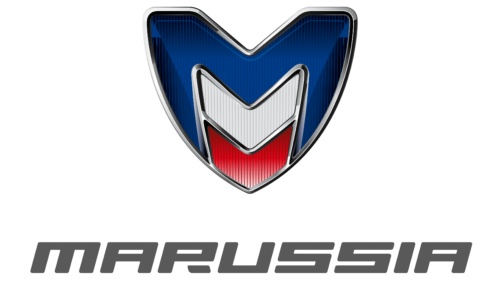 Marussia Motors Logo PNG
The most concrete documented link between the badge and the cars is a styling one. According to Wikipedia’s entry on the Marussia B-Series, the B2’s front-end was shaped to echo the M of the logo, which tied the emblem to the car’s face rather than leaving it as a decal on the bonnet.
How the Marussia emblem is described
A Spanish motoring publication, Excelencias del Motor, describes the Marussia emblem as a downward-pointing arrowhead rendered in the colours of the Russian flag, with the letter M repeated at three decreasing sizes, each in a different colour. The blue, white and red do not appear in flag order. That account is enthusiast documentation rather than a primary brand record, and no official identity guideline or designer credit for the emblem is included in the reliable published material on the company.
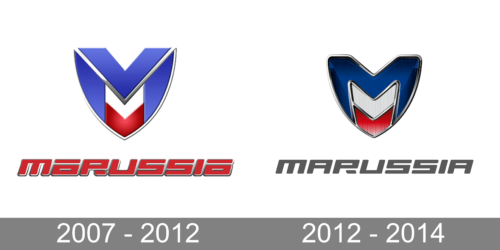
Surviving artwork for the Marussia badge is not securely dated. Published sources do not document a redesign, a second colour scheme or a later version of the mark, so the emblem is best recorded as a single identity rather than a sequence of revisions.
Company history behind the name
Marussia was founded in 2007, and reports differ on exactly who founded it. English Wikipedia lists Fomenko alongside Andrey Cheglakov and Libor Haluza, while Kommersant and Russian outlets describe the venture as Fomenko working with businessman Efim Ostrovsky and later investor Cheglakov. RAPSI names Anton Kolesnikov as a co-owner. The exact founding group is not settled in the available record.
Two dates anchor the brand’s visual history. The B1 prototype was unveiled on 16 December 2008 at Moscow’s New Manege hall, and the B2 made its debut at the Frankfurt Motor Show in September 2009, according to Wikipedia. A planned 500-unit run of the B2 was reported as pre-ordered, but the Valmet Automotive production deal signed in March 2012 never resulted in series output. Za Rulem put total sales at roughly four cars, with only a few dozen prototypes built, so the badge never reached the road in meaningful numbers.
The name in Formula 1
Marussia Motors took a controlling stake in the Virgin Racing F1 team in November 2010. The team raced through 2011 as Marussia Virgin Racing and was rebranded the Marussia F1 Team from 2012, according to Formula 1. This was a separate British operation, not the Moscow car company, and the shared name is often conflated with the road-car business.
The end of the brand
Marussia Motors ceased operations in April 2014, as reported by Kommersant. The company’s legal ending is recorded inconsistently: English Wikipedia describes it as dissolved in 2015, while RAPSI describes bankruptcy in 2014. The Formula 1 team, meanwhile, went into administration in October 2014 and folded on 7 November 2014, the BBC reported. Either way, the arrowhead badge stopped appearing on new cars after 2014.
FAQ
Who designed the Marussia Motors logo?
No designer or agency credit for the emblem is documented in reliable published sources on the company. The badge is generally described in enthusiast and motoring coverage rather than in official brand material.
Did the Marussia logo have more than one version?
Sources do not establish a documented redesign or dated second version of the emblem. The badge is consistently described as a single tricolour arrowhead built around the letter M.
Disclaimer
This article is part of the educational resources provided by Logo Index, an independent archive covering logos, visual identities and graphic design history. Marussia Motors and associated trademarks and brand assets remain the property of their respective rights holders where applicable.